

Sonja Kalb comes to painting through an unusual doorway: engineering. Born in Stuttgart, Germany, she started out in textile and design engineering, a field built on exactness—systems, structure, materials, and the quiet logic of how things hold together. That background still shows up in her art, but not as stiffness. It shows up as clarity. She understands construction, and she understands restraint.
What makes her work feel fresh is that she doesn’t treat discipline as a cage. She uses it as a base, then steps past it. In her abstractions, control and release sit side by side. There’s planning in how space is organized and how color carries weight, but the surface never feels overmanaged. The paintings breathe, shift, and stay responsive. They don’t ask you to solve anything. They ask you to stay with them long enough for your own perception to change.
Nature Pure I–III: Paintings That Turn Into Places
You can take in Nature Pure I–III at speed—bold color, layered texture, motion across the surface. But the trilogy isn’t built for a quick read. It’s built for a slower kind of attention, where your first impression is only the entry point. Spend time with these works and they stop acting like images. They begin to feel like environments. Clearings appear. Edges soften. Possible presences drift into view and then disappear again.
What’s striking about the trilogy is its refusal to prettify nature. Kalb isn’t offering a clean, decorative version of the natural world. This is nature as it actually feels: lush, complicated, sometimes welcoming, sometimes opaque. The paintings stay abstract, but they carry an organic truth. They don’t declare, this is a forest or this is a river or this is a creature. Instead, they create the conditions where those associations can rise up on their own. That’s why the trilogy reads as both landscape and inner space—an exterior world that behaves like a state of mind.
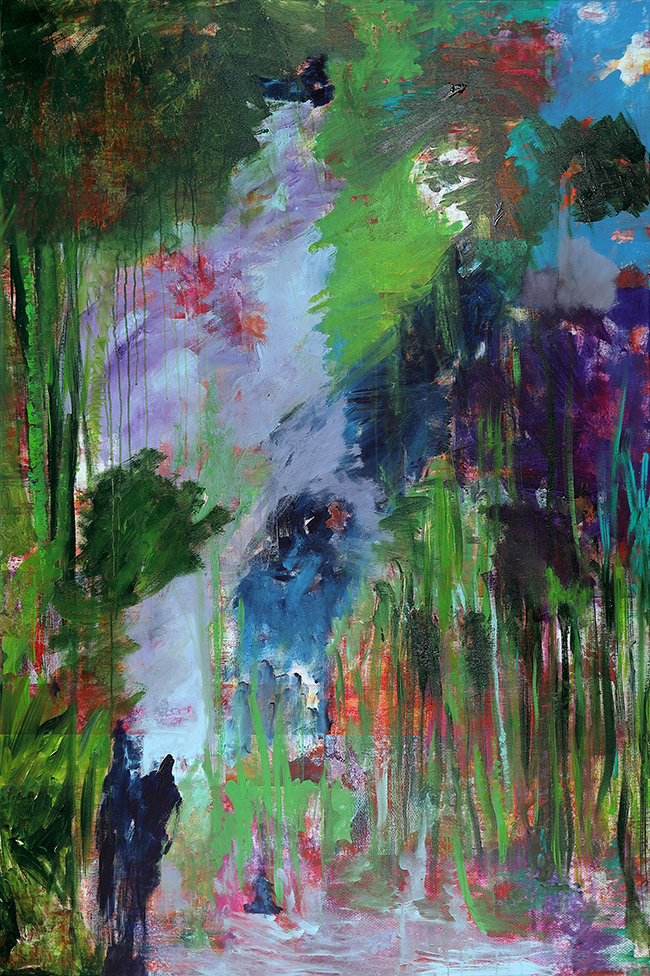
Nature Pure I: A Route That Only Shows Up When You Pause
In the first painting, a bright opening sits near the center, like a lane of light cutting through density. It might register as a stream, a passage, a breath moving forward. Around it, stronger, darker zones press in—heavy greens, deep purples, and small hits of red that feel like quick signals: bloom, alarm, pulse, proof of life.
The drips are a turning point. They keep the work from becoming too polished, too “designed.” They read like weather, gravity, or something allowed to happen rather than something fully controlled. The surface feels lived-in, not staged.
Beneath the brighter areas, shadow starts to gather. You might sense shapes—figures, animal hints, silhouettes—or you might simply feel thickness and depth. The uncertainty is intentional. The painting leaves room for recognition without locking anything down, letting the mind hover between seeing and imagining.
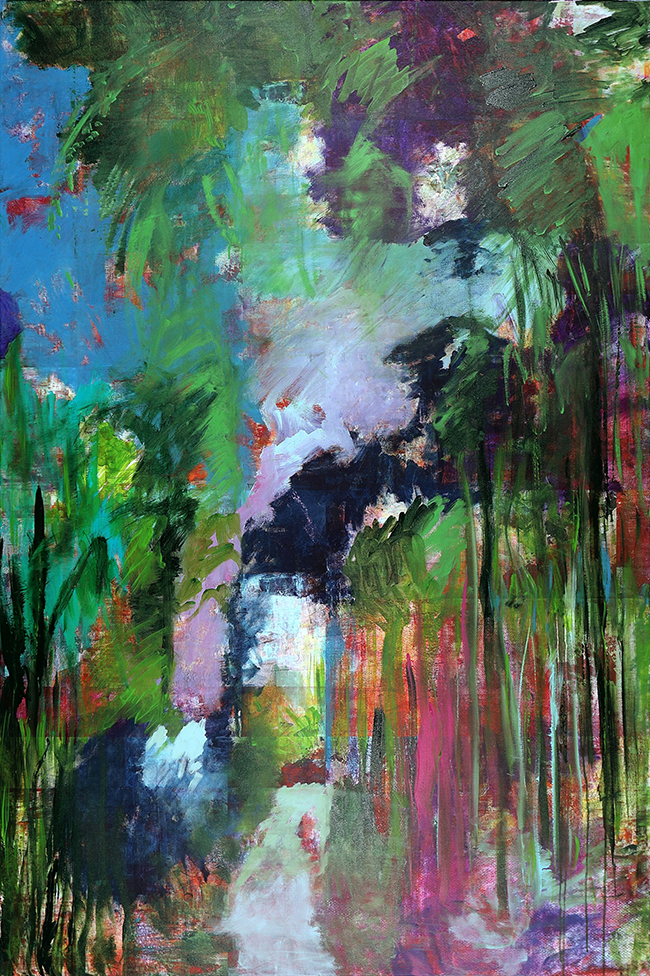
Nature Pure II: A Doorway With Rules You Don’t Get to Write
The second work feels more direct—more packed, more saturated, almost like it steps closer to you. On the left, a clear turquoise-blue reads as air after rainfall. On the right, a strong magenta band suggests fabric, curtain, or boundary—something that could open, conceal, or frame what’s next. Between them sits a pale, milky zone that could be fog, an opening, or a veil.
This is where “presence” becomes most intense. In the darker areas, face-like flashes can appear—not as literal forms, but as sensation. It can feel like the painting is aware of you while you’re looking at it. There’s an invitation here, but it comes with a limit: step in, yes—but don’t expect to control the experience.
That push-pull is the charge of the piece. It doesn’t soothe. It sharpens attention. It asks you to notice what you’re bringing to it, what you’re projecting, and what might be coming back from the painting itself.
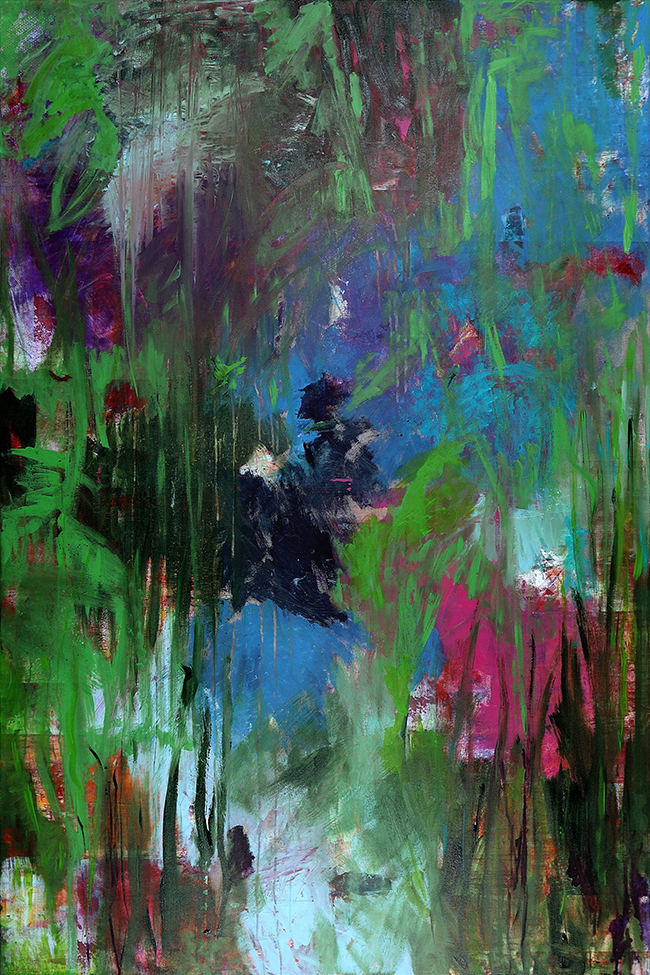
Nature Pure III: Going Deeper Until You Feel Included
The third painting draws everything inward. It’s darker, more layered, and more mysterious in its structure. A cool blue holds one side, while green slides over it like a living curtain—as if growth is overtaking something older underneath. In the center sits a dense, dark concentration: a core, a quiet pool, a thought you can’t quite reach the bottom of. Lower down, a lighter passage opens up—an exit, an entrance, a gap you can’t name. The uncertainty remains, and that’s what makes it work.
This piece carries a subtle emotional shift: the moment nature stops being scenery and starts being a system you’re inside. Not as a tourist. As something included. The painting doesn’t perform for you—it absorbs you. And in that absorption, it becomes quietly deep without needing to announce it.
One Simple Way In
If you want a clean entry into the trilogy, delay the urge to label. Give each painting twenty seconds before you try to “recognize” anything. First, search for paths—clearings, openings, breaks, passages. Then look for beings—presences, silhouettes, face-hints, animal suggestions, whatever your perception offers up.
What you get isn’t certainty. It’s unfolding. These paintings don’t behave like declarations. They behave like places—and the longer you stay, the more they open.
