

Pasquale J. Cuomo’s story starts the way a lot of real creative lives start: with a teenager and a camera, not fully aware of what he’d just picked up. He was born in the United States, and over more than fifty years behind the lens, photography didn’t stay a hobby or a phase—it became a steady through-line. Cuomo moved with the medium as it shifted from film to digital, learning the patience of darkroom time and the speed of modern capture, and letting both approaches shape the way he sees. What comes through in his work is a long relationship with looking: the trial-and-error years, the quiet improvements, the resets, the returns. His images feel lived-in, as if the craft isn’t something he “does,” but something he has kept close for decades—because it still gives him that simple, reliable pull: go outside, notice what’s there, and make a photograph.
Cuomo’s photographs carry the calm confidence of someone who has stayed with the process long enough to stop chasing shortcuts. After decades of practice, the work isn’t about showing off technique. It’s about attention—where he stands, what he waits for, what he leaves alone. That kind of attention is especially clear in his newer Hudson River Valley series, where the land, the sky, and the built world share the frame without competing. These images don’t ask the viewer to be impressed. They ask the viewer to slow down.
The two photographs you’ve shared—one taken at Croton Reservoir Park and the other at Clermont State Historic Site—feel like companion pieces. Not because they look the same, but because they share the same values: openness, clarity, and a sense of place that isn’t forced. They feel like Cuomo is letting the Hudson River Valley speak in its own voice, rather than narrating over it.
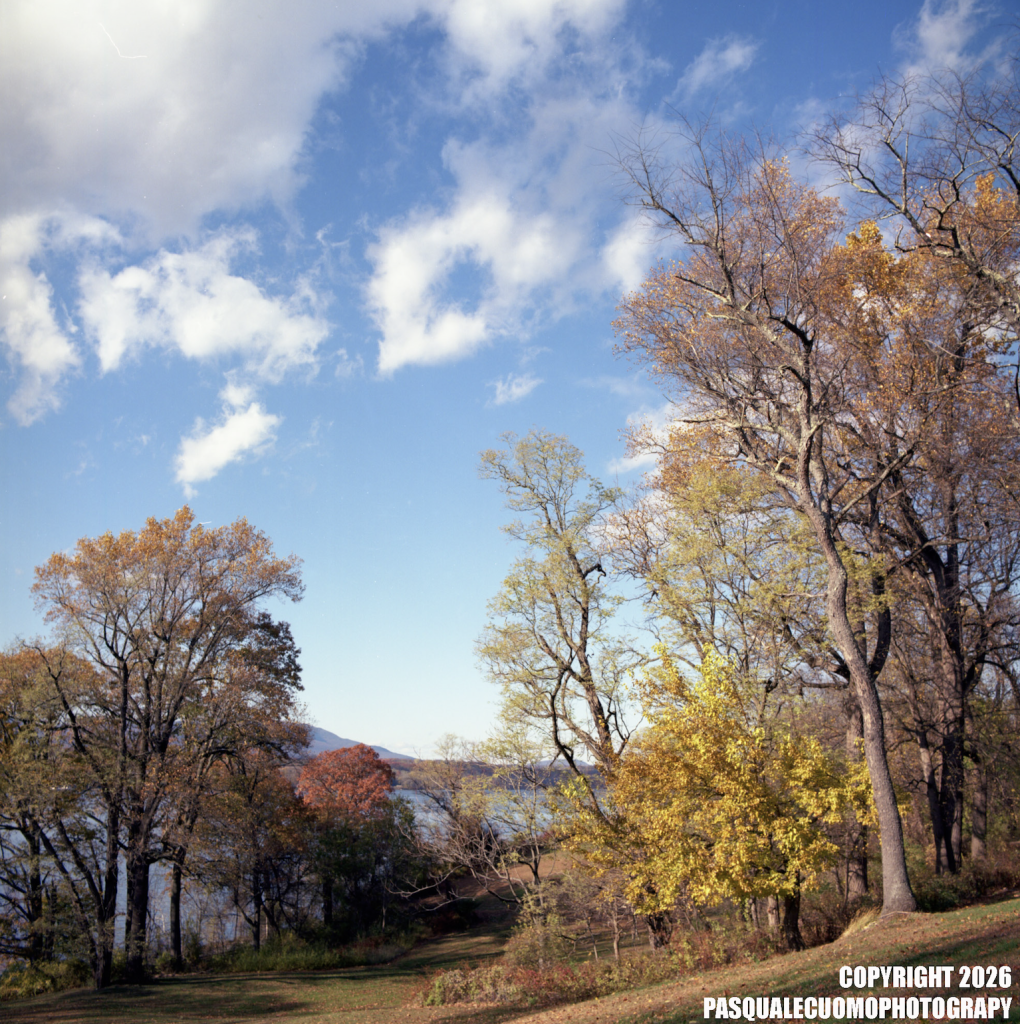
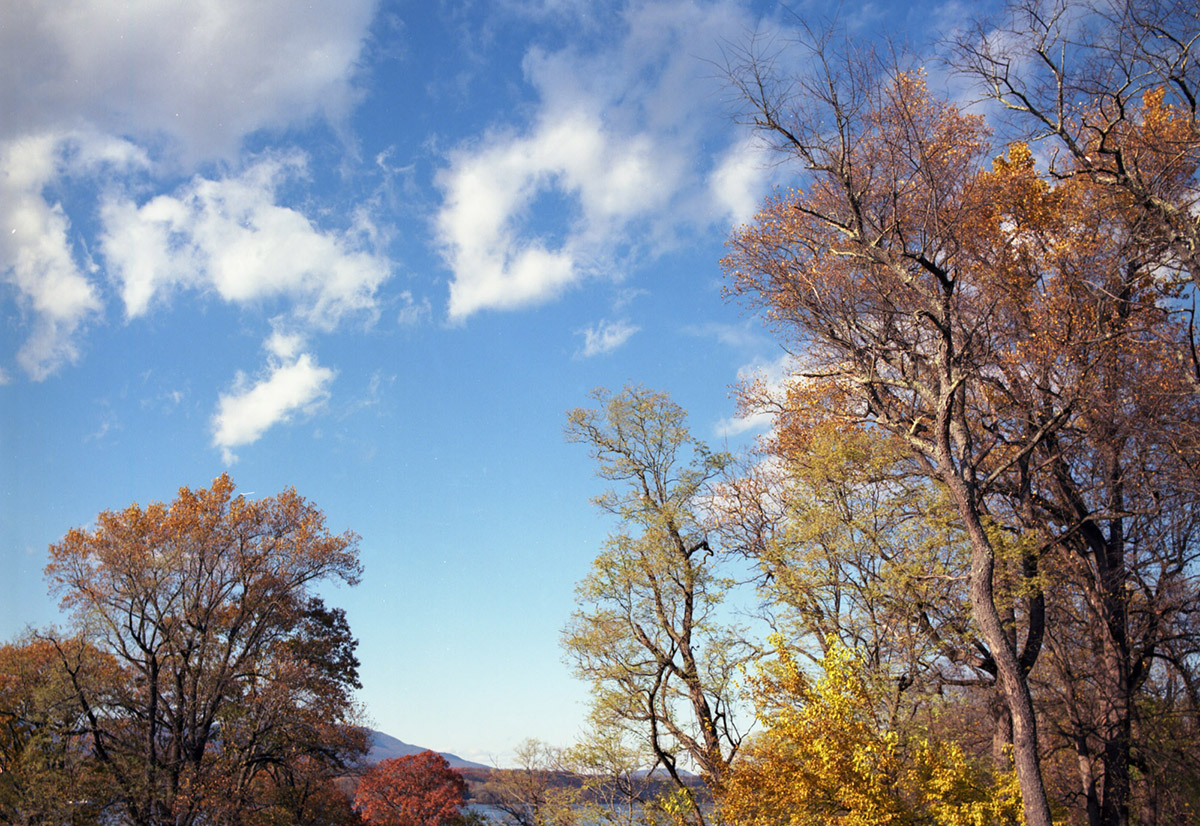
In the Croton Reservoir Park image, the first thing you notice is how much sky Cuomo gives you. The frame is generous with air. The blue isn’t just background—it’s part of the subject, filled with soft clouds that break up the space and keep the eye moving. Below that, the trees sit in late-season transition: some still holding warm color, others already bare. That mix is one of the most honest things about the Hudson River Valley in fall. It’s never one clean postcard moment. It’s change happening in layers.
Cuomo composes this scene in a way that feels natural but intentional. The trees create a loose border on both sides, guiding your gaze toward the center distance where water and land meet. There’s a quiet sense of depth here—foreground shadow, midground trees, then that distant strip of horizon—without any heavy-handed drama. It reads like a place you could actually stand in and breathe. The light is clean and bright, but not harsh, and it gives the image a kind of clarity that feels earned: not edited into existence, but found by paying attention to timing.
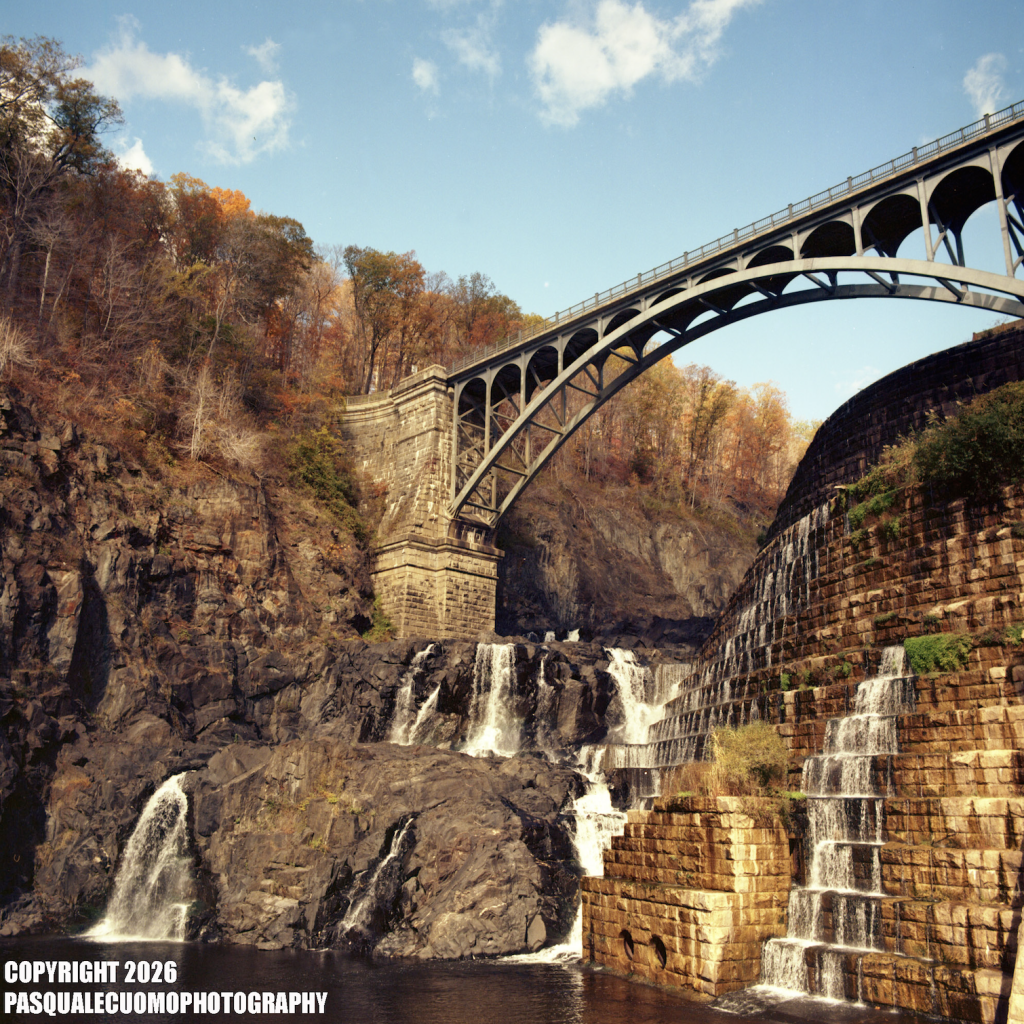
Then there’s the Clermont State Historic Site photograph, which shifts from open landscape to structure, weight, and engineering. Here, Cuomo frames a large arched bridge cutting across a pale blue sky, with autumn trees rising behind it. Below, the scene drops into rock, water, and stone—multiple textures stacked in a way that could easily turn busy. But Cuomo keeps it readable. The bridge becomes the sweeping line that organizes everything else.
What makes this image work is how it balances the built environment with the natural one. The bridge isn’t treated as an interruption to the landscape; it’s treated as part of the valley’s identity—something that belongs to the place now. The stonework on the right, with water streaming down in stepped cascades, adds a second architectural rhythm that echoes the bridge’s repeated arches. And the darker rocks at the base anchor the scene so it doesn’t float away into “pretty view” territory.
There’s also a strong sense of timing in this photograph. The light is warm enough to bring out the browns and golds in the trees and stone, but the sky stays clean, keeping the mood lifted rather than heavy. The water provides motion, but it’s not the main event. It’s there to remind you that the valley is always in motion, even when the structures look permanent.
Taken together, these two pieces show what Cuomo seems to be doing with this new Hudson River Valley series: mapping mood through place. One image leans into openness and seasonal shift. The other leans into scale, structure, and the way humans leave marks on the land. Both are grounded in clear seeing. They don’t rely on gimmicks, extreme processing, or spectacle. They rely on the fundamentals: light, balance, and the photographer’s willingness to stand still long enough for the scene to settle into its best version of itself.
That long arc of Cuomo’s career matters here, because you can feel the restraint that comes with experience. After fifty-plus years, a photographer often stops trying to prove they can take a picture, and starts focusing on why they want to. These images feel like they come from that place. They’re not hurried. They’re not trying to be loud. They’re careful, spacious, and specific—two quiet statements from a photographer who still finds meaning in the simple act of framing the world and saying, “Look at this. This is worth your time.”
