

Kathryn Trotter paints the way some people speak when they’re excited—fast, bright, and with zero interest in toning it down. Her canvases hit you first with color and surface. You can feel the paint in them before you start naming what you’re looking at. Animals show up like celebrities arriving to a party: centered, confident, and surrounded by an entire world of florals, pattern, and ornament that refuses to stay in the background. The work reads as joyful on first contact, but it doesn’t float on charm alone. If you give it a moment, you start to see how controlled it is, how carefully it’s held together, and how much training sits beneath the expressive finish.
That foundation starts in Texas, where Trotter studied textiles and fashion design—disciplines that teach you to build a surface rather than simply fill one. Fabric is never just color; it’s structure, repetition, scale, and the push-and-pull between detail and silence. Those instincts carry directly into her paintings. She thinks in layers, and she understands how a composition can be “constructed” the way clothing is constructed—panel by panel, seam by seam, with choices that either flatter the whole or throw it off balance. Later, in San Francisco, she explored trompe-l’oeil, the tradition of painting that leans into illusion and demands a sharp eye. Trompe-l’oeil is not about guesswork. It’s about looking closely and making decisions that persuade the viewer’s brain. Even when Trotter’s brushwork is energetic and thick, that kind of observation still shows up in her handling of light, edges, and form.
Her style lands between impressionism and heavy impasto, and that pairing is what gives the work its particular charge. Impressionism lets her keep the brush visible and allow color to do the describing instead of tight outlines. Impasto brings the physical punch. Paint becomes a material you can read—ridges, peaks, scraped areas, and dense passages that catch light and throw tiny shadows. Seen in person, the surface is not just a finish; it’s part of the subject. You’re aware of movement: where she pressed hard, where she skimmed, where she piled paint up to make a petal feel built rather than suggested. The paintings ask you to move your body. You step forward to study the topography of the paint, then step back and watch the image settle into clarity. Shift slightly and the light changes the whole experience again.
Animals are a recurring anchor in Trotter’s work, but she doesn’t present them as distant wildlife. She treats them like portrait sitters. The goal isn’t to place a cheetah or tiger into a believable landscape and explain its habitat. The goal is presence. She brings the animal forward, gives it the composure of a formal sitter, and surrounds it with visual signals that feel like costume, set design, and storytelling all at once. Flowers act like adornment. Pattern works like atmosphere. Decorative elements behave like plot. The result can feel playful, but it’s not casual—it’s a deliberate shift from “animal image” to “character,” with a sense of personality and poise that holds the gaze.
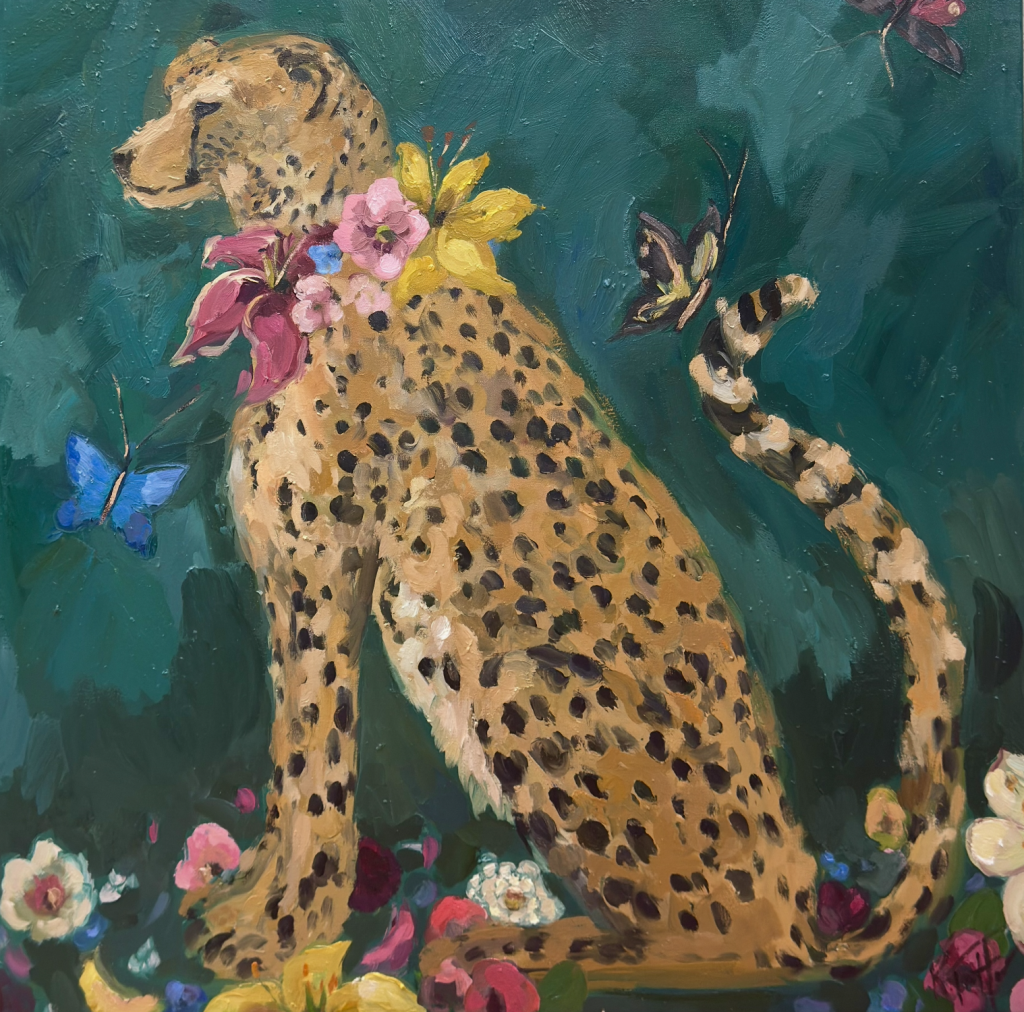
Two works that make this approach easy to see are “Lilly Ruben” (sold) and “Le Tigre” (available). Both are oil on canvas and both sit in gold-edged floater frames that underline their sense of presentation. The framing isn’t an afterthought. It reinforces what the paintings are doing: treating these animals with ceremony, as portraits meant to live as focal points in a space. The ornament inside the frame matches the confidence of the frame itself.
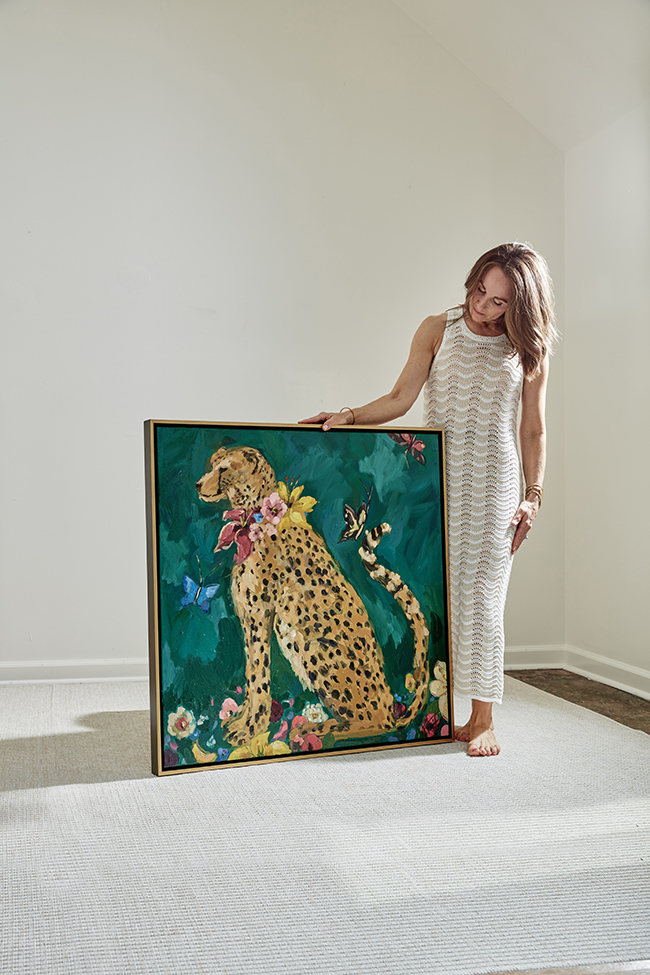
“Lilly Ruben” is a 36×36” cheetah portrait described as bold and colorful, with the animal adorned in a dramatic collar of flowers. The square format helps. It keeps the composition direct, centered, and front-facing, like a portrait that doesn’t want distractions. The floral collar does several jobs at once. It frames the cheetah’s face the way a ruff might frame a historical sitter, giving the animal an almost formal, dressed-up presence. It also gives Trotter a stage for what she loves: saturated color relationships, rhythmic shapes, and thick paint that can make petals feel constructed rather than merely painted. There’s an enjoyable tension built into the concept—sleek, fast animal energy against the lush weight of flowers; precision against flourish. The painting pulls the viewer close. You aren’t observing the cheetah from afar. You’re meeting it.
The gold-edged floater frame strengthens that “portrait” feeling. It doesn’t blend into the wall; it supports the idea that this work is meant to stand out and hold attention. “Lilly Ruben” was sold through Design Supply Shop in Birmingham, Alabama, placing it in a design-forward setting where artwork often functions as both visual statement and room-defining anchor. The work’s story includes a documentary note as well: a photo of the artist with “Lilly Ruben” is credited to Patrick McGough (Birmingham, AL). That detail ties the painting to a specific moment and place—proof that it moved through real hands and real rooms, not just digital feeds.
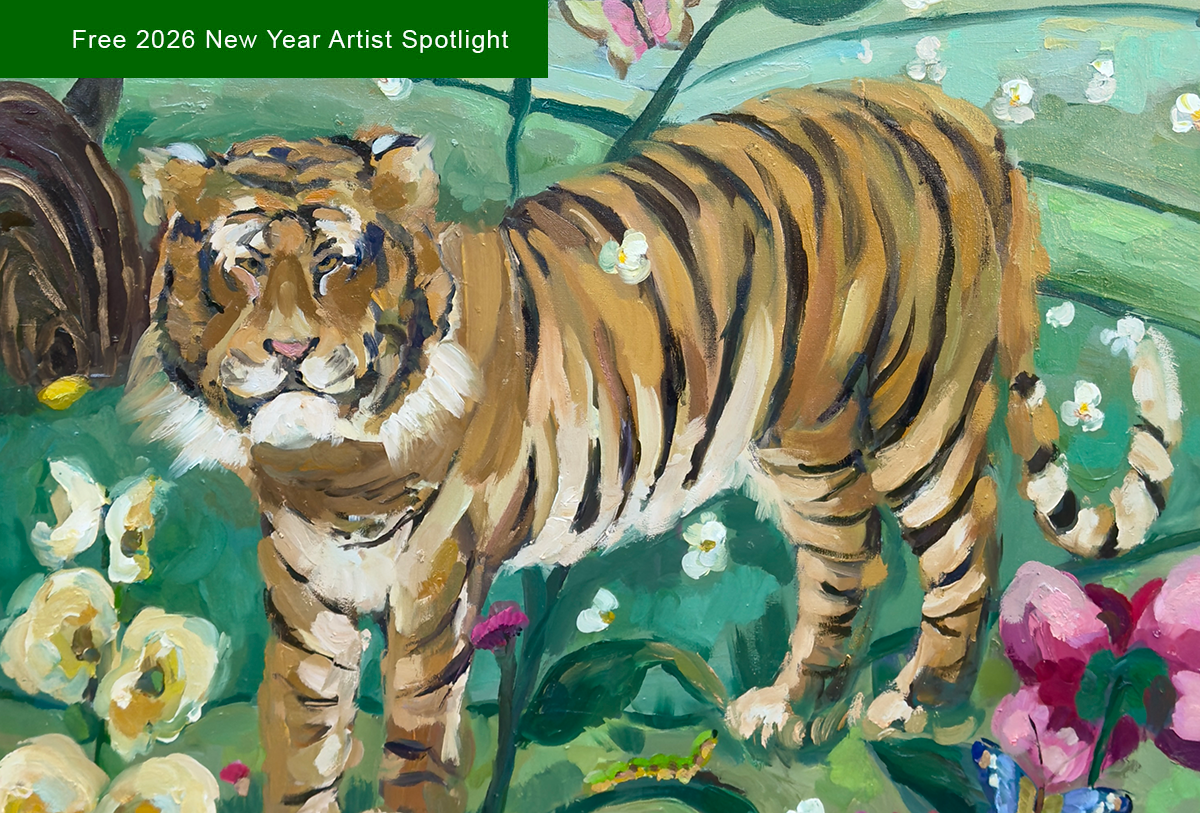
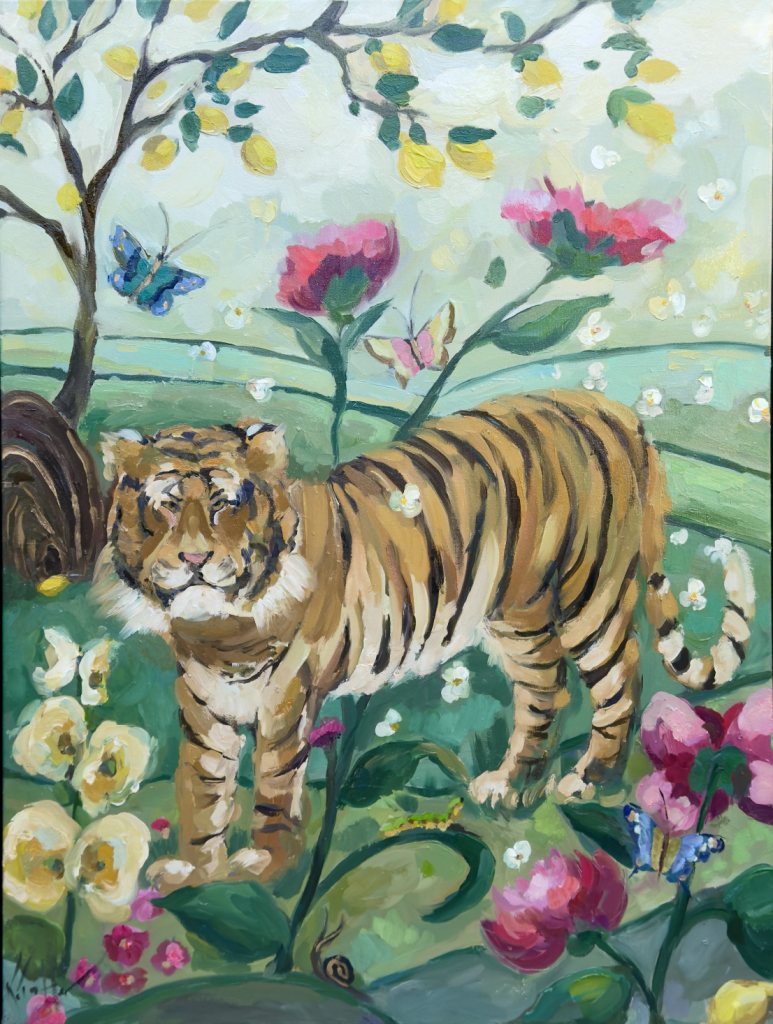
“Le Tigre,” at 36×48”, opens the world wider. The larger format gives Trotter more room to build an environment around the subject. The work belongs to her “Life in Bloom” collection and is described as a vivid piece featuring a tiger placed in a chinoiserie-inspired scene with flora and fauna of all kinds. That setting is a natural match for her instincts. Chinoiserie is already a language of ornament, pattern, and imagined nature, and Trotter uses it like a stage set. Here, pattern becomes environment and decoration becomes narrative. The tiger holds the center with authority while the surrounding details create a sense of abundance that stays active rather than flat.
A lemon tree appears in “Le Tigre,” described as “a bonus,” and it’s an inspired detail. Lemons bring sharp pops of color, a fresh note, and a touch of humor—small bright elements that punctuate the lushness around them. They help guide the eye through the scene and add another layer to the painting’s mood: vibrant, lively, and unapologetically generous. Like “Lilly Ruben,” the piece is presented in a gold-edged floater frame, keeping the collection cohesive and reinforcing the idea of finished, intentional presentation. “Le Tigre” is available through Michael Mitchell Gallery in Charleston, South Carolina, where viewers can experience what photos can’t fully capture: the thickness of the paint and the way the surface shifts as light moves across it.
Taken together, these paintings show why Trotter’s work sticks. She brings together design training, the discipline of illusion, and the freedom of painterly gesture. She builds images that are decorative without being empty, bold without being messy, and joyful without losing structure. The paintings hold attention because they are made—layered, considered, and physically alive on the canvas.
“Le Tigre”
36×48″ oil on canvas can be purchased at Michael Mitchell Gallery in Charleston, SC
843-577-0400
