

Nicola Mastroserio doesn’t make work to keep pace with what’s “in.” The studio, for him, isn’t a place to answer demand or anticipate what will appeal to buyers. He’s after something slower and harder to pin down—questions that don’t expire. Art becomes his way of investigating what lies beneath the visible: not the look of things, but their underlying nature. What he returns to, again and again, is essence—how reality is formed, how it’s experienced, and how it might be approached beyond the noise of everyday surfaces.
That focus gives his art a distinct tone. It feels contemplative without turning cold, and philosophical without slipping into theory for its own sake. In Mastroserio’s world, life is organized by forces we can sense but rarely name—patterns of thought, perception, and intelligence that quietly shape what we accept as “real.” The painting isn’t a conclusion; it’s a sustained attention. His images hold space for the basic questions: what it means to exist, to perceive, to think, and to keep searching for the deeper order moving through everything.
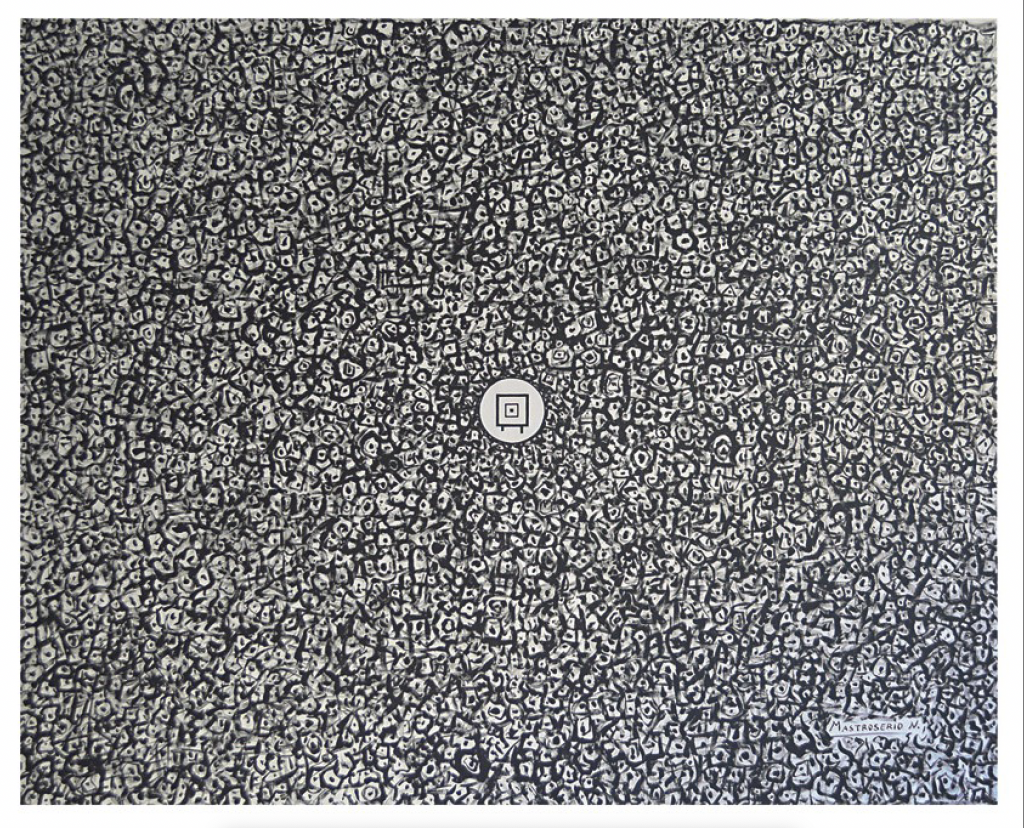
Esse Thesis (146 x 182 cm)
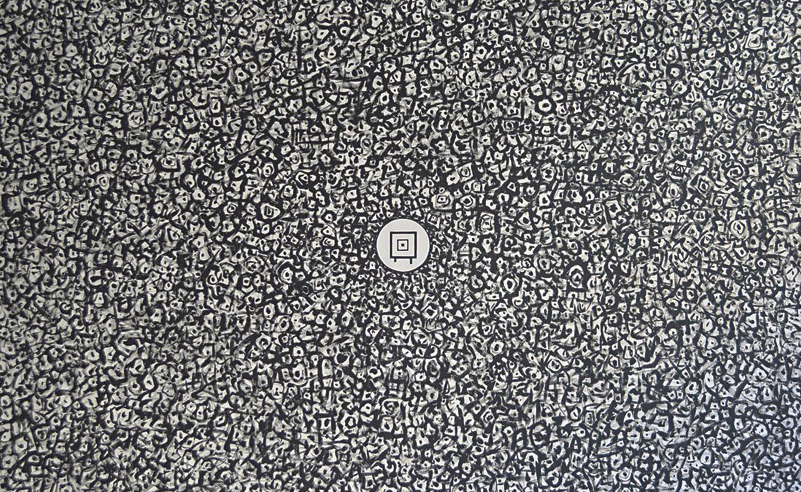
With Esse Thesis, Mastroserio attempts to give form to an idea that is at once expansive and personal: a visual model for life’s originating design. He describes the work as a representation of Cellulism (Cellulismo)—an existentialist theory he developed through study, observation, and intuition, meant to explore how life arises and how it generates worlds. Instead of treating life as a purely biological event or a mechanical chain reaction, Cellulism proposes life as a formative intelligence—an initiating principle capable of shaping both matter and non-matter through the same internal logic.
This is the central proposition the painting asks you to consider. If the physical and the non-physical are shaped by a single life-principle, then the old division between material reality and spiritual reality loses its sharp edge. Reality becomes one connected field—different layers, different states, but rooted in the same source. In that sense, Mastroserio isn’t depicting an external landscape. He’s outlining a structure. The canvas operates like a space where physical intelligence, ultra-physical intelligence, and spiritual intelligence can be imagined as expressions of one originating force.
At the work’s center sits what he calls the Universal Symbol of Life, presented as the origin point of all created things. Visually, it reads as a core—almost cellular in its logic. Philosophically, it functions as a starting pulse: one organizing mark from which the rest can expand. Even if a viewer doesn’t adopt the full language of Cellulism, the composition communicates a clear insistence on beginnings—on the possibility that creation has an underlying pattern, a grammar that can be sensed and studied.
Because the work frames itself as a thesis, it also behaves like an opening rather than an endpoint. It encourages the viewer to treat reality as something living—something that can be understood, and possibly shaped, through awareness. Mastroserio states this directly: his aim is not simply to understand created things, but to apply that understanding “for the benefit of all human beings.” That shifts the painting from private speculation to shared purpose. Esse Thesis becomes more than a personal framework rendered in paint; it’s positioned as knowledge meant to circulate.
A key strand of his research centers on the push and pull between division and unity. He speaks about the limits life imposes, and the strategies human beings can develop to live well—longevity, happiness, and the full expression of individual potential inside a complex social organism. In this view, society resembles a living body: many parts, one system. Individual flourishing and collective health aren’t separate projects. They reflect each other. Understanding life’s principles, then, isn’t abstract—it has consequences for how we relate, how we build, how we care.
There is also an explicitly ethical direction in Mastroserio’s language. He describes his research as an offering toward “a prosperous and wonderful future,” and he connects this knowledge to the possibility of world peace—rooted in love and fraternity among human beings and evolved cosmic entities. Whether read as literal cosmology or as symbolic aspiration, the intention is clear: he is aiming toward unity, toward expanded empathy, toward a future where conflict is not treated as a permanent condition.
Scale supports that ambition. At 146 x 182 cm, the painting meets the body as much as it meets the eye. It’s large enough to feel immersive—something you stand before, not something you casually pass. That physical presence reinforces what the work wants to be: not just an image, but a model, a proposition, a kind of visual blueprint. It suggests that the universe may be immense, but not chaotic—that mystery can coexist with structure, and structure can invite understanding.
Mastroserio’s system continues through symbols that mark time and development. From Cellulism, he identifies two emblems: the Universal Symbol of Life (2012) and the Universal Symbol of Love (2025). Those dates imply sustained work over years—an extended process of building, refining, and extending his ideas. Love, in this framework, isn’t separated from life; it follows from it. If life is the originating intelligence, love becomes the intelligence of relation—the force that makes coexistence and continuity possible.
Seen this way, Esse Thesis reads as a painted philosophy: a proposal that there is a living order under the ordinary, and a path from insight to ethics. It asks what life is made of, what intelligence might be beyond the brain, and how deeper understanding could change the way we live together. Mastroserio isn’t presenting a decorative motif or a market-ready image. He’s building a system—an inquiry—through visual form. And he treats art as one of the tools through which life can be approached, understood, and, over time, improved.
