

Julian Jollon is an American artist whose journey into art has unfolded in chapters rather than a straight line. He trained in Fine Arts, Photography, and Painting, and originally envisioned a future rooted in studio practice. Life redirected that vision. For more than a decade, he worked in Hospital Epidemiology, a profession shaped by research, structure, and the protection of human health. During those years, he also underwent a liver transplant, an experience that reshaped his perception of time, vulnerability, and what it means to keep going.
When he returned to art, it was with focus and intention. His work now draws as much from lived experience as from academic training. Questions of fragility, resilience, and mortality run quietly beneath the surface of his images. Instead of pursuing spectacle, he gravitates toward what lasts—stone, memory, myth, and the human impulse to search for meaning in the natural world.
Myth, Stone, and Memory
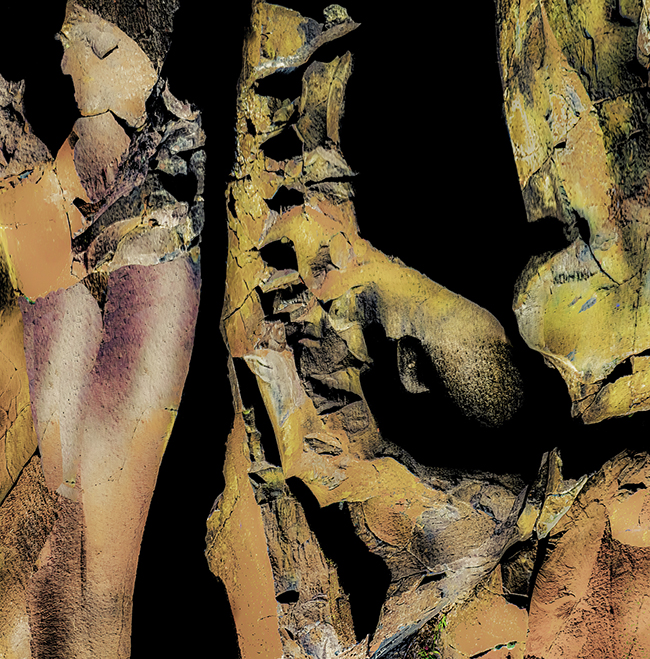
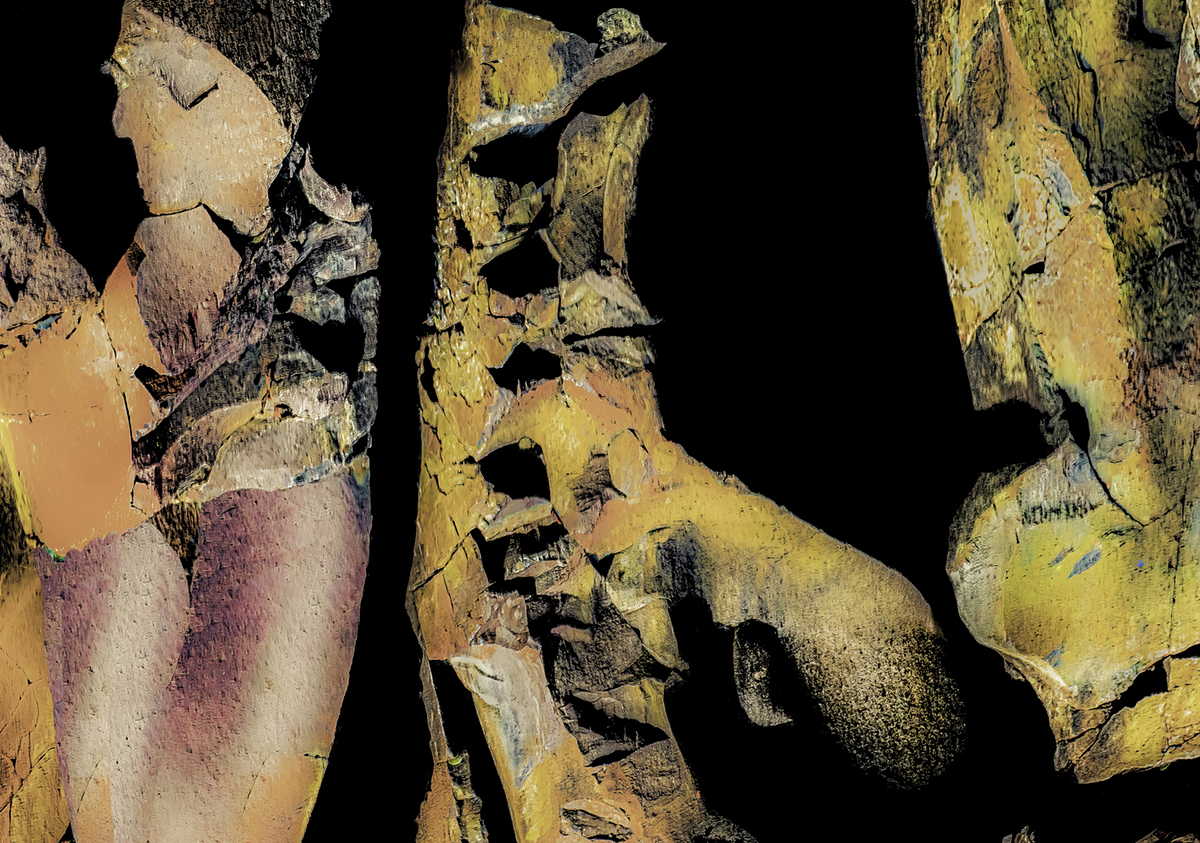
Jollon’s photographic work Mythical Geology considers how landscapes can carry narrative. On first encounter, the piece appears as an abstract study of rock and mineral formations. Earth-driven hues—rust, ochre, deep browns—recall clay, soil, and eroded cliffs. The textures feel tactile, pulling the viewer into fissures and surfaces that seem almost touchable.
Yet the image moves beyond geological observation. Gradually, forms begin to emerge within the stone: a coiling serpent, a suggestion of a woman’s body, a face that feels otherworldly. These shapes are not imposed; they reveal themselves slowly, the way figures appear in shadow or cloud.
The serpent introduces a symbol found across many cultures. Often linked to renewal and healing, it speaks to cycles rather than danger. In Jollon’s image, the snake belongs to the terrain. It is neither separate nor dominant, but woven into the same visual language as the rock. This creates a sense that life and land are continuous, not divided.
The feminine form adds another layer. She appears to rise from the stone rather than stand before it. This can be read as a reflection on Earth as generative force, or on the shared act of creation between nature and perception. The interplay between the softness of a human curve and the hardness of rock creates a quiet contrast, raising questions about tenderness and endurance.
An alien-like visage pushes the image outward toward cosmic time. Here, the work hints at awareness beyond the human frame. The suggestion of watchers—beings outside linear time—turns the landscape into a site of memory and observation. Stone becomes record, witness, and archive.
Light and composition guide these readings. Shadows shape forms that feel like thresholds, while highlights trace edges that suggest emergence. There is a sense of becoming, as if the land is in the act of revealing itself. Time is present, but not as hours or minutes; it reads as geological duration and emotional depth. The terrain feels alive in its stillness.
The poetic language connected to Mythical Geology reinforces this tone. It emphasizes listening over touching and suggests that stories live within mineral silence. This mirrors Jollon’s larger approach. His photography encourages pause. Rather than directing interpretation, he leaves room for personal response.
Odysseus and the Stone Watchers
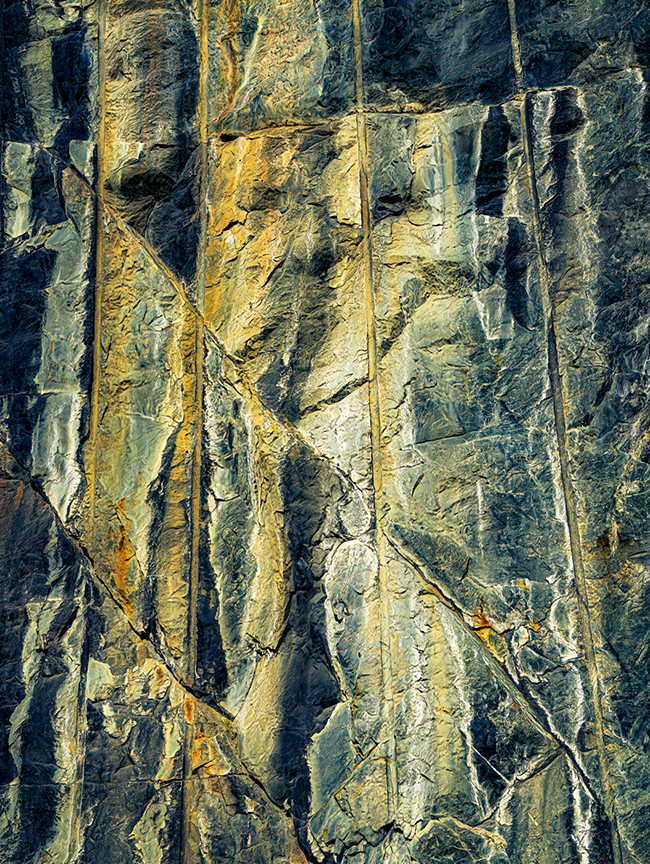
In Odysseus Confronts the Rocky Cliff, Jollon leans into storytelling. The piece draws from classical myth but relocates it into the realm of stone. Odysseus is reimagined not as a sailor, but as a seeker drawn to geological memory. The journey turns inward, moving through cliffs and canyons rather than seas.
Central to the narrative is the “spirit lens,” a tool that reveals what stone remembers. This idea parallels photography itself. The camera is not only for recording what is seen, but for uncovering what lies beneath the surface. Through the lens, ancestors appear, grief becomes visible language, and avoided truths take the shape of masks.
Each carved head—T’kama, Eshuna, Moroq—holds a distinct human condition. Questioning, sorrow, humor, and self-recognition surface through these encounters. Eshuna’s tears turning into glowing symbols suggest that grief can communicate rather than simply weigh down. Moroq’s trickster presence transforms avoidance into honest reflection.
These meetings feel like interior states mapped onto physical terrain. The cliffs operate as psychological spaces as much as natural ones. When the final forming face mirrors the seeker himself, the message becomes clear: the search was never about finding the Watchers. It was about becoming one. Memory lives not only in landforms, but in those who observe and carry experience forward.
A Practice Rooted in Attention
Across his projects, Jollon returns to themes of awareness—of time, connection, and human limits. His background in epidemiology and his medical journey likely sharpened his sensitivity to interdependence and survival. Even when his work engages mythic or symbolic ideas, it stays grounded in physical realities: rock, surface, light.
His process also carries patience. The images do not demand quick reactions. They invite slow looking and comfort with uncertainty. Meanings shift depending on who is looking and when.
Jollon’s return to art feels less like a restart and more like a continuation shaped by life beyond the studio. His photographs suggest that stone holds memory, and that people do too. In bringing together geology and imagination, he creates work that is contemplative, open-ended, and attentive to the quiet conversation between Earth and perception.
