

Bobbie Carlyle, an amazing American sculptor, builds her work from a life that is both full and grounded. As a mother of seven and a grandmother many times over, her creative process is closely tied to lived experience. Rather than separating art from life, she allows the two to move together. She pursued her Fine Arts degree at Brigham Young University while raising her family, a decision that speaks to both persistence and clarity of purpose. That same sense of commitment runs through her sculpture. Carlyle approaches bronze not just as a material, but as a way to hold energy, memory, and emotion in physical form. Influenced by artists such as Leonardo Bistolfi, Solon Borglum, Gutzon Borglum, Daniel Chester French, and Michelangelo, she moves across classical structure, art nouveau fluidity, and contemporary expression without being confined by any one tradition. What emerges is a language that feels direct, shaped by both discipline and instinct, and rooted in a desire to capture the essence of a moment rather than simply describe it.
Stretch the Limits
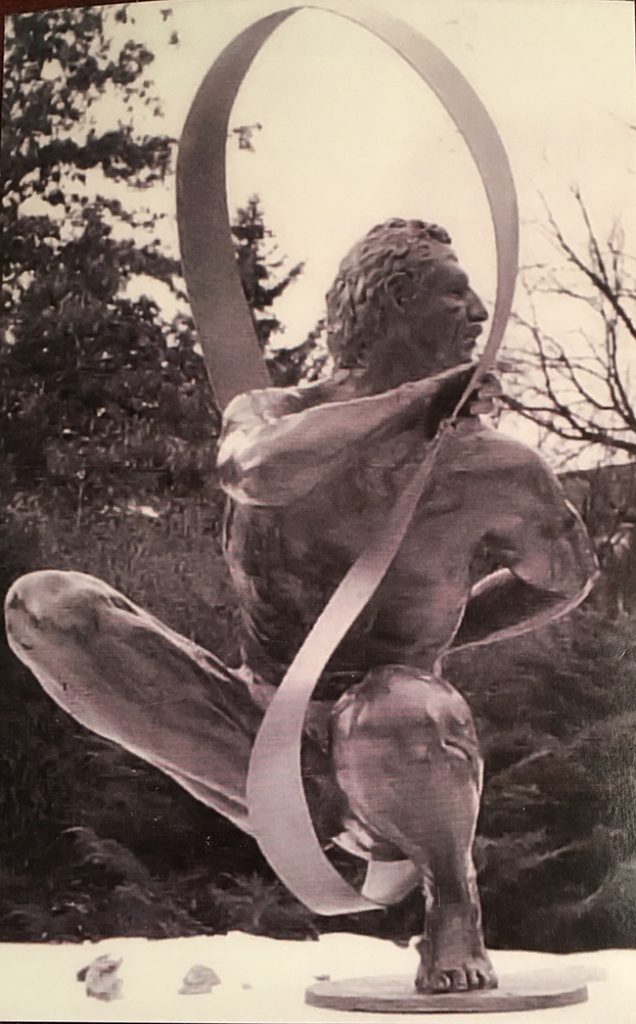
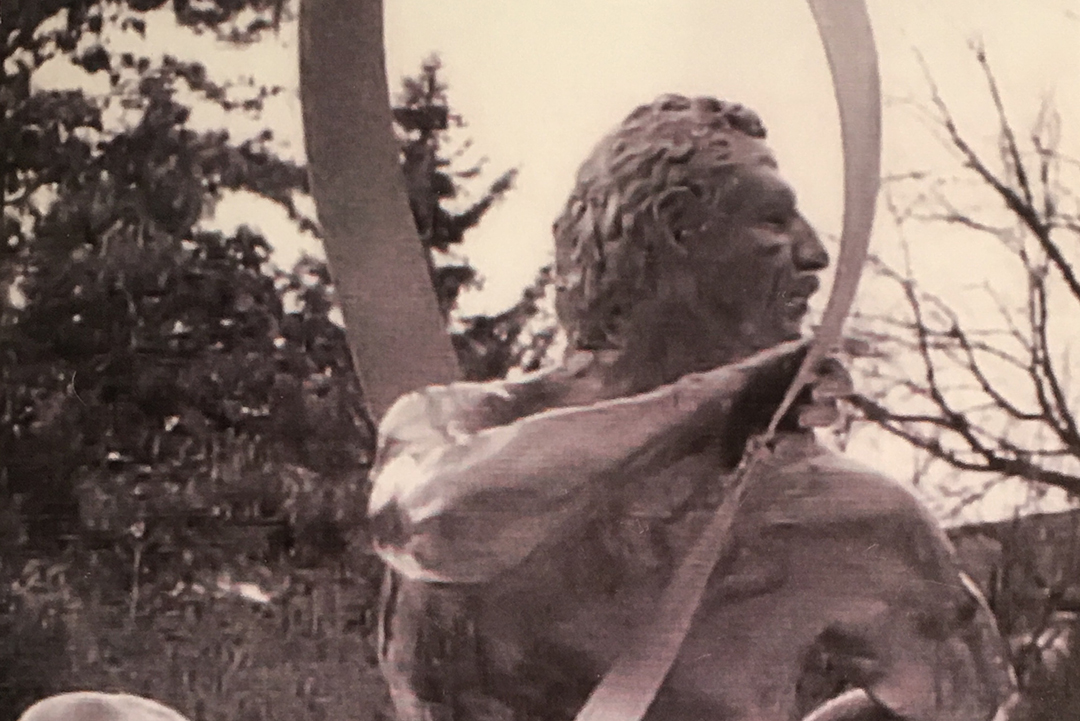
In Stretch the Limits, Carlyle brings tension and expansion into a single continuous gesture. The figure is caught in motion, twisting through a looping form that both surrounds and interacts with the body. This ribbon-like structure does not feel separate from the figure. It acts as both resistance and extension, suggesting a force that the body must push against while also being shaped by it.
The composition is built on movement. Nothing is static. The limbs are extended, the torso rotates, and the circular element directs the eye in an unbroken path. This creates a rhythm that feels ongoing, as if the action has no fixed beginning or end. Carlyle uses this motion to suggest something internal rather than purely physical. The sculpture reads as a reflection of personal limits being tested, stretched, and redefined.
There is also a balance between control and release. The figure appears grounded, yet at the same time, it leans into instability. This tension gives the work its energy. It is not about overcoming something in a triumphant sense. Instead, it focuses on the act itself, the effort, the moment of pushing forward. The bronze surface reinforces this, holding subtle shifts in light that follow the curves and emphasize the continuous flow of the form.
Seaswept
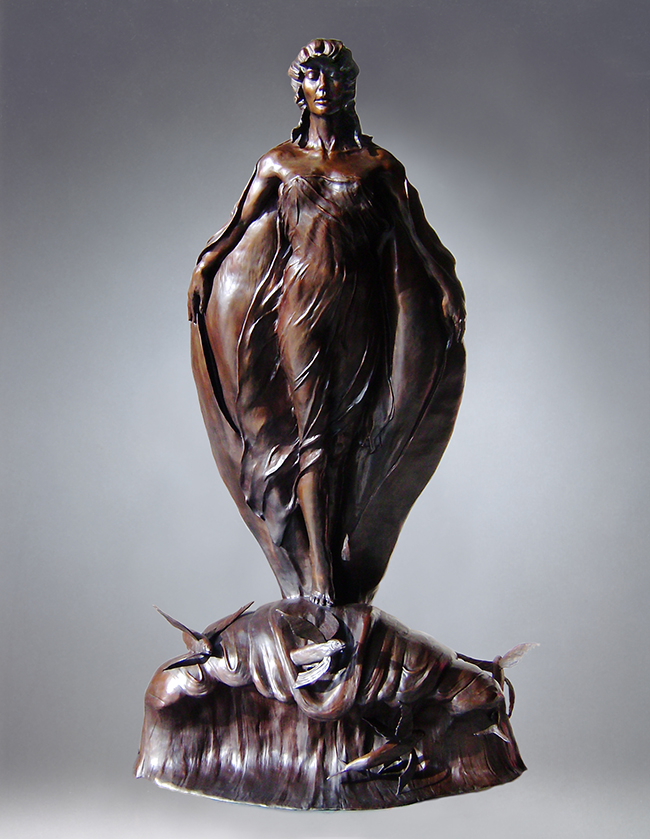
Seaswept moves in a different direction, but it continues Carlyle’s interest in motion and transformation. Here, the figure stands upright, yet the sense of movement comes through the surrounding forms. Drapery expands outward, shaped as if by wind or water, creating a surface that feels alive.
The base introduces another layer. It suggests a natural form, something organic, possibly tied to the sea. This anchors the figure while also reinforcing the idea of environment as an active presence. The sculpture is not isolated. It exists within a force that shapes it.
Unlike the tension found in Stretch the Limits, this work leans toward openness. The figure stands with a quiet steadiness, allowing the movement around it to unfold. The gesture is less about resistance and more about acceptance. Carlyle captures a moment where the figure is not pushing against the elements but moving with them.
The surface treatment plays a key role. The bronze catches light across the folds, creating contrast between areas of smoothness and deeper shadow. This variation gives the work a shifting quality, as if it changes depending on where it is viewed from. The figure remains central, but the surrounding forms expand the experience outward.
Sunriser
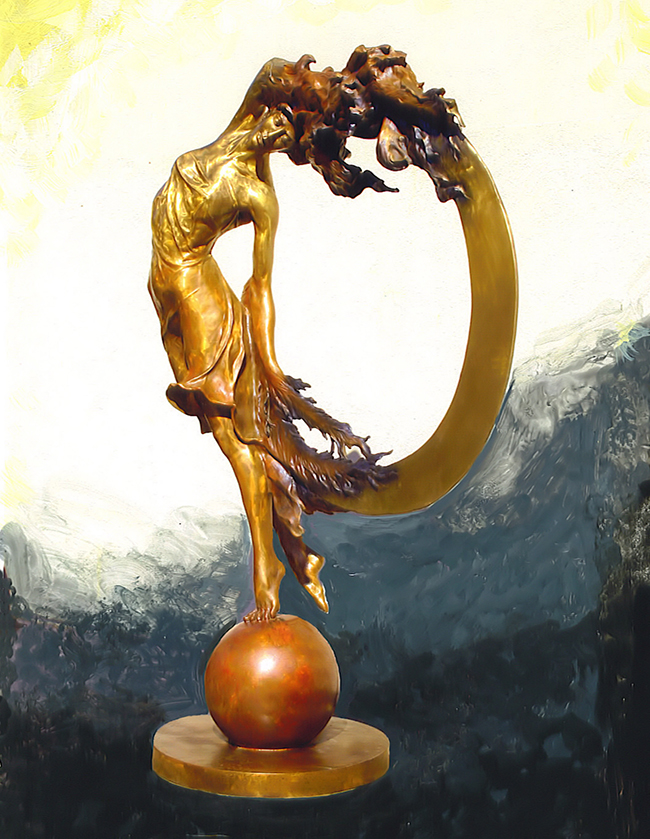
In Sunriser, Carlyle brings together balance, elevation, and renewal. The figure stands on a sphere, a form that immediately introduces instability. At the same time, a large circular element frames the body, echoing the idea of a rising sun.
The composition is more vertical than the other works. The figure reaches upward, while the circular form extends around and behind it. This creates a sense of lift, as if the sculpture is moving beyond its base. The sphere beneath the feet adds to this feeling. It suggests a point of transition rather than a fixed foundation.
There is a contrast between weight and lightness. The bronze carries physical mass, yet the arrangement of forms makes the figure appear almost suspended. Carlyle uses this contrast to explore the idea of beginning again. The title points toward a new day, but the sculpture itself focuses on the moment of emergence.
The figure’s posture is open, yet there is still a trace of strain in the positioning. This keeps the work grounded. It does not present renewal as something effortless. Instead, it acknowledges the effort required to rise, to balance, and to move forward.
Across these works, Carlyle returns to a central concern: how to give form to internal experience. Whether through tension, movement, or balance, her sculptures focus on moments that feel transitional. They do not settle into a single state. Instead, they remain in motion, holding that brief point where change is taking place.
