

Eliora Bousquet is a French-listed abstract painter and illustrator whose paintings sit right where emotion starts to widen into something hard to measure. Born in Angoulême, France, in 1970, she fully entered her artistic life in 2009. Rather than reading as “late,” that start feels intentional—like she waited for the moment when instinct could take the wheel without apology. Her work follows intuition more than blueprint. There’s a gentle, persistent sense of wonder in it, along with a clear attraction to the night sky: its stillness, its distance, its repeating rhythms. In Bousquet’s hands, nature and the cosmos aren’t separate themes. They’re two faces of the same cycle—arrival and departure, swelling and thinning, brightness and fade, then return.
Her canvases often feel like crossings—places where earthbound sensation meets a larger, quieter scale. Color is the main voice. Silence is part of the structure. She isn’t trying to reproduce objects the viewer can name in two seconds. She’s reaching for what the body recognizes first: the shift in the chest when you stare at a horizon, the calm (or unease) that comes with looking up and realizing how much you can’t hold in one glance. The paintings don’t explain that feeling. They give it somewhere to land.
A lot of abstract work comes with an implied challenge: solve me. Bousquet doesn’t work that way. Her paintings ask for attention, not decoding. They behave less like fixed arrangements and more like changing atmospheres. Shapes gather, dissolve, drift, and regroup. Color moves across the surface as if it has its own current. Spend time with one canvas and you can feel it rebalancing while you look—mist becoming density, density becoming flare, flare becoming quiet again. There’s a bodily intelligence in how the layers operate, as if the painting knows when to tighten and when to release.
Her surfaces hold soft veils and sudden blooms. Edges blur, then snap into focus. One layer melts into the next, then separates again so you can sense depth. That shiftiness is part of the invitation. You aren’t pushed into one reading. You’re allowed to float between impressions. The work is immersive, but it isn’t aggressive. It draws you in the way weather draws you in: you notice the air changing, and suddenly you’re inside it.
Light is one of the key organizing forces in her practice. Not light as simple shine, but light as a kind of internal architecture. Even when her palette leans bright and airy, there’s depth underneath—an undertow that keeps the painting from becoming purely decorative. In these newer pieces, luminosity arrives in different forms: glowing centers, foggy halos, and small flecks that hover like dust, salt crystals, or distant stars. Those tiny marks matter. They give the eye measurement. They hint at scale without turning the image into illustration. You start to feel two distances at once: something microscopic and something cosmic. A cell and a sky. A tide pool and a nebula.
Three new works: variations on formation
Seen as a group, these three paintings feel like a small suite about becoming—how something forms, gathers pressure or energy, breaks open, and settles into a new state. The language stays consistent across all three: flowing boundaries, layered transparencies, and radiant cores. But the emotional temperature changes from one to the next, like a sequence of breaths.
Work 1
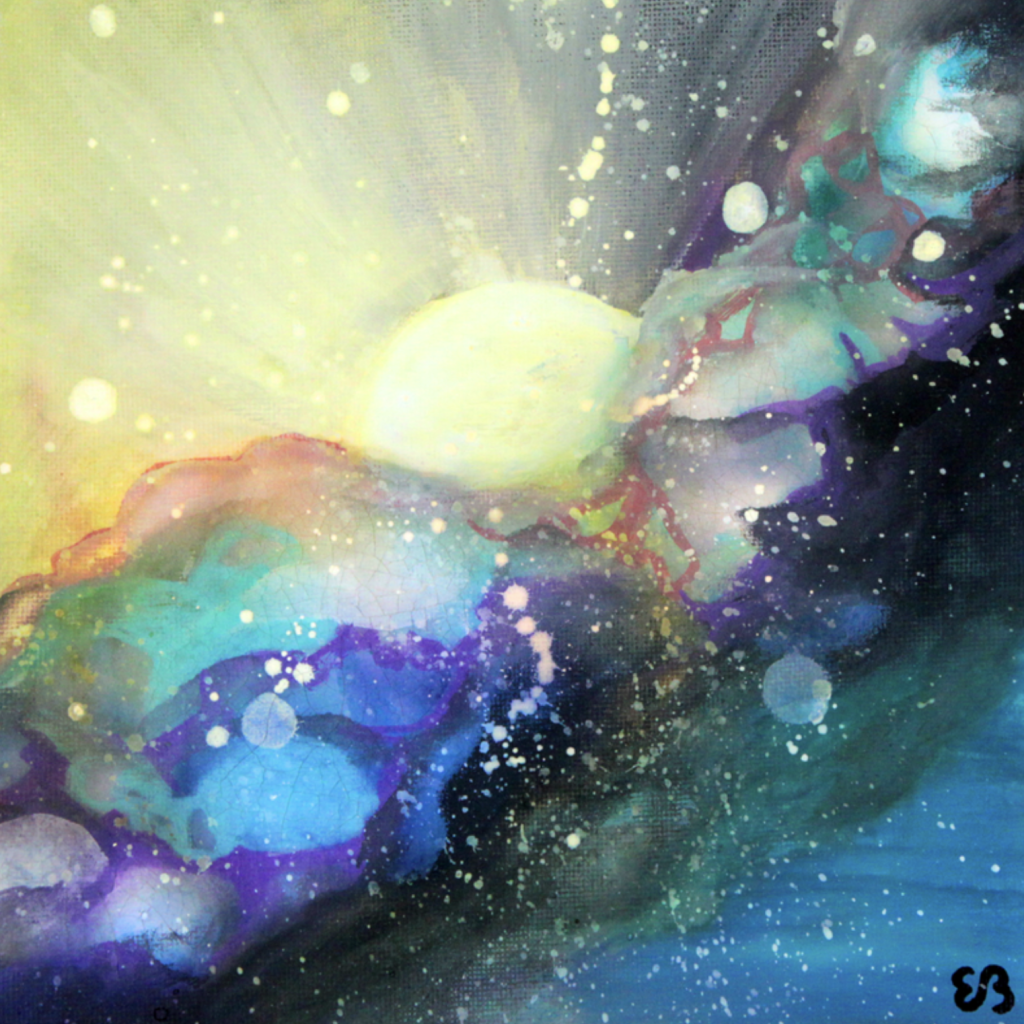
The first piece begins with warmth, like sunlight filtered through haze. Near the center sits a pale, rounded glow that reads as moon-like at first, though it isn’t a literal moon. It behaves more like a source—an inner light around which the rest of the painting gathers. Blues and purples pool and layer around it, creating depth that can feel aquatic in one moment and atmospheric in the next. The surface is activated by scattered droplets and specks—some crisp and small, others larger and softly edged—like pollen floating, or spray catching light midair.
That constellation of marks does important work. It interrupts the calm without cracking it, keeping the painting alive and slightly unstable, in the best way. The left side leans into a yellow-green radiance, while the right side dips into deeper blues and charcoal tones, creating a subtle shift from day toward night. There’s also a gentle topographic feeling—rounded forms stacking and overlapping like underwater stones or slow cloud banks. You can sense “landscape,” but it won’t lock into place. It stays closer to sensation: the memory of light hitting a surface, the experience of looking into depth without finding an edge.
Work 2
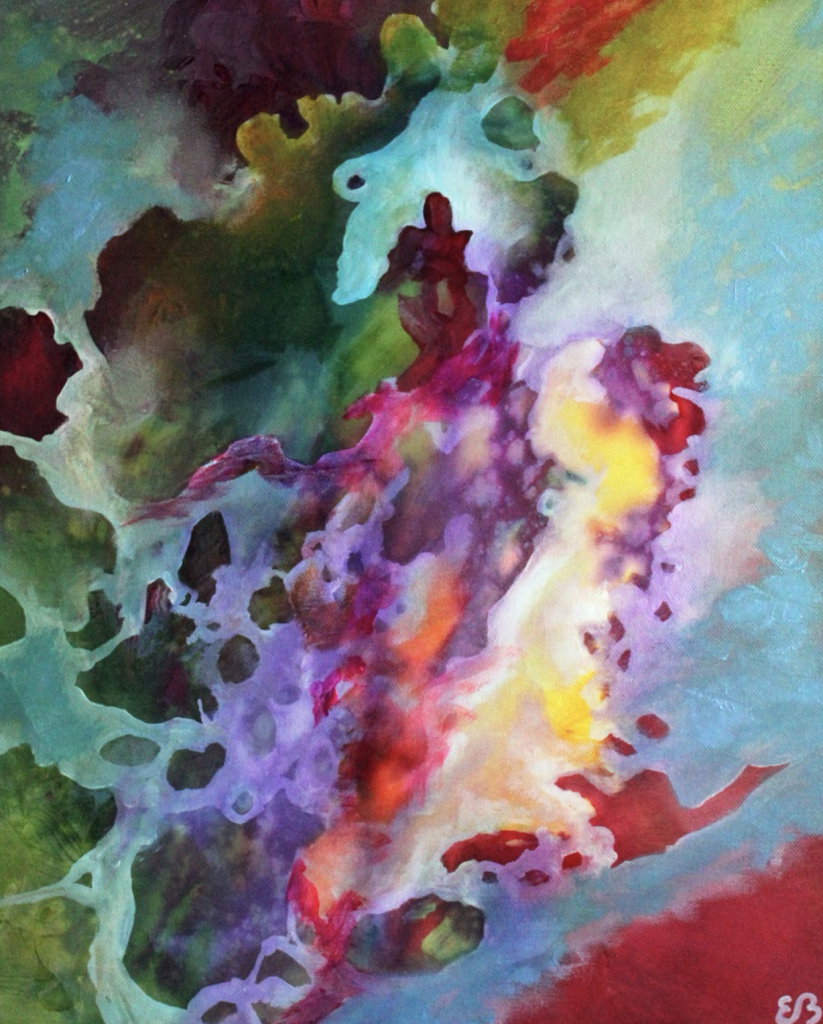
The second painting turns more physical. It feels denser, more turbulent, more charged. Warm reds, magentas, violets, and amber heat flare within a cooler field of aquas and sea-greens. The forms suggest coral, reef, or mineral bloom—something alive and vulnerable, but stubbornly persistent. Negative spaces open like pockets and channels. Parts of the surface look dissolved or eaten away, creating lace-like edges that feel lush and slightly raw at the same time.
This is the piece with the strongest push-pull. Dense pigment presses against airy wash. Heat pushes into cool translucence. You can feel pressure and release inside the same frame. It’s easy to imagine an underwater world here, but it also reads as an internal map—emotion collecting, intensifying, then moving through. The beauty doesn’t sit at a distance. It asks you to come close, where nature becomes complicated and the line between attraction and unease starts to blur.
Work 3
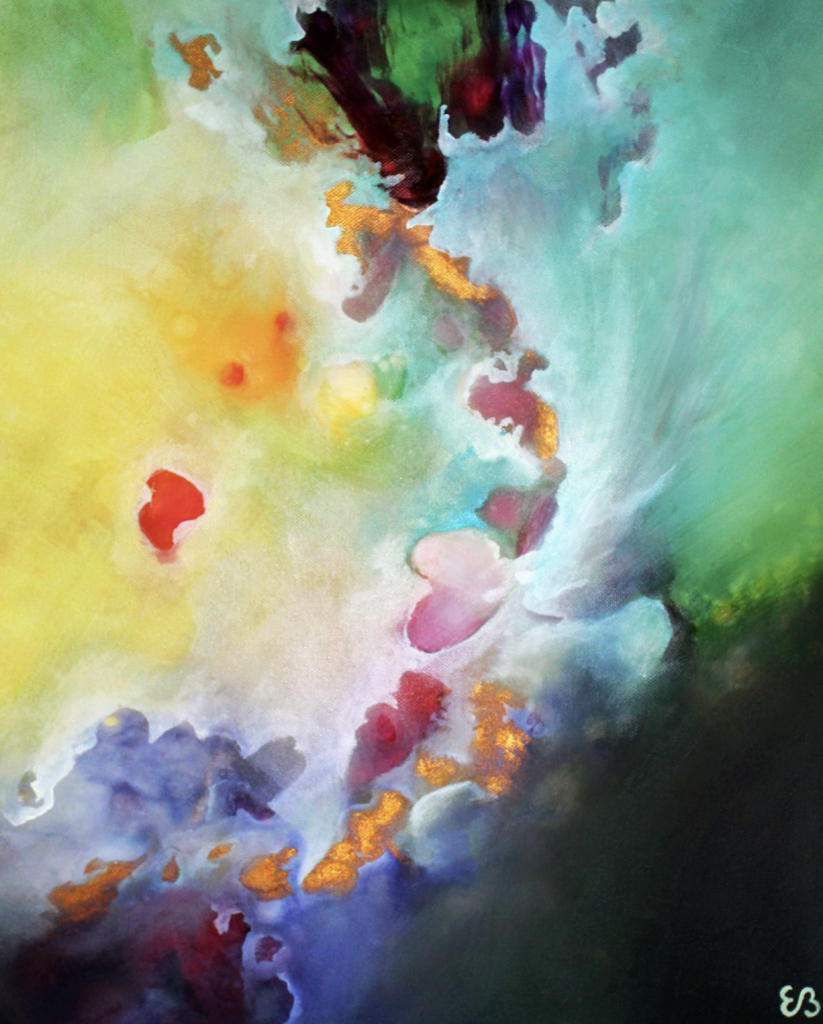
The third work feels like a clearing after intensity. The space opens. A bright, pale center holds the composition and reads as a threshold—almost portal-like, not in a sci-fi way, but in the sense of stepping from one state into another. On the left, soft yellow light expands. On the right, greens and teals drift into cooler air. Small warm accents—golden-orange fragments—appear like sparks or flecks of matter, reminders that even the most airy space still has weight.
Here the forms are less object-like and more like passing presences: hints of petals, embers, or drifting organisms. What holds the painting together is breath—the way light seems to pulse. The center isn’t a flat white; it’s layered and clouded, as if lit from within. The mood is quiet but not empty. It feels like a pause between waves, a moment when the mind stops grabbing for meaning and simply floats.
Across these three works, Bousquet keeps her visual language steady while letting the emotional register shift: cosmic calm, organic intensity, then open release. That range is part of the pull. She lets abstraction carry feeling without tipping into drama. She keeps light and space active without sliding into decoration. And she leaves room for mystery—while still keeping the door open.
