

Jane Gottlieb’s artistic path has been guided by an enduring fascination with color, motion, and visual intensity. Born in Los Angeles and now based in Santa Barbara, her creative foundation began in painting before shifting toward photography, where she discovered new ways to explore composition, rhythm, and light. More than thirty years ago, she made a defining move that continues to shape her work today: hand-painting individual Cibachrome prints. This process transforms photographic images into one-of-a-kind physical pieces, blurring the boundary between mediums. Rather than treating photography as a fixed image, Gottlieb reworks it into something tactile and fluid, where color is not simply applied but embedded. Through this method, she creates artworks that exist between painting and photography, carrying both the immediacy of the camera and the expressive freedom of the hand.
Gottlieb’s work does not sit quietly within a single category. It operates in a space where photography becomes a starting point rather than a conclusion. The image titled Brancusi Head, Paris reflects this approach clearly. The architectural structure, recognizable in form, is transformed through intense, almost electric color. The building is no longer just a site in Paris; it becomes a stage for visual reinterpretation.
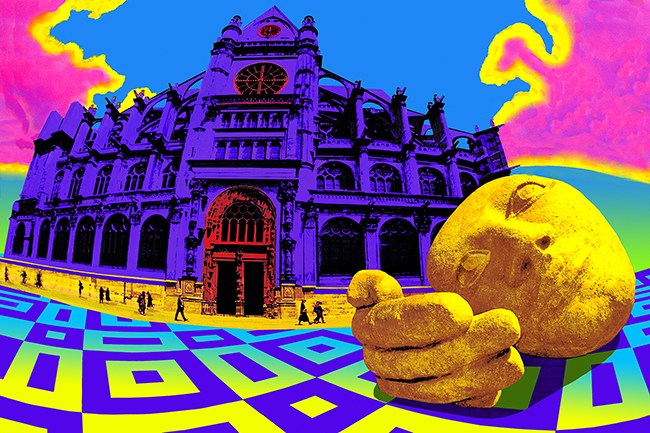
In this piece, color functions as both disruption and construction. Deep purples, saturated blues, and acidic yellows flatten and expand the space at the same time. Perspective becomes unstable. The viewer is aware of the structure, yet also aware that it has been reimagined into something closer to a psychological environment than a physical location. The addition of the sculptural head in the foreground introduces a surreal presence, one that feels both playful and slightly disorienting.
There is a tension in the work between familiarity and transformation. The architecture grounds the viewer, while the color pulls them away from certainty. Gottlieb uses this push and pull to create a sense of movement within a still image. The eye does not settle. It travels across the surface, guided by contrast and intensity rather than traditional composition.
Her process is central to this effect. By hand-painting Cibachrome prints, she physically intervenes in the photographic surface. This is not digital manipulation. It is direct contact. Each gesture leaves a trace, making every piece singular. The photograph becomes a base layer, but the final work carries the presence of time and labor. It holds both the captured moment and the artist’s continued engagement with it.
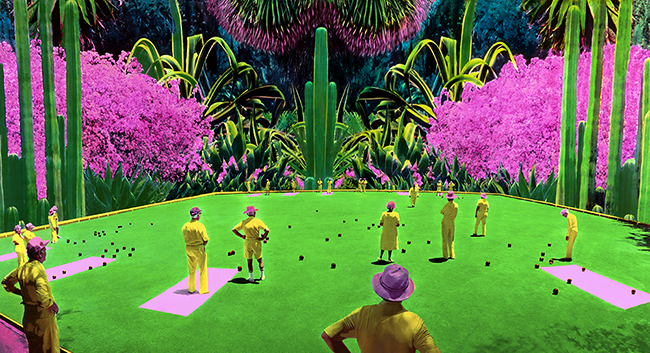
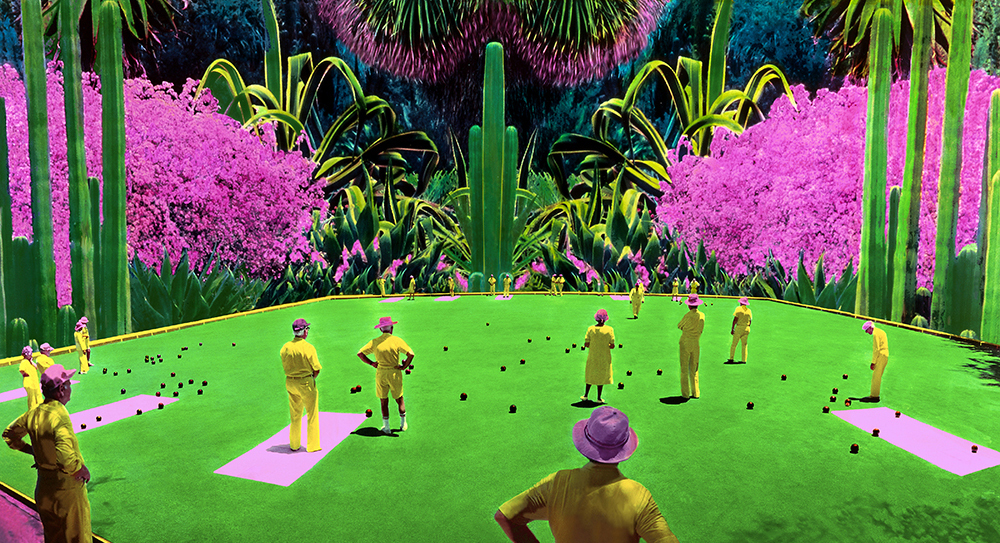
In contrast, Lawnbowler’s Series: Life shifts the focus from architecture to human activity, though it remains equally transformed. The scene presents a group of figures engaged in lawn bowling, but the setting defies natural expectations. The landscape is heightened into a vivid, almost dreamlike environment. Bright greens dominate the ground, while surrounding foliage appears in exaggerated pinks and dense, layered textures.
What stands out is Gottlieb’s use of background as a variable element. She describes altering the background to evoke different emotional tones, and this is evident in the image. The figures remain relatively stable, but the world around them changes. This approach turns the setting into an active participant rather than a passive backdrop.
The figures themselves are simplified, almost uniform, dressed in similar tones that allow them to blend into the scene while still maintaining presence. Their arrangement across the field introduces a quiet rhythm. They are spaced in a way that suggests both interaction and isolation. Each figure occupies its own zone, yet they are connected through the shared activity.
Color once again becomes the driving force. It does not describe reality; it constructs a new one. The exaggerated palette creates a sense of heightened awareness, as if the viewer is seeing the scene through an altered state. This is where Gottlieb’s work becomes less about representation and more about perception. She invites the viewer to consider how environment shapes experience.
There is also a subtle narrative quality. The title Life suggests that the scene is more than a simple depiction of a game. It becomes a metaphor for participation, distance, and observation. The figures engage in a structured activity, yet the surrounding environment feels unpredictable and expansive. This contrast introduces a quiet tension, one that mirrors the balance between control and uncertainty.
Across both works, Gottlieb maintains a consistent approach. She begins with reality but does not remain bound to it. Through her process, she reshapes images into spaces that feel both constructed and organic. The hand-painted surface carries a sense of immediacy, while the photographic base anchors the work in something recognizable.
Her art exists in that in-between space. It is not fully painting, not fully photography. It is a hybrid form where color leads and structure follows. Each piece invites a different kind of looking, one that moves beyond identification and into experience.
