

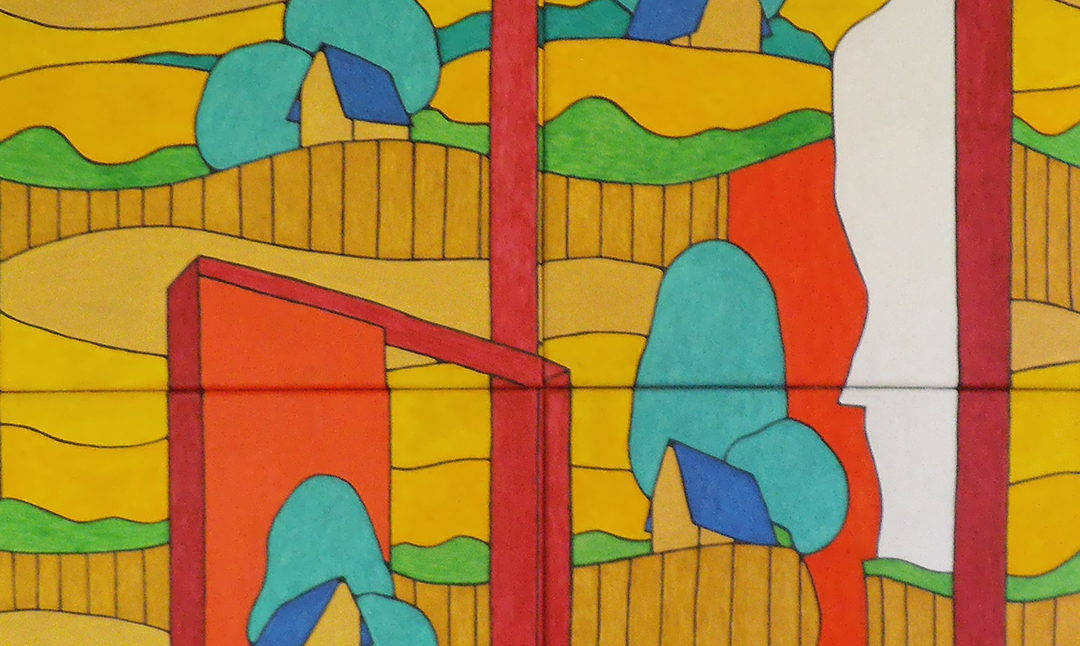
Michel Marant, born on August 4, 1945, in Saint-Junien, France, has developed a body of work rooted in the quiet patterns of daily life and the presence of the natural world. Trained at the National School of Decorative Arts in Limoges and affiliated with the Maison des Artistes, his practice has gradually shaped itself into a distinct visual language. Working across pencil, acrylic, oil, and collage, Marant moves between surfaces such as canvas, paper, and cardboard without hierarchy. His approach draws from the flowing sensibility of art nouveau, yet it is not bound by it. Instead, he builds a personal structure where line, color, and form interact in a direct and unforced way. His paintings do not attempt to replicate reality. They reorganize it, offering a version of the world that feels both familiar and quietly transformed.
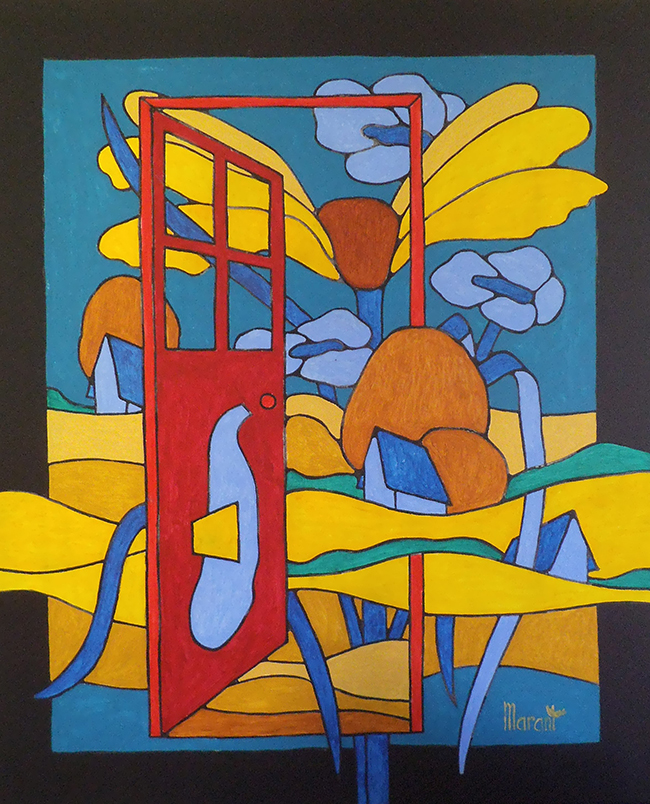
In Opening onto the Dragonfly Flower (2025), Marant constructs a scene that feels both open and enclosed at the same time. A red door stands prominently in the foreground, slightly ajar, acting as both an invitation and a boundary. It does not lead to a conventional interior. Instead, it opens onto a landscape that unfolds in layers of simplified shapes and vivid color. Yellow fields stretch horizontally, intersected by blue and green forms that suggest plants, stones, or fragments of terrain. Above them, stylized flowers rise like quiet markers, their rounded forms echoing the curves found throughout the composition.
The door is not just an object. It becomes a device that frames perception. By placing it within the landscape, Marant shifts the idea of entry. The viewer is not stepping into a room, but into a way of seeing. The bright red contrasts sharply with the surrounding blues and yellows, creating a visual tension that anchors the composition. At the same time, the lines remain clean and controlled. There is no excess detail. Each element is reduced to its essential form, allowing color and structure to carry the image.
The presence of the dragonfly flower, suggested rather than described, adds another layer. It does not function as a botanical study. Instead, it becomes part of a symbolic environment. The landscape is not fixed. It feels assembled, as if each component has been placed with intention but remains open to interpretation. The result is a space that is both calm and slightly disorienting, where scale and depth shift subtly.
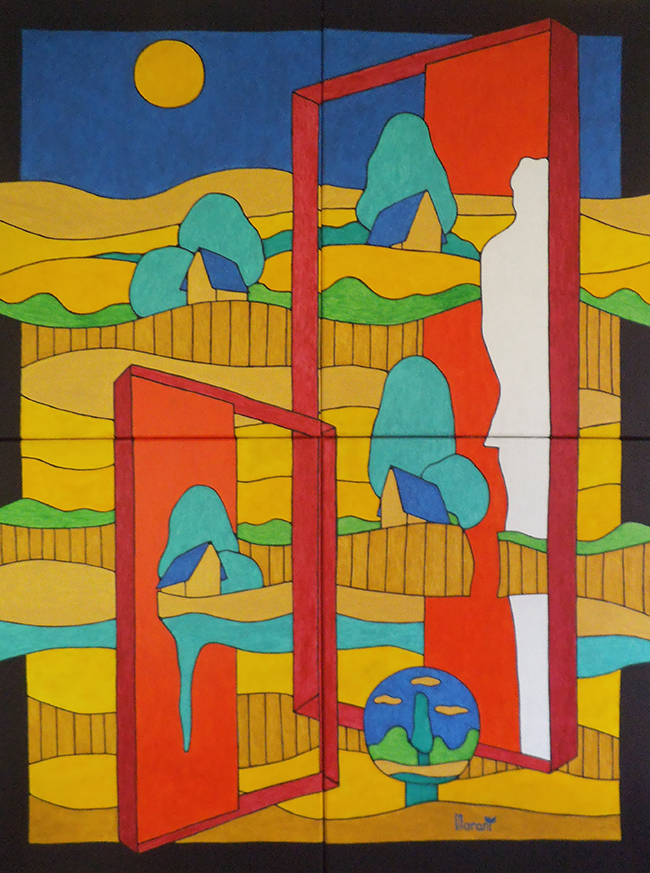
In White Silhouette with Red Frames (2026), Marant continues this exploration of framing, but with a more pronounced focus on the human presence. A white silhouette stands within a large red rectangular structure, set against a landscape of rolling yellow fields and simplified trees. The figure is not detailed. It is a flat, unmodulated shape, almost like a cutout. This absence of detail removes any specific identity, allowing the figure to exist as a placeholder rather than an individual.
The red frames function in a similar way to the door in the earlier work, but here they multiply and intersect. One frame stands upright, enclosing the silhouette, while another lies at an angle in the foreground. These structures create a layered spatial arrangement that disrupts traditional perspective. The viewer is aware of depth, but it does not follow a single, stable logic. Instead, space is built through overlap and contrast.
Color plays a central role again. The yellow fields dominate the background, creating a sense of continuity across the surface. The blue sky, punctuated by a simple circular sun, reinforces the clarity of the scene. Against this, the red frames assert themselves with strong, uninterrupted lines. The white figure, placed within this structure, becomes both contained and isolated. It is present, but also removed from the surrounding environment.
A small globe-like form appears near the base of the composition, adding an unexpected element. Its rounded shape and varied colors suggest a miniature world, echoing the larger landscape behind it. This repetition of form reinforces the idea that the painting operates on multiple levels at once. Large and small, interior and exterior, figure and environment all coexist without a fixed hierarchy.
Across both works, Marant maintains a consistent approach. He reduces forms to their simplest expressions, allowing color and line to define space. His compositions do not rely on illusionistic depth or detailed rendering. Instead, they create a structured surface where each element holds its place. The use of frames, doors, and boundaries is central. These devices do not close off the image. They open it, guiding the viewer through different layers of perception.
There is also a sense of rhythm in his work. Repeated shapes, curved lines, and horizontal bands create a steady visual flow. Nothing feels abrupt. Even when contrasts are strong, they are balanced within the overall structure. This balance gives the paintings a quiet stability, even as they challenge conventional ways of seeing.
Marant’s work does not explain itself. It offers a space to enter, but not a single path to follow. The viewer is left to move through the composition, to notice how elements connect or resist each other. In this way, his paintings remain open, continuing to shift depending on how they are approached.
