

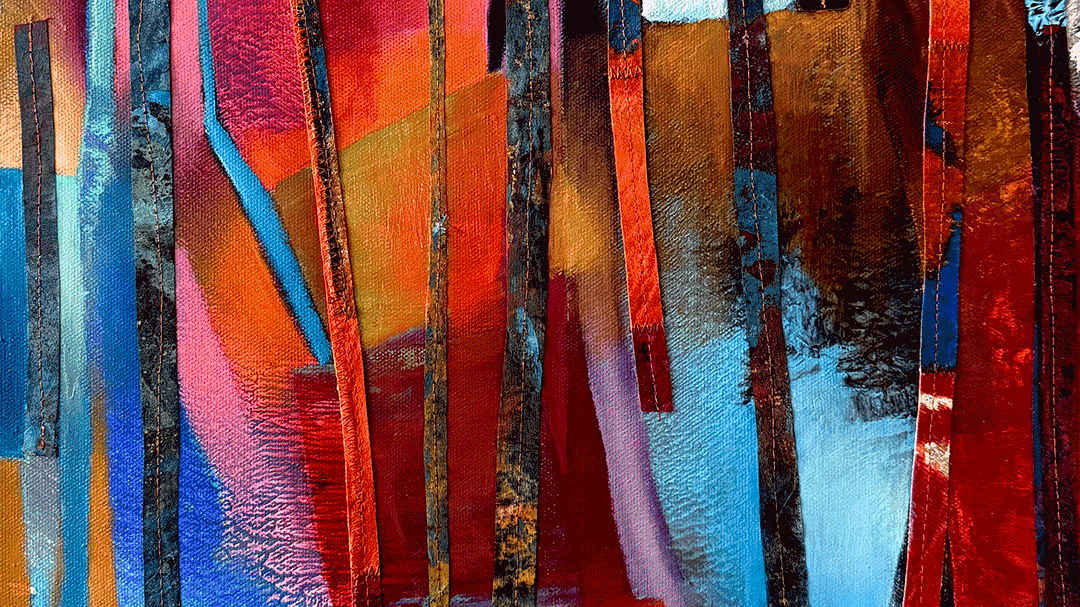
Miguel Barros is an artist shaped by movement, distance, and layered experience. Born in Lisbon in 1962, he carries with him a cultural mix that spans Portugal, Canada, and Angola. This breadth of perspective continues to inform how he sees and builds his work. In 2014, he relocated from Angola to Calgary, a shift that introduced new visual and emotional terrain, yet his connection to Lisbon remains central. Trained in Architecture and Design at IADE in Lisbon, Barros approaches painting with a structural awareness that never feels rigid. Instead, it becomes a quiet framework for exploration. His work moves between order and intuition, where geometry meets atmosphere, and where memory takes on physical form. Through this balance, he creates images that feel both constructed and deeply felt, rooted in place yet open to interpretation.
Barros’s paintings begin with a city, but not as it appears on a map. Lisbon exists in his work as something internal, recalled rather than observed. It rises through color, rhythm, and fragments of form. The word azulejo becomes more than a reference to tiles. It turns into a visual language, a way of organizing space and memory. Alongside it, the idea of Azul’Tejo carries both sound and image, linking the blue of the Tagus River with the broader identity of the city.
In his work, blue is not just a color choice. It holds weight. It suggests distance, air, water, and time. It moves across surfaces in a way that feels continuous, almost endless. This blue interacts with warmer tones—reds, oranges, and golds—that ground the compositions and prevent them from drifting too far into abstraction. The balance between these elements creates tension. The viewer feels both stability and movement at once.
His background in architecture is present, but it does not dominate. Instead of precise representation, Barros breaks structures into vertical and horizontal segments. Lines rise like beams or columns, dividing the surface into layered spaces. These elements recall buildings, streets, and facades, yet they never fully resolve into a single viewpoint. The result is a shifting environment, where multiple perspectives exist at the same time.
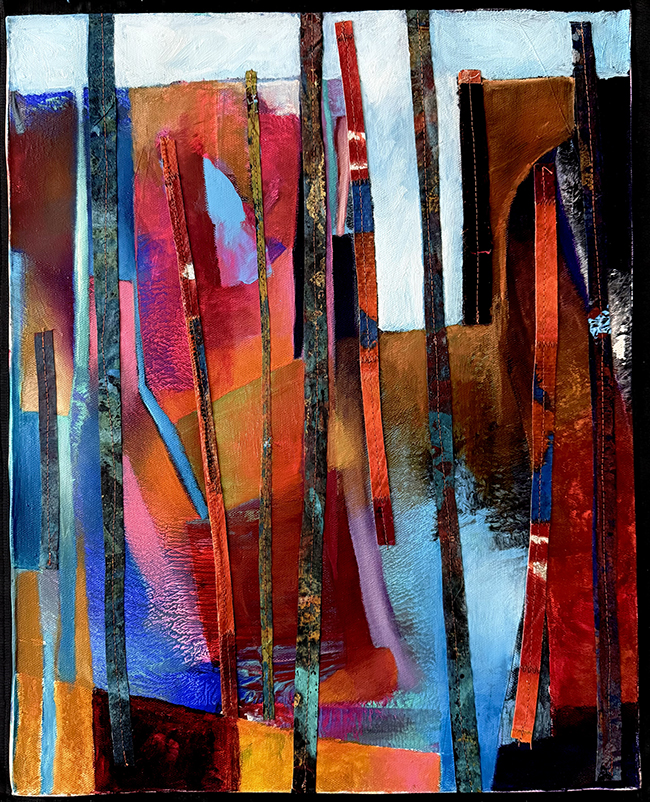
In The Old Cathedral of Lisbon, this approach becomes clear. The painting suggests an architectural presence, with arches and openings that hint at historical structures. Yet these forms are partially obscured, intersected by vertical bands that cut across the composition. These bands act like interruptions, or perhaps like time itself moving through the image. The cathedral is not presented as a fixed monument. It is experienced as something remembered, something filtered through emotion and distance.
The surface carries texture that reinforces this idea. Layers of paint overlap, sometimes revealing what lies beneath, sometimes concealing it. This process mirrors how memory works. It is not clean or linear. It builds, erases, and rebuilds over time. The viewer is not given a single, clear image but is invited to navigate through fragments.
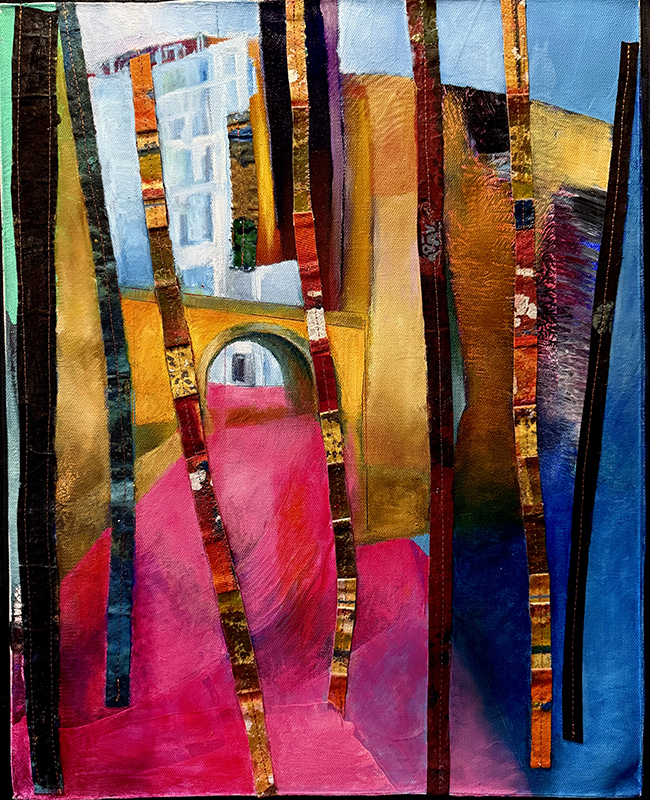
In The Pink Street Lisbon, the tone shifts slightly. The presence of pink introduces a different energy, one that feels more immediate and grounded in the life of the city. The composition still holds the same structural divisions, but the color creates a sense of warmth and movement. The street is not depicted directly. Instead, it is suggested through planes of color and directional lines that guide the eye inward.
There is a sense of walking through the space, even though the image remains abstract. Vertical elements continue to divide the scene, acting almost like figures or markers within the environment. They create rhythm, a repeated pattern that gives the painting a kind of pulse. The viewer moves between these elements, as if navigating a narrow street lined with shifting walls and reflections.
Across both works, Barros treats the city as something alive. It is not static architecture but a living surface that responds to light, sound, and memory. The idea of Lisbon as an “open-air gallery” becomes evident here. Every wall, every corner, every passage contributes to the whole. The paintings echo this by refusing to settle into a single focal point. Instead, attention moves across the surface, discovering new relationships between color and form.
There is also a quiet sense of longing present. The city is not physically in front of the artist, yet it remains close. This distance creates a different kind of clarity. Details are simplified, but the emotional connection becomes stronger. What remains is not exact representation but essence.
Barros’s work sits between abstraction and recognition. The viewer may not immediately identify specific locations, yet there is a familiarity that lingers. This balance allows the paintings to operate on multiple levels. They can be seen as studies of color and structure, but they also function as reflections on place, memory, and identity.
In the end, his Lisbon is not a fixed location. It is something that continues to shift and expand. Through color, line, and layered surfaces, Barros turns the city into an internal landscape. One that can be revisited, reassembled, and experienced again, each time slightly different.
