

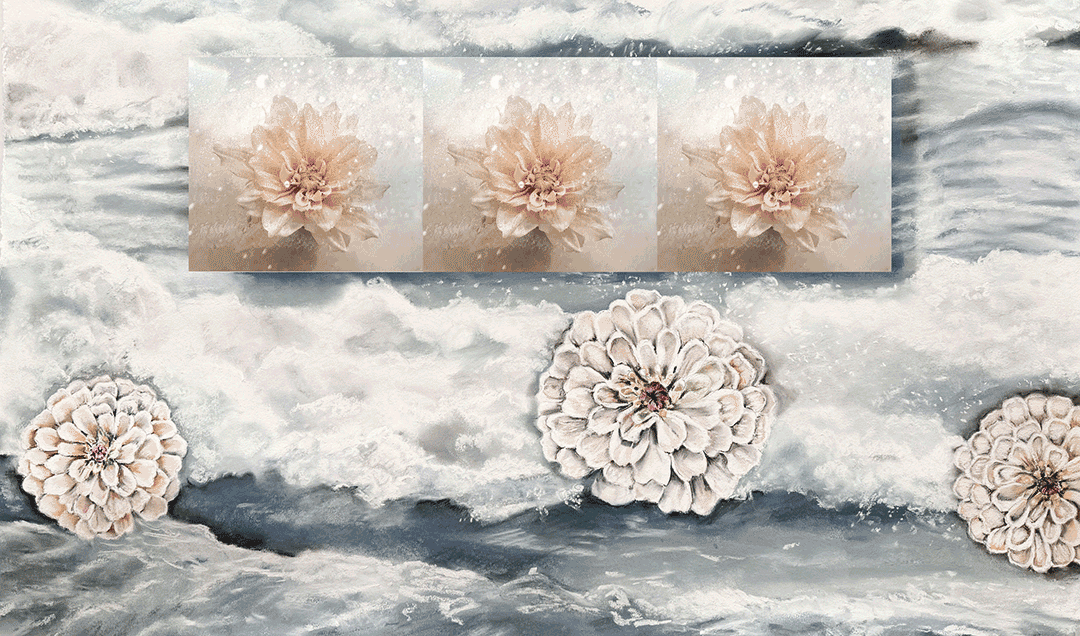
Nancy Staub Laughlin moves between disciplines with ease, working as both a pastel artist and photographer while allowing each practice to inform the other. Based in the United States, she holds a BFA from Moore College of Art in Philadelphia, a foundation that continues to shape her approach to composition and material. Over time, her work has been presented across galleries and museums along the East Coast, finding its way into both corporate and private collections. Critics have responded to her work with interest, including Sam Hunter, who described it as refreshingly unique. That response feels grounded in what her work does best: it resists easy categorization. Instead, Laughlin builds images that sit somewhere between observation and invention, where natural elements are reimagined through a careful balance of control and intuition.
At the center of Laughlin’s recent work is a conversation between water and form. In both The Floriferous Tides of Froth and The Blooming of Froth, she constructs environments where the ocean becomes more than a setting. It acts as a shifting surface, a place where movement, light, and structure meet. Waves are not treated as fixed shapes. They stretch, dissolve, and reassemble across the picture plane, carrying with them a sense of constant change. This movement creates a rhythm that guides the viewer’s eye, pulling attention across the surface without settling in one place for too long.
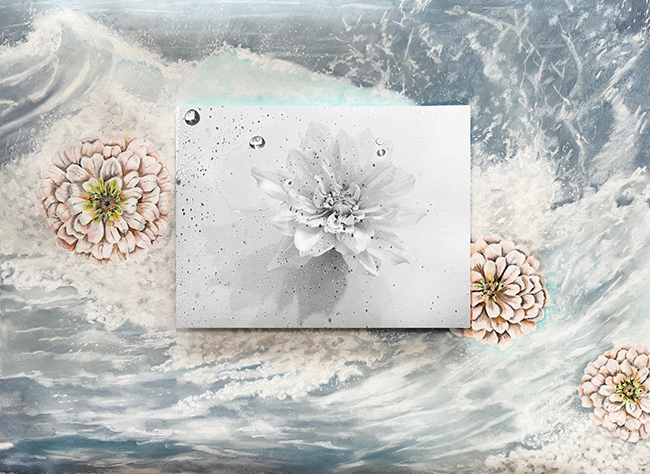
What makes these pieces distinct is the way floral forms emerge within that motion. The flowers do not sit on top of the water as decorative elements. Instead, they appear embedded within it, as if they have surfaced from the same energy that drives the waves. In The Floriferous Tides of Froth, the composition introduces a central image layered over the ocean backdrop. The grayscale flower at the center feels suspended, almost detached from the surrounding color, yet still connected through texture and form. Around it, softer-toned blooms echo the same structure, creating a dialogue between repetition and variation. The contrast between monochrome and muted color becomes a way of controlling focus, allowing one element to hold still while the rest continues to move.
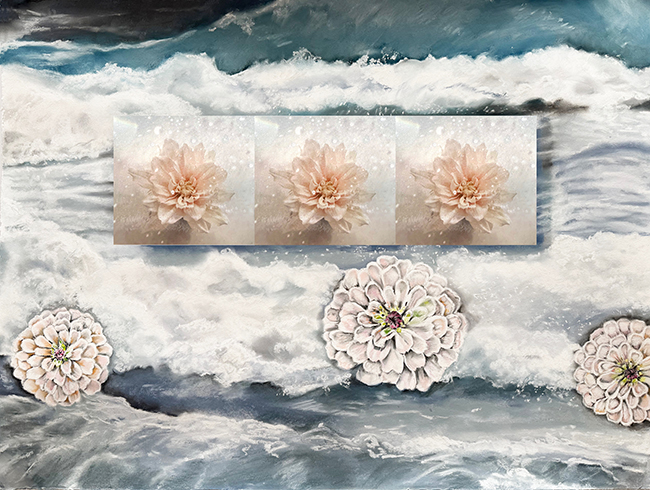
In The Blooming of Froth, this idea shifts. Rather than isolating a single central form, Laughlin expands the repetition. Three floral images stretch across the middle of the composition, creating a horizontal sequence that interrupts the vertical energy of the waves. This change in structure alters how the work is experienced. The eye moves laterally, following the rhythm of the repeated blooms, before returning to the turbulence of the ocean behind them. The flowers themselves feel softer here, their tones warmer, but they remain tied to the same underlying motion. They are not static objects. They seem to pulse with the same energy as the water.
Laughlin’s use of pastel on mounted photography plays a central role in achieving this effect. The photographic base provides a sense of depth and realism, grounding the image in something recognizable. Over that, pastel introduces softness, atmosphere, and a kind of tactile presence that photography alone cannot achieve. The surface becomes layered, both physically and visually. Light appears to sit within the image rather than simply reflecting off it. This combination allows her to shift between clarity and ambiguity, revealing certain areas while allowing others to dissolve into texture.
There is also a quiet tension in how these works handle space. The ocean suggests depth, an expansive environment that extends beyond the frame. The flowers, however, often appear flattened or slightly removed from that depth, existing in a more compressed visual plane. This tension creates a subtle push and pull. The viewer is aware of multiple spatial conditions at once, never fully settling into a single perspective. It is this instability that gives the work its sense of movement, even in stillness.
Emotionally, the work does not rely on direct narrative. Instead, it builds a mood through accumulation. The repetition of forms, the layering of textures, and the interplay between control and fluidity all contribute to a feeling that is difficult to define but easy to sense. There is a calmness in the palette, yet also an underlying energy that never fully resolves. The ocean can be read as both a place of serenity and a force of constant motion. The flowers, often associated with stillness or fragility, take on a different role here. They become part of that motion, no longer separate from the environment but fully integrated within it.
Laughlin’s work invites a slower kind of looking. It does not present itself all at once. Instead, it unfolds gradually, revealing shifts in texture, subtle changes in color, and small variations in form. The longer one spends with the work, the more these details begin to connect. What initially feels like a contrast between elements becomes something more unified. Water and bloom, movement and stillness, photography and pastel all begin to operate within the same visual language.
In these pieces, Nancy Staub Laughlin does not aim to document the natural world as it appears. She reshapes it, allowing different elements to merge and transform. The result is a body of work that feels both familiar and altered, grounded in observation but guided by imagination.
