

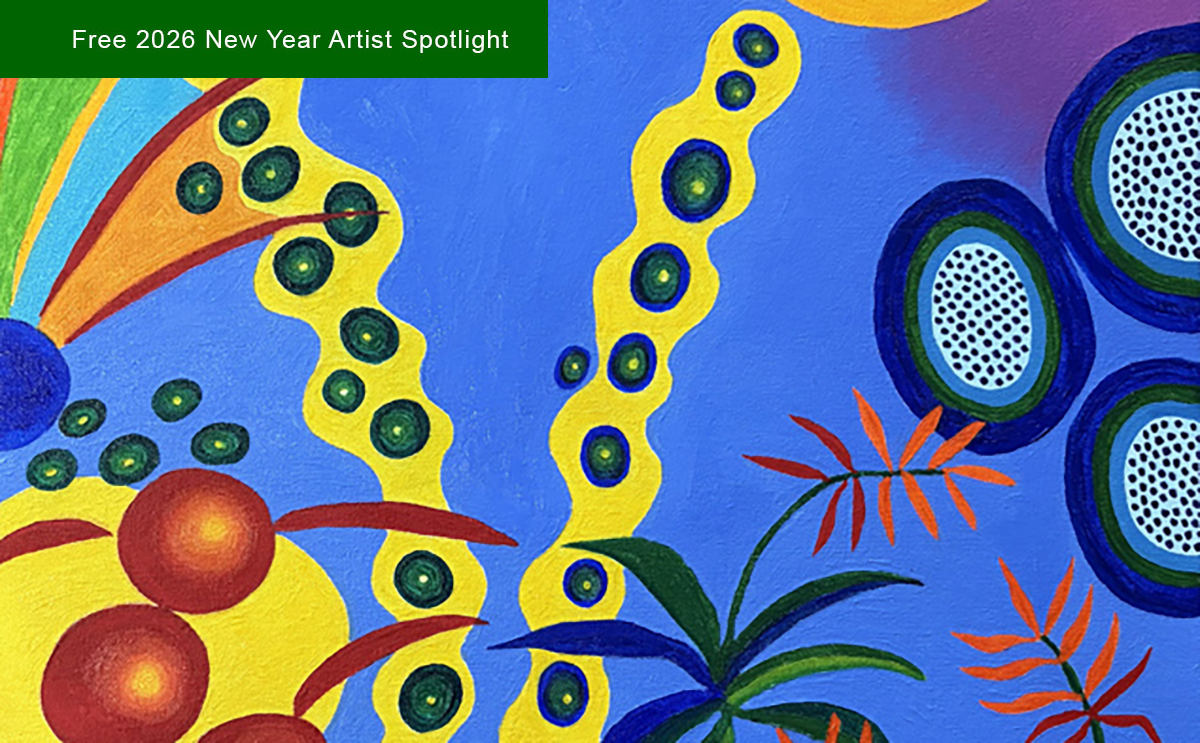
When Oenone Hammersley settled in Palm Beach Gardens in 2024, Florida’s lush environment quickly began to show up in her studio. She brings a practice informed by theatre design, years of travel, and a deep commitment to the natural world. Internationally recognized for mixed-media paintings that combine saturated color with tactile surfaces and glowing light, Hammersley often circles back to water—its shine, its movement, and its fragility. Her work has been exhibited in Palm Beach, New York, London, Paris, Washington D.C., and Miami, and is held in both private and public collections. The tropical gardens around her have become a daily source: layered leaves, repeating patterns, humid air, and those sudden bursts of brightness after a storm. Born in England in 1957, and shaped by travels through Southeast Asia, India, Africa, and Latin America, she merges hand-painting, multiple paint pours, and resin finishes to create paintings that keep environmental awareness close to the surface.
Hammersley approaches a canvas the way a designer builds a stage: with attention to pacing, focus, and atmosphere. Her theatre background shows in the way she organizes complexity. Color doesn’t just fill space—it directs the eye. Texture doesn’t sit quietly—it behaves like a physical element, something that creates depth and presence. The work can be visually dense, yet it rarely feels uncontrolled, because the composition always has an underlying structure.
Her travels widened the range of what she allows into the work—pattern as meaning, ornament as rhythm, landscape as something lived rather than observed at a distance. These influences don’t arrive as literal references. They show up as repetition, layering, and a sense of multiple environments overlapping inside one image—like different climates speaking to each other.
Water as beauty—and as warning
Water holds a central place in Hammersley’s work because it can be both soothing and unsettling. It can read as pure pleasure—light sliding across ripples, movement that relaxes the body. But it can also suggest vulnerability: pollution, disappearing ecosystems, and the quiet costs of human habits. Hammersley uses water as a way to speak about what’s at risk without turning the painting into a lesson.
Her focus is direct: deforestation, ocean pollution, and overfishing. She supports conservation organizations through regular donations, which anchors the paintings in action rather than symbolism alone. The work isn’t meant to stay contained within the art world. It gestures outward, toward real places and real consequences.
What makes her approach land is how she handles tone. She doesn’t rely on despair. Instead, she invites you in through beauty—through color, surface, and light—then lets the tension emerge slowly. The shift is subtle: admiration turns into attention, and attention turns into concern.
Florida’s gardens as a new source of momentum
Since arriving in Palm Beach Gardens, Hammersley’s tropical garden series has become a fresh engine for her ideas. Gardens are living, but they are also shaped and arranged. That dual nature gives her a strong visual tension to work with: organic forms meeting geometric order, growth meeting design.
The oil paintings carry motion. Leaves seem to multiply and overlap. Shapes return like echoes. Color travels across the surface and changes temperature—cool in one area, heated in another—so the image feels active rather than fixed.
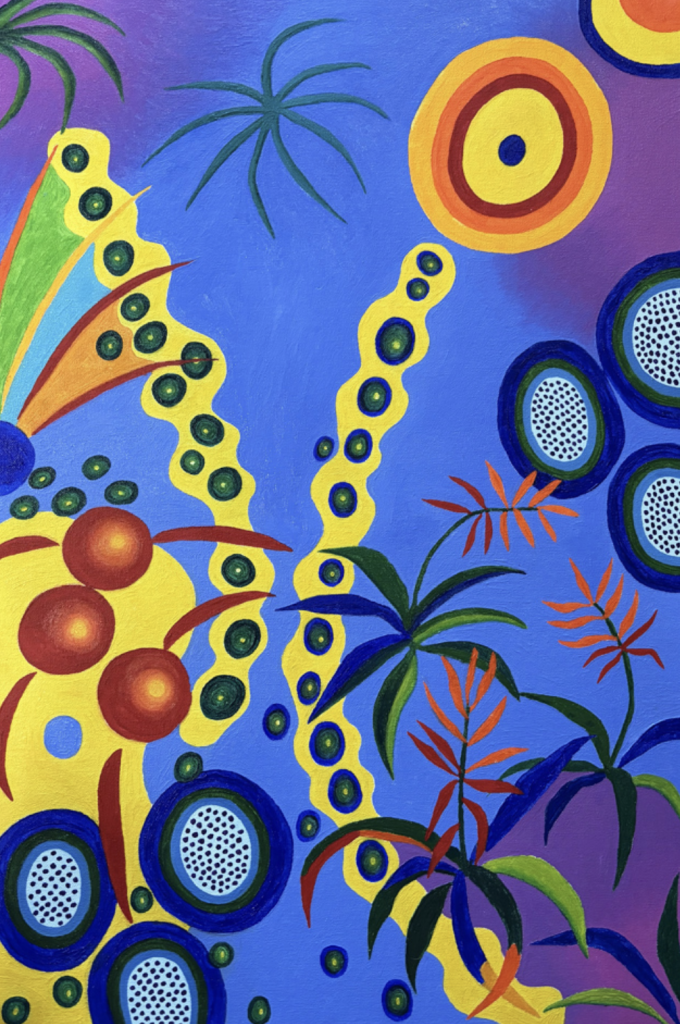
In Falling Seeds, Hammersley borrows the language of botany without turning it into a literal scene. The title suggests beginnings—small forms that contain an entire future. The painting translates that idea into floating, seed-like shapes and fragments that hint at pods, petals, and drifting organic pieces suspended in motion. Rather than depicting one plant, the work gathers many plant gestures—curves, clusters, droplets, bursts—and turns them into a charged field.
Color functions like a framework here, not decoration. The palette is bold but controlled, with high-energy zones balanced by quieter passages that give the eye space to breathe.
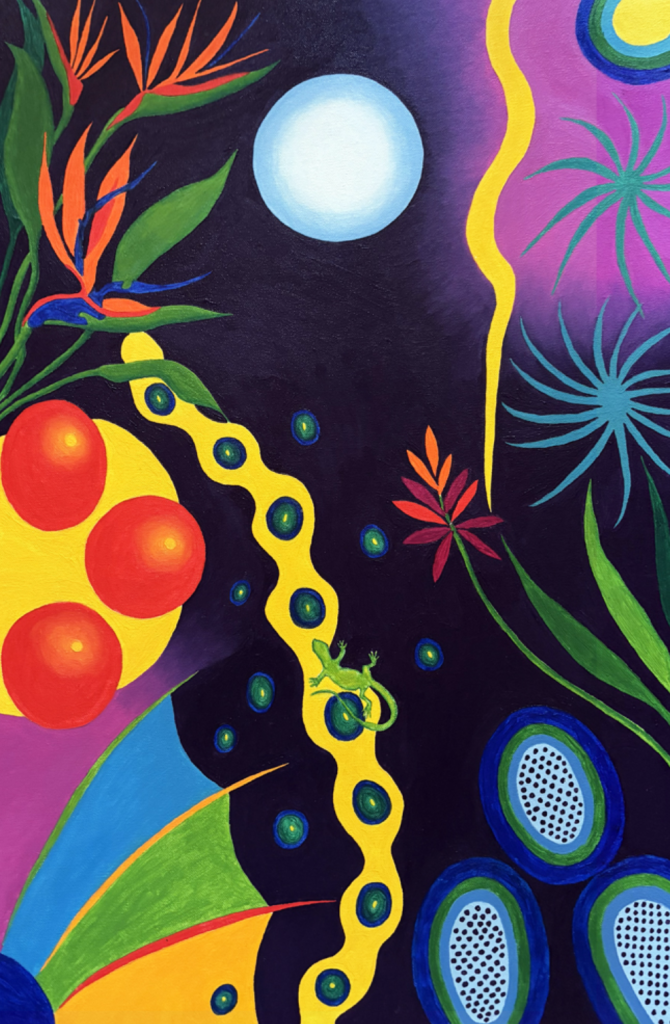
Midnight in the Garden moves into a more enveloping mood. Where Falling Seeds feels open and buoyant, Midnight in the Garden feels like stepping into dense vegetation at night—when shapes become less certain and color becomes more concentrated. The title sets the atmosphere, but Hammersley avoids illustration. She builds a sense of place through layered leaf-like forms, hidden patterning, and deeper tones that pull you inward gradually.
Midnight here isn’t absence—it’s intensity. Against darker grounds, color feels heavier, richer, more saturated. Her blend of organic shapes and geometric patterning becomes especially meaningful in this work. A garden is both wild and arranged, both free and managed. Midnight in the Garden holds that tension without resolving it, letting the viewer sit inside the contradiction.
Together, these two paintings show Hammersley’s strength: she creates work that doesn’t empty itself on first glance. It asks for time. It rewards slow looking. And beneath the color is a steady reminder—this beauty is real, and it’s not guaranteed.
You can see her Tropical Garden oil paintings in person at the Palm Beach Modern & Contemporary Art Fair (PB Convention Center), March 19–26, at the Walter Wickiser Gallery Booth.
For more information, visit: www.oenonehammersley.com
