
Miguel Barros was born in Lisbon in 1962, and his art carries the imprint of a life lived across several worlds. Time spent between Portugal, Angola, and Canada has given him an expanded sense of what “place” can mean—how it shapes identity, how it lingers in the body, and how memory can travel even when a person does. He trained in Architecture and Design at IADE Lisbon, graduating in 1984, and that foundation still shows in the way he approaches painting: with a sensitivity to structure, pacing, proportion, and the way space can be organized without losing emotion. When he moved from Angola to Calgary, Alberta in 2014, it didn’t sever his connection to home. Instead, it added another layer to his visual vocabulary. Barros continues to pursue a language that can hold multiple cultures at once—where surfaces become meeting points, and where lived experience turns into form, light, and color.
Barros’ paintings feel like they come from someone who understands “home” as something plural. Not a single fixed address, but a shifting set of references that overlap over time. In his work, migration isn’t treated as a headline; it shows up more quietly, in how colors suggest climate and mood, in how materials carry stories, and in how the picture plane behaves like a threshold—something you cross rather than simply observe. Travel, for him, isn’t a subject added after the fact. It’s part of the process itself, a way of working that keeps the studio open to movement and change.
His architectural background offers a useful lens for understanding his method. Architecture is essentially the art of layers: base, framework, skin, light, and the unseen systems that hold everything together. Barros brings that layered thinking into painting, building images through careful construction rather than a single, spontaneous gesture. Even when his surfaces appear airy or atmospheric, there is an underlying sense of design. Elements align with intention. Negative space is measured. Transparency isn’t decorative—it’s structural, used to create depth and guide the eye. The result is painting that feels “made” in the fullest sense: shaped through decisions that balance control with discovery.
What gives the work its particular charge, though, is the way Barros folds lived cultural experience into that structure. Portugal appears in his paintings as something felt rather than illustrated—a rhythm of color, a warmth of gesture, a pull toward tradition and memory. Africa, India, and Canada enter the same visual field, not as distant references, but as realities that have touched his daily life. Instead of relying on symbols, he often allows the materials themselves to speak. This changes the entire relationship between image and meaning. A textile is not just a surface; it’s a carrier of use, touch, exchange, and history.
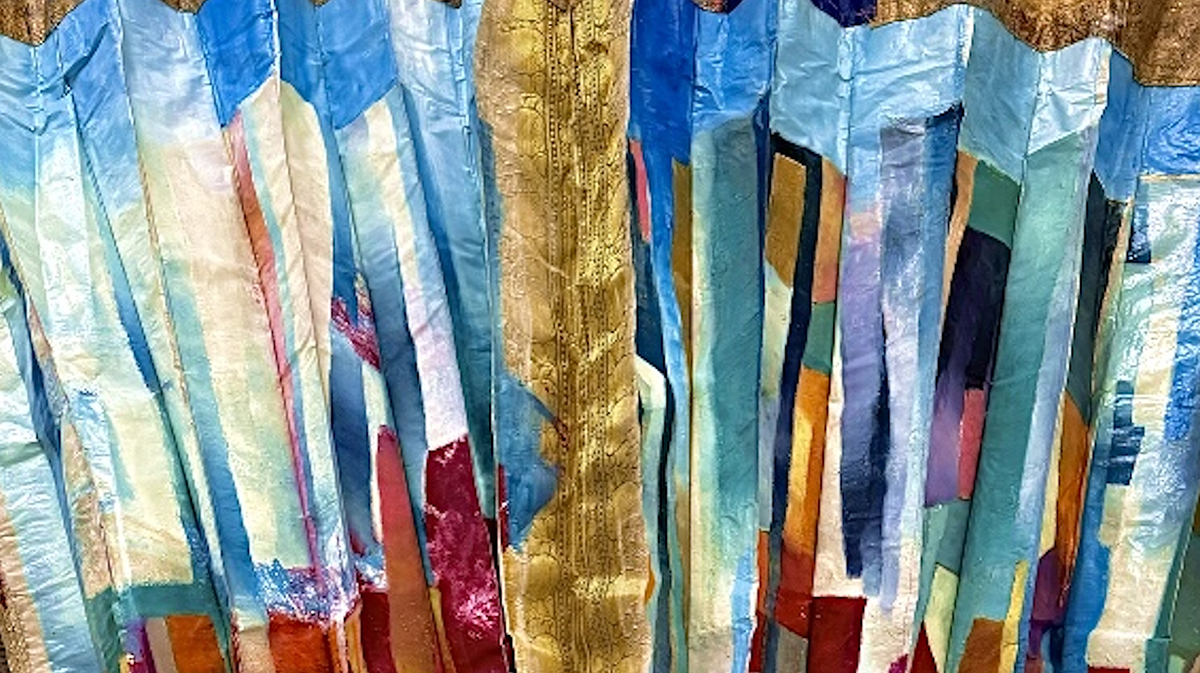
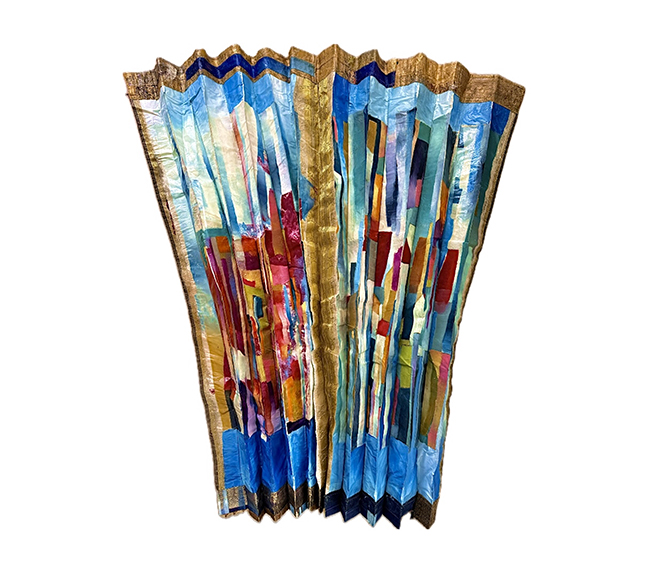
This is especially present in works made on fabrics such as silk sarees, African cotton capulanas, and Portuguese textiles like Chita bedspreads from Alcobaça, alongside cotton and paper. Each material arrives with its own identity—its weave, pattern traditions, cultural associations, and physical behavior under paint. A sari suggests both ceremony and daily life, dye and sheen, softness and strength. A capulana carries rhythm and social presence, a language of pattern that is both personal and communal. Portuguese Chita textiles evoke domestic memory and craft lineage. Barros doesn’t treat these as exotic backdrops. He treats them as evidence—physical traces of places that have shaped him.
There is also something deeply personal about the way these materials enter the studio: they were carried in his own travel luggage. That detail matters because it turns the paintings into objects of passage. The supports have been folded, transported, kept close, and then opened for work. The journey is not only metaphorical; it is embedded in the material life of the piece. These paintings become accumulations—of travel, time, contact, and labor.
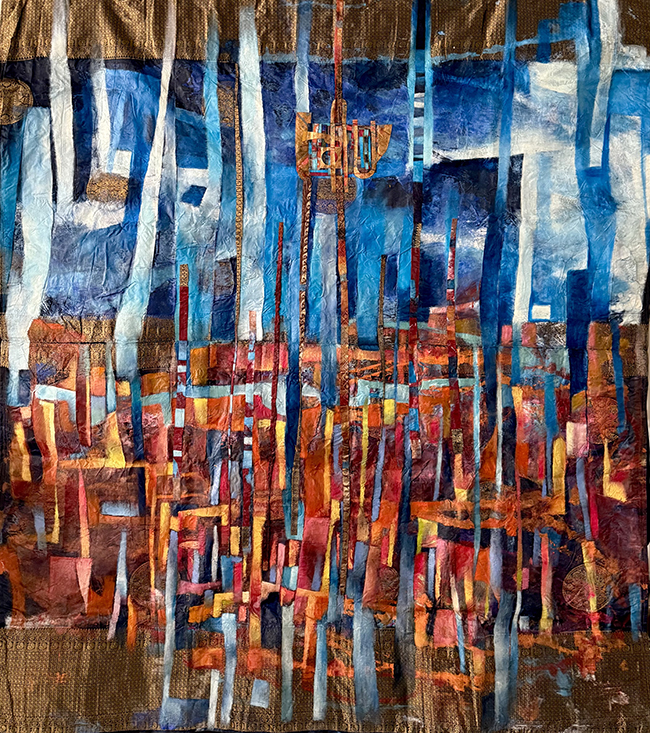
Barros also pushes each surface according to its limits. Fabric doesn’t behave like stretched canvas; it absorbs unevenly, resists in places, and can shift under repeated layers. Rather than fighting that, he uses it. Oil paint builds gradually in successive veils, allowing translucency to do much of the work. Light travels through thin films, creating a sense of depth that feels almost architectural—like looking through layers of glass or gauze. This dimensionality isn’t achieved through thick paint alone, but through optical space, where what sits beneath remains visible enough to haunt the surface.
From this layered approach, figures sometimes appear—rarely as direct portraits, more like partial presences. Faces, silhouettes, and shadowed forms drift into view and then recede. They feel like fragments of memory: desires, fears, uncertainties, moments that don’t fully resolve into a single story. In other passages, intricate shapes and dense color fields catch sharp lines of illumination, creating reflections that can feel mirror-like. The paintings sometimes suggest urban interiors or corridors—spaces that feel familiar but slightly dream-shifted, as if the city is being remembered rather than recorded.
Even with this inward, psychological quality, Barros’ work doesn’t close itself off. At its center is an insistence on human dignity and shared experience. He speaks about keeping people at the heart of the work—honoring what is true within different cultures and the generosity he has encountered across them. That perspective keeps the paintings from turning culture into decoration. Instead, the works suggest a grounded belief in universal needs—safety, joy, peace, connection—and in art’s ability to draw distances smaller without erasing difference.
The viewer becomes an active part of this exchange. Because much of the imagery is partly concealed, the paintings ask for time. They reward slow looking, and they change depending on light, distance, and the mood you bring to them. Meaning forms in the space between what is offered and what remains hidden. Barros seems to trust that each person will complete the work through their own memory and imagination.
In the end, Miguel Barros uses painting as a kind of translation—between climates and histories, between textiles and lived experience, between inner states and shared human ground. His work doesn’t argue for one homeland over another. It suggests identity can be layered, carried, unfolded, and rebuilt, again and again, into a visual language where structure holds emotion, and where borders become meeting points rather than walls.
