

Ruth Poniarski’s creative path bridges structure and imagination. A graduate of Pratt Institute with a Bachelor of Architecture in 1982, she spent a decade working in the construction industry before turning fully to painting in 1988. That shift marked more than a career change—it opened a new way to interpret the world. Through her surreal and psychological paintings, Poniarski blends myth, philosophy, and literature into layered visual narratives. Her art moves between the rational and the fantastic, where symbols, emotion, and human experience coexist in a delicate balance.
Who’s Game
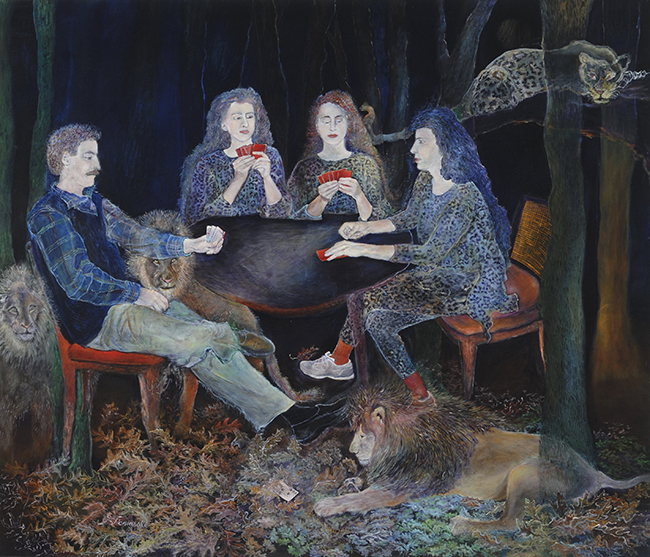
In Who’s Game, Poniarski turns a simple card game into a symbolic drama. Four players sit around a table deep in the woods, their faces calm but unreadable. The air feels dense with quiet tension. Beneath and around them, lions linger—silent witnesses or perhaps extensions of the players’ hidden instincts. The wild and the civilized meet here, not through violence but through an uneasy peace.
The setting—dim, nocturnal, and saturated with greens and deep blues—feels suspended between waking and dreaming. Light flickers across faces and cards, revealing and concealing thoughts, much like the games people play with one another in real life. Poniarski’s brushwork captures that balance between precision and dream, anchoring the figures in realism while keeping the mood ethereal.
Every element contributes to a layered allegory. The lions, emblems of strength and ego, seem to shadow their human counterparts. Each person’s body language hints at guarded emotions and unspoken rivalry. What begins as a card game becomes a meditation on human relationships—the power dynamics, the restraint, the subtle manipulations that define interaction.
The painting offers no resolution. There is no winner, no end to the game—just the eternal tension between reason and impulse, civilization and instinct. Who’s Game is both a stage and a mirror, inviting viewers to see themselves in the calm faces and the waiting lions.
Reflections
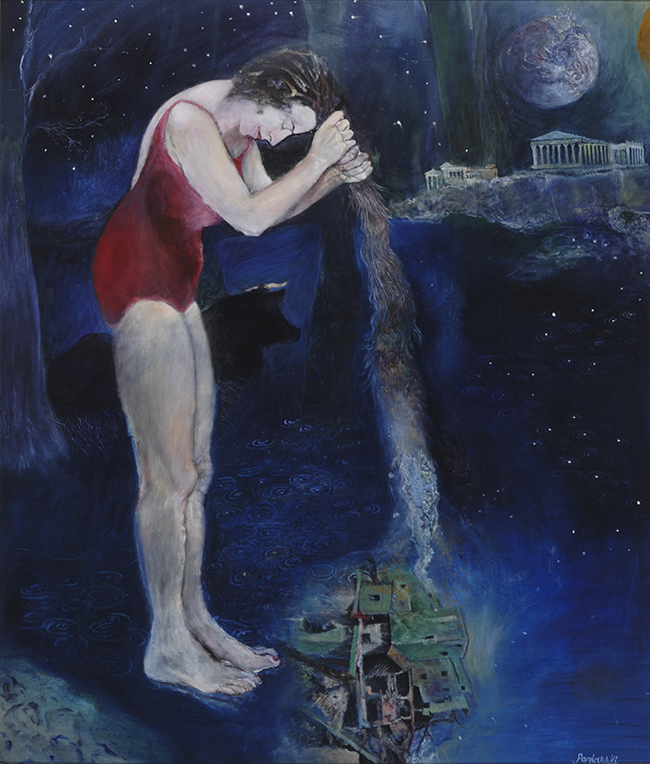
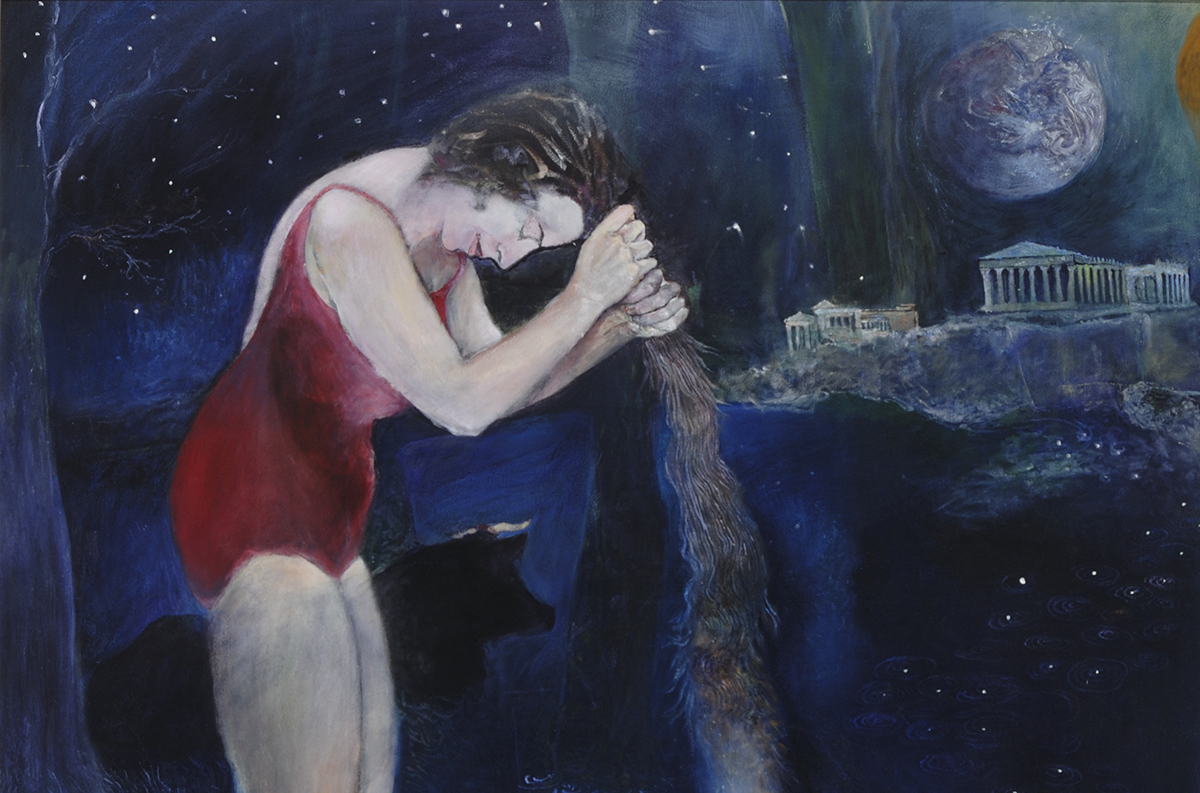
With Reflections, Poniarski shifts from the collective to the personal. A solitary woman, dressed in red, stands under a cosmic sky, wringing water from her long hair. The liquid flows downward into a surreal abyss where submerged buildings rest in silence. Behind her, ancient ruins stand against a moonlit horizon—a timeless reminder of creation and decay.
Here, Poniarski’s architectural roots emerge more visibly. The carefully rendered ruins and drowned structures suggest both destruction and reconstruction, as if the woman is draining one world to shape another. She becomes a mythic figure—part goddess, part artist—channeling energy from within to transform what lies below.
The palette of dark blues and violets enhances the work’s sense of introspection. Light falls gently across the woman’s figure, revealing vulnerability amid strength. Her downward gaze and the steady stream of water create a circular rhythm between release and renewal. The act of wringing her hair becomes an allegory for expression itself—the letting go of something deeply internal to bring forth something new.
In Reflections, time feels fluid. The submerged buildings may represent memory, while the celestial backdrop suggests infinite continuation. It’s as if the past and future exist together in the same quiet moment. Poniarski paints not only what is seen but what is remembered and imagined—an emotional architecture built from both loss and creation.
The World Beneath the Surface
Across both works, Poniarski examines the tension between order and chaos, intellect and intuition. Her background in architecture is always present, not through rigid design but through compositional clarity—every line and shadow feels deliberate. Yet her imagery resists confinement. She paints dreamscapes where the boundaries between human and animal, conscious and unconscious, dissolve.
What unites Who’s Game and Reflections is their exploration of control and surrender. One captures a silent struggle among people in the wilderness of their own instincts; the other shows a woman surrendering to a ritual of release and remembrance. Both speak to the complexities of being human—our need for structure and our simultaneous yearning for transcendence.
Ruth Poniarski doesn’t paint to escape reality but to expand it. Through her surreal realism, she turns the invisible—emotion, conflict, introspection—into something tangible. Her work invites quiet reflection, asking us to confront what lies beneath the surface of our own thoughts.
