

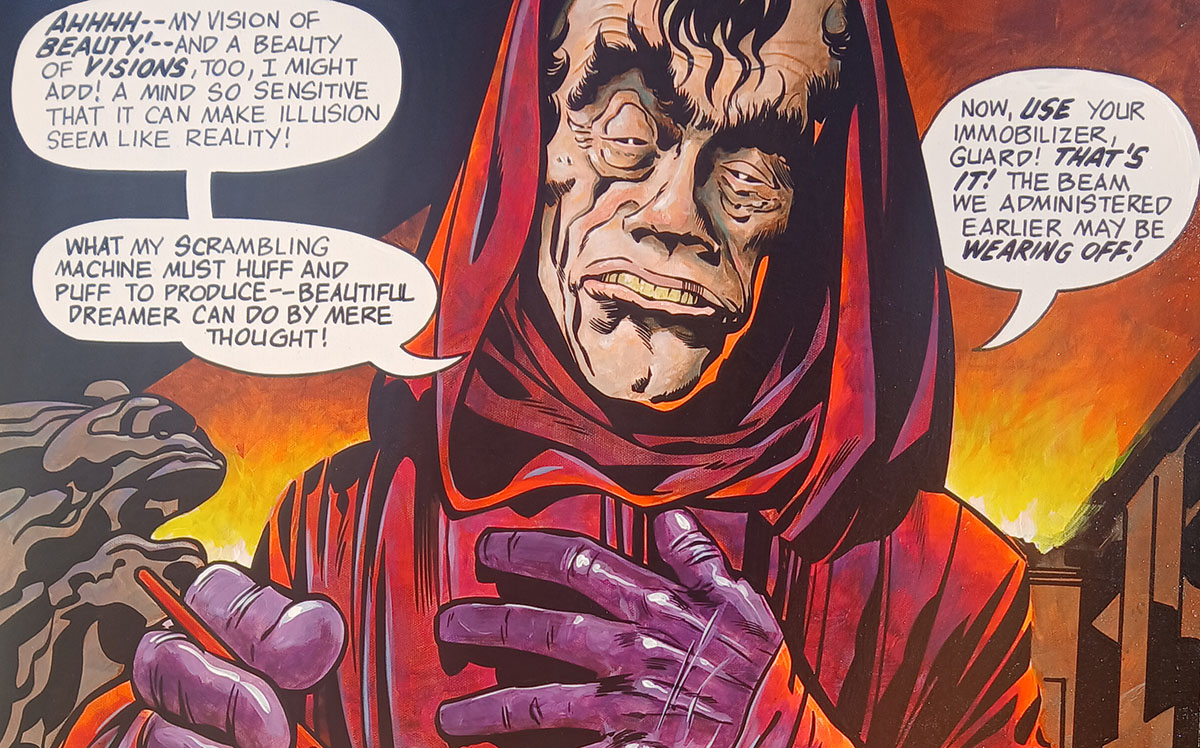
The name Peter Parker does not arrive quietly. It carries a long trail of comic book memory, a built-in sense of story, and a familiarity that immediately sparks curiosity. When a set of works is received under that name, it naturally raised a question. Is it genuine, or is it a deliberate reference? In the end, the distinction feels secondary. What holds more weight is the role connected to it.
Here, Peter Parker is not the one creating the paintings. He occupies a different space, one that often stays just outside the spotlight. His position is rooted in support. He encourages, backs, and helps sustain the artist behind the work. It is not a role that demands attention, yet it quietly shapes what can exist. The paintings themselves draw heavily from the visual structure of American comic books, realized through the work of artist Pete “PG” Garcia. Together, this creates a layered situation where authorship, influence, and support intersect rather than stand apart.
There is a clear directness in these paintings. They do not hesitate or soften their impact. Instead, they move forward with a firm visual intent, grounded in the traditions of American comic art. This can be seen in the compositions, in how the image is paced, and in the way each element pushes for attention while still holding the overall balance. The work carries traces of different comic eras, from early storytelling formats to later, more expressive and dynamic phases.
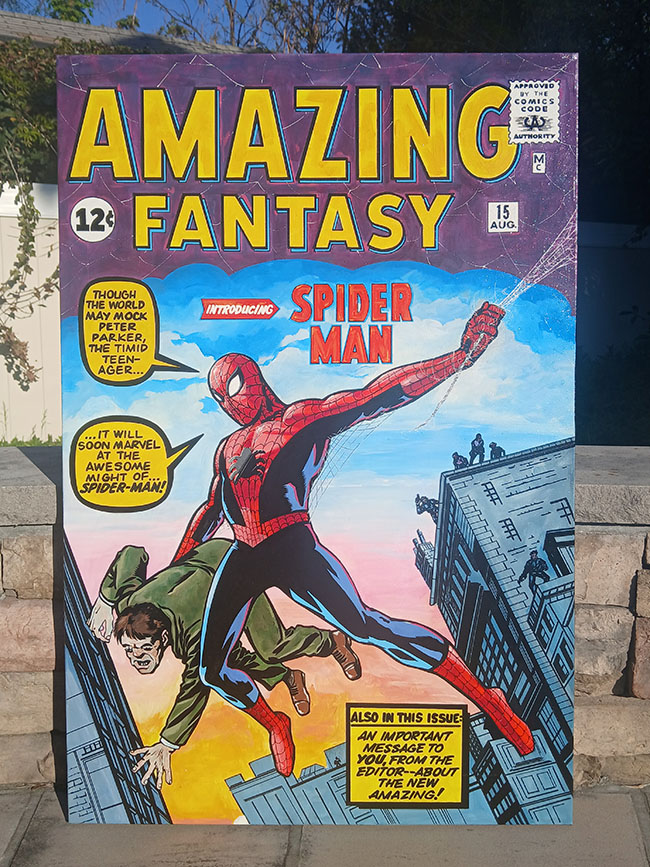
The piece centered on Dessad from Forever People #4 offers a strong example of this direction. Dessad is not a quiet or restrained character. He is built to disturb. Coming from the world of Apokolips, he serves Darkseid, but not in any simple or straightforward way. His presence exists within a structure of fear, power, and calculation. There is always a sense that something sits beneath the surface. He appears loyal, yet there is tension in that loyalty. He follows, but with an awareness that makes him unpredictable.
This sense of contradiction carries into the visual treatment. The figure does not feel settled within the frame. There is tension in the posture, in the way the lines tighten around the body, and in how the surrounding space feels dense and compressed. The image holds itself in check, as if containing something that could easily spill out. That restraint creates unease. It is not chaotic, but controlled in a way that feels deliberate.
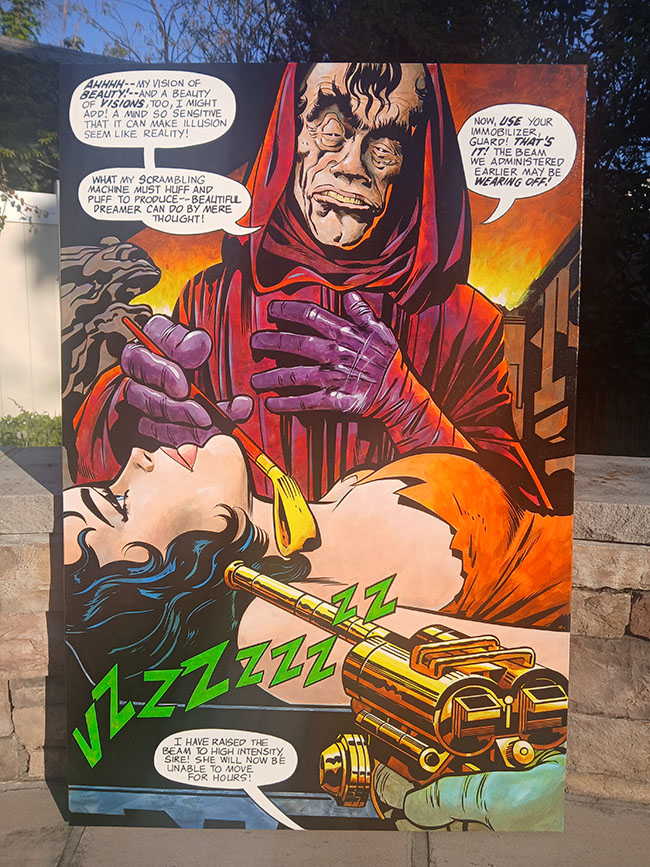
The visual language used to shape Dessad follows traditions established in classic comic work, especially the bold and structured approach often associated with Jack Kirby. There is a strong focus on form and silhouette. Shapes are pushed slightly beyond realism, enough to heighten emotion while keeping the figure clear and readable. This clarity is essential in comic-inspired imagery, where impact often depends on immediate recognition.
Color, when used, does not act as decoration. It works as a signal. It directs the eye, builds contrast, and strengthens the emotional tone of the scene. In a character like Dessad, color tends to lean toward extremes. It reinforces both instability and control at the same time. Even in stillness, the image feels active.
What adds another layer to this body of work is the separation between the name it arrives under and the artist who creates it. The paintings are made by Pete “PG” Garcia, yet they come forward through the name Peter Parker. This creates a subtle shift in how the work is perceived. It highlights the idea that art does not always come from a single visible source. It can be supported and made possible by someone who remains just outside the frame.
In some ways, this reflects the structure of the comic world itself. A single image often carries the effort of multiple contributors, even if only one name is most visible. Writers, inkers, colorists, and editors all play a role in shaping the final result. Here, that kind of structure appears in a more personal form. The supporter and the artist move alongside each other, both essential to what ultimately becomes visible.
The choice of Dessad as a subject deepens this reading. He is a character built on hidden motives and layered intent, and that mirrors the way the work itself is presented. There is a quiet alignment between subject and structure. The image does not only represent the character. It also reflects the conditions behind its creation.
This is where the work settles. It does not try to simplify or resolve these layers. Instead, it allows them to remain present. The name, the support, the artist, and the subject all exist at once. That tension gives the work its edge. It is shaped not only by what is shown, but by the circumstances that bring it into view.
