
Silas Rowan, also known as Rong Jingyu, has a clear way of explaining why he makes art. He says that art, for him, isn’t a performance. It isn’t decoration or a show of technique. It is a way of speaking the truth and waking up the parts of the mind that have gone quiet. He doesn’t care about external forms or stylistic polish. His interest sits with what is underneath—what the mind hides, what the spirit forgets, and what people ignore because it feels easier that way. His work often looks inward, toward the territory where instinct meets confusion and where perception is shaped by forces that few people notice.
Rowan’s approach comes from a personal belief that clarity isn’t automatic. Most people move through their days with borrowed opinions, borrowed fears, borrowed strength. He tries to remind viewers that the inner voice can be drowned out by subtle influences, the kind that shape thought long before someone realizes it. His art follows this thread. Every piece is an attempt to lift a veil, even if only slightly.
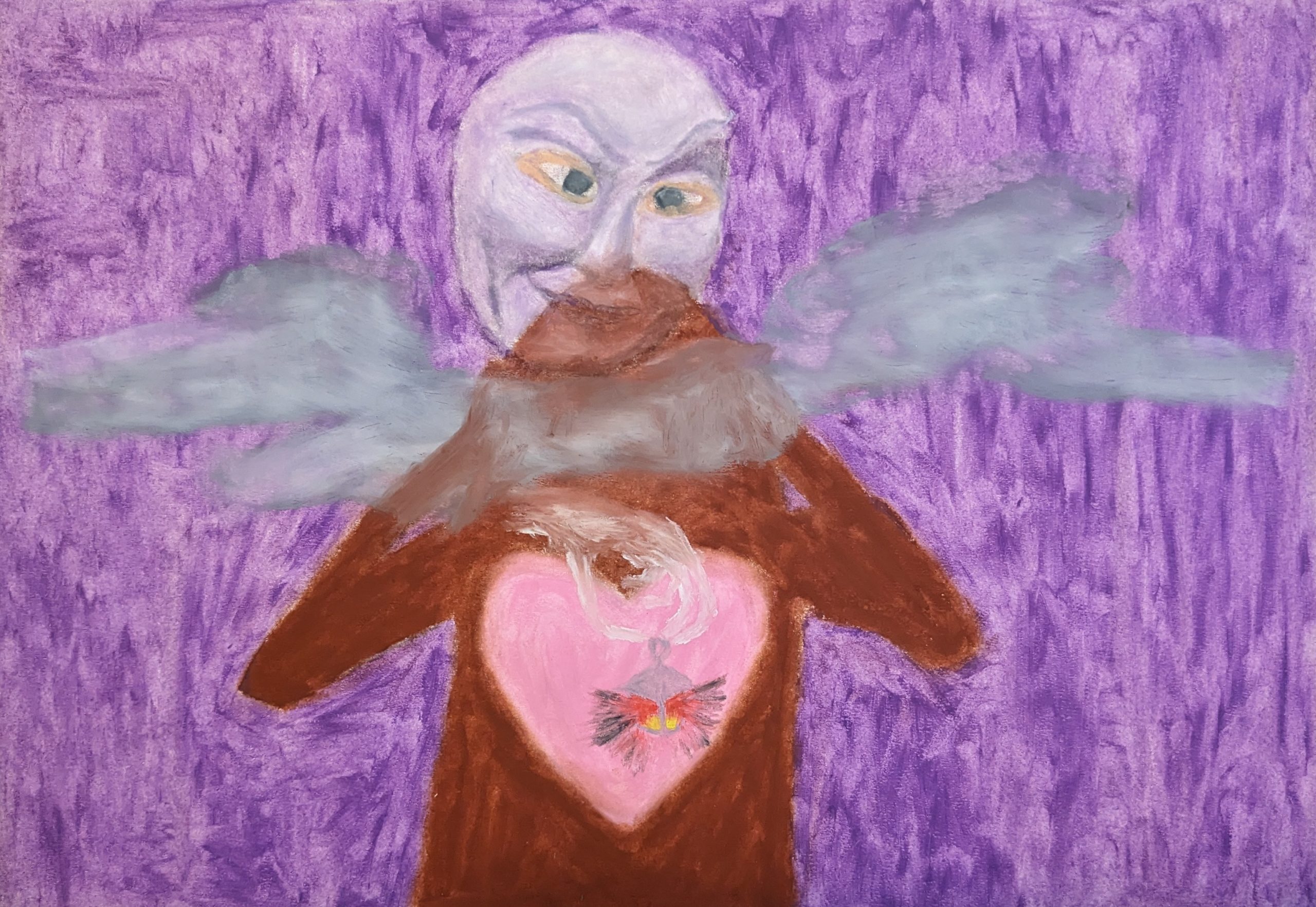
His 2025 oil pastel work Real or Illusion is a clear example of this intention. The image shows a figure with a pale, mask-like face set against a rough, purple ground. The face is expressive but hard to name—part watcher, part trickster, part wounded presence. There is no attempt to make the figure beautiful or polished. Rowan lets the texture stay raw. The purple background presses forward, almost vibrating. The figure’s body is painted in earthy brown tones, and at the center of the chest sits a pink heart-shaped opening containing a small creature with outstretched wings. It looks like a tiny bird or an emblem of something alive and fragile.
Around the figure’s neck and shoulders, gray smoke curls outward, cloud-like but heavy. It obscures, blurs, and disrupts. It sits between the viewer and the figure’s inner world. This hazy barrier becomes the visual stand-in for the ideas Rowan describes—those quiet influences that drift in unnoticed until they become hard to separate from one’s own thoughts.
The written description of the work deepens this. Rowan writes: “Some dwell in shadow, weaving quiet influence, blurring truth. Ever-watchful, they echo your deepest intuitions, making whispered guidance feel like inner knowing—a subtle art that dims the soul’s own light, replacing authenticity with borrowed shadows, where clarity fades and one’s true voice is lost beneath the weight of unseen manipulation.” His words read like an explanation of both the painting and the world it points to. The figure in the artwork holds this tension. It seems aware of the manipulation yet tangled in it at the same time.
There is also a contrast between the heart and the smoky veil. The heart space feels open, gentle, almost childlike. The small winged creature suggests a core of innocence or truth—something still alive despite the layers around it. But the smoke drifts across it, hinting at how easily clarity can be blocked. Rowan leaves it unresolved, which matches his view that art should not soothe or settle things too neatly. He prefers a work that leaves the viewer questioning what they’re seeing, and even questioning their own mind.
Real or Illusion also shows the way Rowan balances symbolism with directness. He doesn’t hide behind complicated imagery. The figure is right there, looking out. The heart is visible. The smoke moves openly across the chest and throat. But the meaning is not handed over. It remains suspended, asking the viewer to sit with discomfort and examine what might be influencing their own perception. This is part of Rowan’s quiet insistence on authenticity. He shows something difficult, but he doesn’t force an answer. He simply makes space for one.
In conversation, Rowan often says he is not interested in performance. This becomes clearer when looking at the pastel surface of the painting. The strokes are rough, almost stubbornly so. They reject the desire to impress. They stay close to the feeling he wants to express—an unstable vision, something shifting, something that does not want to be fixed or controlled. The face of the figure carries a complex expression that could be read as knowing, amused, or haunting. This uncertainty is the point. The painting asks whether what we see is real, or if it is shaped by forces we don’t recognize.
Silas Rowan’s work sits in this borderland between intuition and distortion. He invites viewers to step into that space with honesty, even if it feels uncomfortable. In Real or Illusion, he offers a reminder that awakening doesn’t come from certainty. It comes from paying attention to the shadows, questioning what feels familiar, and listening for the voice that lives underneath all the noise.
