
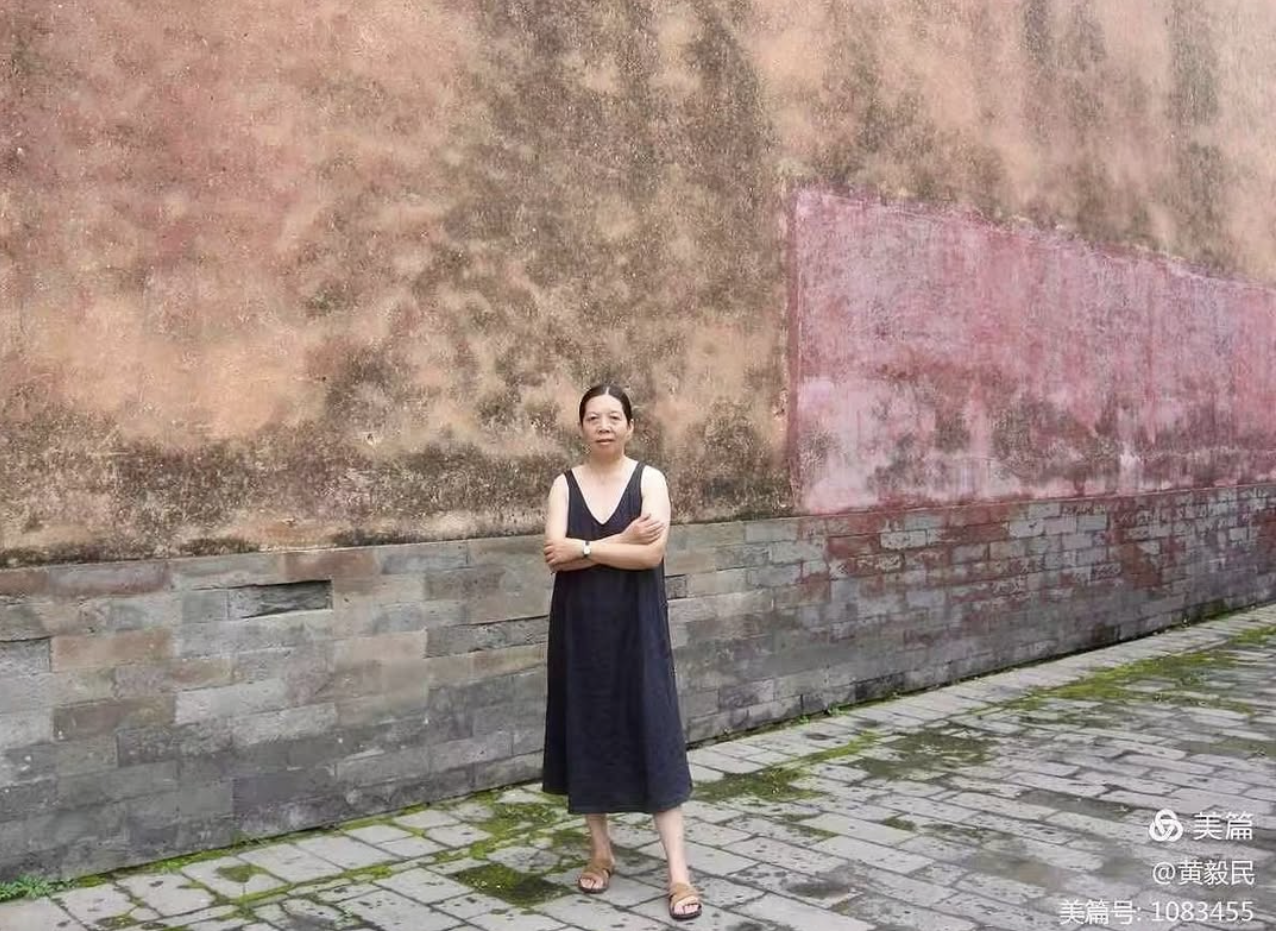
Huang Yi Min’s story begins in Shanghai in 1950, but the places that shaped her most deeply are Beijing and, later, New York. Her life moved between upheaval and quiet observation, between cultural disruption and personal persistence. She studied at the Fine Arts Department of Beijing Normal University and eventually immigrated to the United States in 1997 as an outstanding talent. By then she had already lived several lives—student, young farmer, art editor, and painter working against the tide of a society in flux.
Her early relationship with art started at age ten, when she was selected to join the painting group at Beijing Youth Palace. The studio was inside Shou Huang Hall, a Ming Dynasty structure in Jingshan Park facing the Forbidden City. For nearly a decade, she absorbed traditional aesthetics not from textbooks, but from the daily atmosphere of a historical site. The scent of old wood, the structure of the palace spaces, and the quiet cultural gravitas left a permanent imprint on her way of seeing. This formative period built the foundation for the visual memory that fuels her later work.
Everything changed in 1966. At sixteen, like the rest of her generation, she was swept into the Cultural Revolution. Her studies were halted. Traditional culture was dismissed, and she was sent to rural fields to labor as a farmer. Yet this period did not silence her. She kept sketching—streets, bus stations, markets, neighborhoods, and parks. Beijing became both her subject and her teacher. Without formal instruction, she painted from observation, storing details of a city that would soon disappear under waves of modernization.
Huang often says that only what she sees in reality becomes paint, but her reality is layered. Over decades she learned to merge the visible with the imagined, the remembered with the symbolic. Her landscapes from the 1970s through the 1990s carry this blend. They show everyday China with affection, a lyrical sensibility, and an almost abstract looseness that still holds onto the emotional charge of lived experience. Many of the locations she painted no longer exist. The demolition of old districts was unintentional preservation for her—her paintings now stand as records of vanished streets, shifting habits, and a period of rapid cultural transition. These were painted outdoors, riding a bicycle with an oil box, placing memory, weather, sound, and atmosphere directly onto the surface.
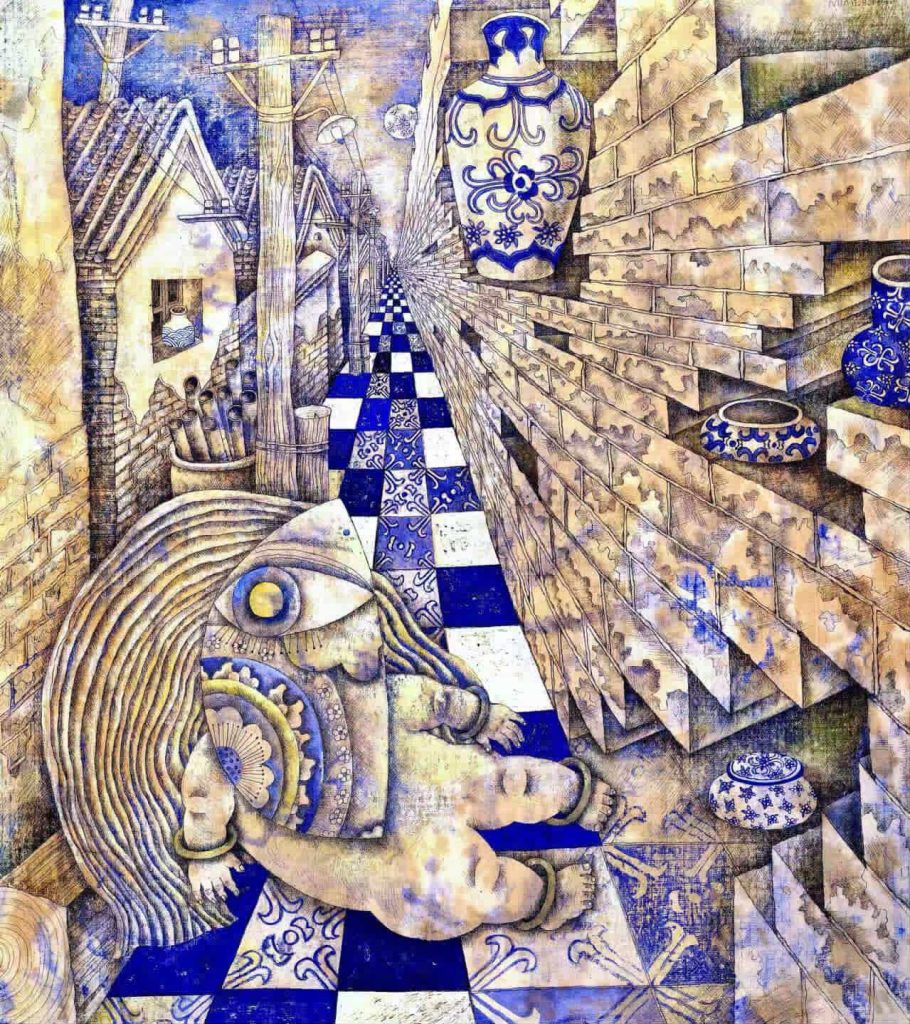
In the 1990s, her work expanded into a long-term project she calls Forbidden City Freedom. This series is rooted in the intersection of Beijing’s imperial past and the life of contemporary residents living around it. It’s a continuum that bridges the Ming Dynasty palace complex with modern apartment blocks, creating a surreal but grounded fusion. She developed this series over more than twenty years, shifting scale, experimenting with materials, and deepening her visual language.
Her compositions often use geometric forms—circles, squares, rectangles, triangles—to adjust rhythm, density, and emotional tone. These shapes intervene in scenes of people, animals, and totems, creating a tension between order and narrative. Huang’s goal has been to move beyond daily emotions like joy or sadness and toward a refined emotional vocabulary that describes something more universal and harder to name. The result is warm yet tense, gentle yet sharp, dreamlike yet anchored in tangible memory.
The Forbidden City Freedom series drew the attention of The New York Times, which wrote that her paintings combine “memory and fantasy in complex amalgams of ancient and modern images,” creating a dream world that merges archetypes with specific observations. This description captures the way her work lives between eras—never purely historical, never purely imaginary.
Her art career developed steadily after immigrating to the United States. While working from New York, she continued to maintain ties with Beijing, letting the two cities shape her perspective. She won the Anna Walinska Academic Achievement Award and received coverage from outlets such as Art News and World Art Post. Her paintings have been collected by directors and private collectors connected to institutions including the Singapore Museum of Art, Hong Kong Museum of Art, Sibin Art Gallery in Singapore, the New York Crystal Art Foundation, the Newark Museum of Art, and others.
Today, Huang continues her practice across both New York and Beijing. Her work still circles back to the Forbidden City, not as a single place but as a symbol of remembered time and shifting identity. She paints from her belief that drawing and painting are the eyes of life, a merging of subjective and objective worlds. Her ongoing series reflects her progress through changing decades—Cultural Revolution trauma, urban transformation, immigration, and the private work of turning experience into visual language.
The Forbidden City Freedom project remains open. She keeps returning to it, refining the way she balances reality with surrealism, place with memory, and personal history with collective change. Through it, she continues to show another image of Beijing—one that exists only through the lens of lived experience and the quiet persistence of an artist who refused to let history silence her.
