

Sigrid Thaler is an Italian artist based in Milan whose practice is shaped as much by geography as by inner reflection. Born in Italy and raised in a small mountain city, her earliest experiences were rooted in close contact with nature—its rhythms, silences, and quiet authority. Over time, her life expanded outward through travel and residencies in Austria, Paris, Singapore, and São Paulo, placing her in dialogue with Nordic, German, and global cultures. These movements did not fragment her vision; instead, they layered it. Thaler’s work reflects a steady interest in how environment, culture, and personal choice intersect. Rather than chasing spectacle, she gravitates toward stillness, presence, and the space where observation becomes acceptance. Her paintings invite a slower way of looking—one that mirrors her belief that meaning does not need to be forced or perfected, but simply allowed to exist.
Walking in Beauty — The Work
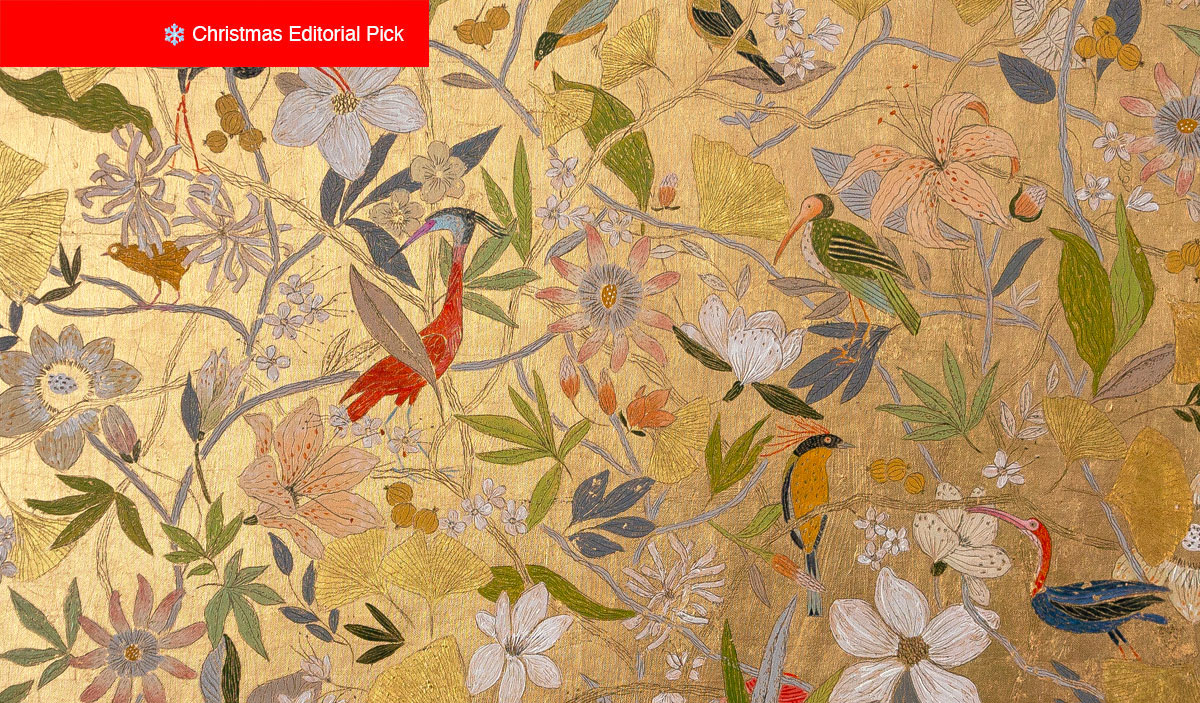
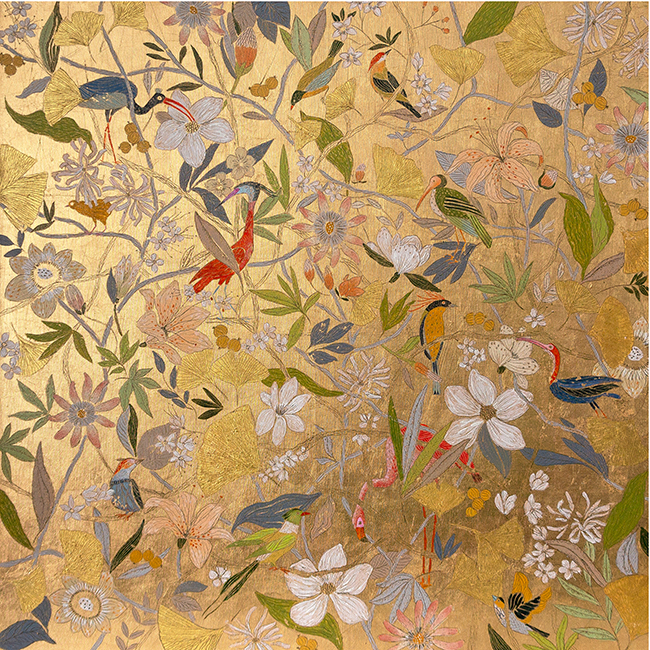
WALK IN THE BEAUTY (2022) stands at the center of Sigrid Thaler’s gold leaf series, both materially and philosophically. Measuring 39.5 x 39.5 inches, the work combines gold leaf and acrylic on canvas, a pairing that immediately signals contrast: the ancient and the contemporary, the reflective and the grounded, the symbolic and the tactile. For Thaler, gold is not about luxury or display. It is a surface that brings calm. She has spoken about how painting on gold leaf gives her serenity, and that quiet emotional state is woven into the finished work.
Gold leaf has a long history in spiritual and sacred contexts, yet Thaler approaches it without dogma. In WALK IN THE BEAUTY, gold functions less as a declaration and more as a field—one that absorbs light, reflects change, and responds to the viewer’s movement. It refuses to remain static. As the day shifts, so does the painting. This subtle instability echoes one of the work’s core ideas: nothing needs to hold a fixed pose in order to be whole.
Layered over the gold, acrylic forms suggest natural movement rather than direct representation. Thaler does not attempt to copy nature. Instead, she responds to it. The gestures feel organic, as if guided by growth patterns rather than strict design. This approach aligns with her belief that nature is complete precisely because it does not aim for flawlessness. Nature simply exists, and in doing so, becomes both unique and expansive.
The title, WALK IN THE BEAUTY, is not metaphorical. It is an instruction—quiet, but firm. Embedded in the work is a reflection on how much energy people spend striving to become something else: more successful, more polished, more acceptable. Thaler questions this endless reaching. The painting suggests another option: choosing presence over pursuit. Not withdrawing from life, but inhabiting it fully, without comparison or urgency.
This philosophy is visible in the composition. There is no central point demanding attention, no hierarchy insisting on where the eye should land. Instead, the surface invites wandering. Viewers are free to move across it, pause, return, and notice new relationships between form and light. The experience mirrors the idea of “just being”—a state where attention exists without pressure.
Thaler’s background in multiple cultures is present here, not as quotation but as sensibility. The restraint and clarity often associated with Nordic environments, the reverence for material found in Central European traditions, and the openness influenced by broader global contexts all quietly coexist. Yet the work never feels crowded with reference. It remains spacious, intentional, and calm.
Importantly, WALK IN THE BEAUTY resists spectacle. In a time when speed and visibility often dictate creative choices, Thaler’s work asks for patience. The gold leaf does not shout; it breathes. The acrylic does not dominate; it converses. Together, they form a surface that holds space rather than demands it.
What makes this piece resonate is not technique alone, but clarity of intention. Thaler does not position art as an escape from life’s tensions, nor as a solution to them. Instead, she offers a reminder: fulfillment may require far less effort than we assume. The act of deciding—choosing how to live, how to see, how to stand within one’s own experience—can be enough.
WALK IN THE BEAUTY ultimately functions as both artwork and quiet companion. It does not instruct through argument or explanation. It simply exists, steady and reflective, inviting viewers to slow down and consider the possibility that happiness is not something to be achieved later, but something that begins the moment we decide to be present.
