

Vandorn Hinnant was born in Greensboro, North Carolina, in 1953, and his practice has always lived at the intersection of making and thinking. From the start, art wasn’t just a skill to him—it was a tool for asking questions about how we live, what we value, and what shapes us. He earned a B.A. in Art Design from North Carolina A&T State University, then deepened his command of three-dimensional form through sculpture studies at the University of North Carolina at Greensboro. That mix—design discipline paired with sculptural training—shows up throughout his career: his work is built with clarity and intention, but it also leaves room for symbolism, intuition, and layered reading. Now based in Durham, Hinnant is especially recognized for public projects that turn shared space into a place of reflection—works that encourage people to slow down, look closely, and reconsider ideas like leadership, dignity, and collective memory.
“A Monument to Leadership at FSU” — rising by design
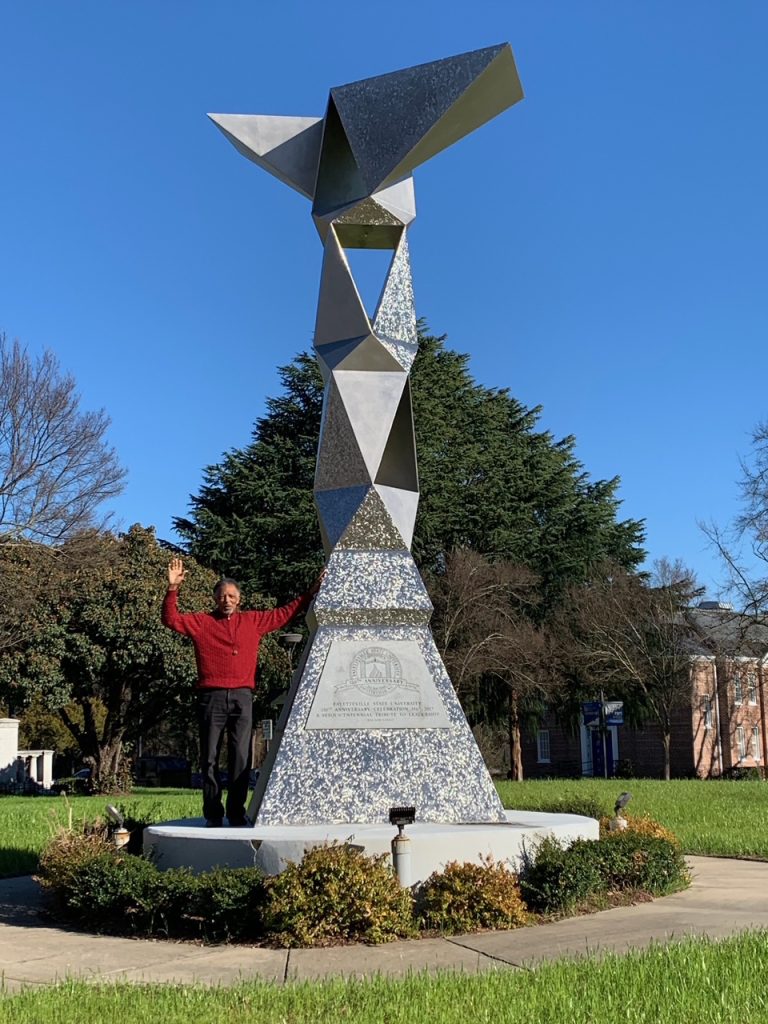
At Fayetteville State University, A Monument to Leadership stands like a tall, concentrated statement—somewhere between a ceremonial marker and an architectural spine. It doesn’t sit quietly in space; it feels like it’s reaching. The structure implies an upward spiral, guiding the eye in a steady climb rather than offering a single, fixed viewpoint. The piece is organized around the number four—fourfold symmetry that connects to the Four Directions and to the idea that leadership isn’t a single trait, but a balance of forces working together.
Hinnant has spoken about the sculpture in terms of stacked sections, almost like a vertical map of inner development. Near the top, the shape suggests a crown or headdress, yet it can just as easily be read as wings—authority, but also lift. Lower sections point to what supports that authority: emotional center, insight, will, and grounded strength. The openings in the upper portion—spaces that might initially read as “empty”—operate as deliberate pauses, implying something unseen: spirit, breath, or a presence beyond material. At the base, historical inscriptions function as more than information; they turn the foundation into a metaphor for roots—what holds, what came before, and what allows growth upward.
Work 2: “A Monument to Dignity and Respect” — two hands, one message
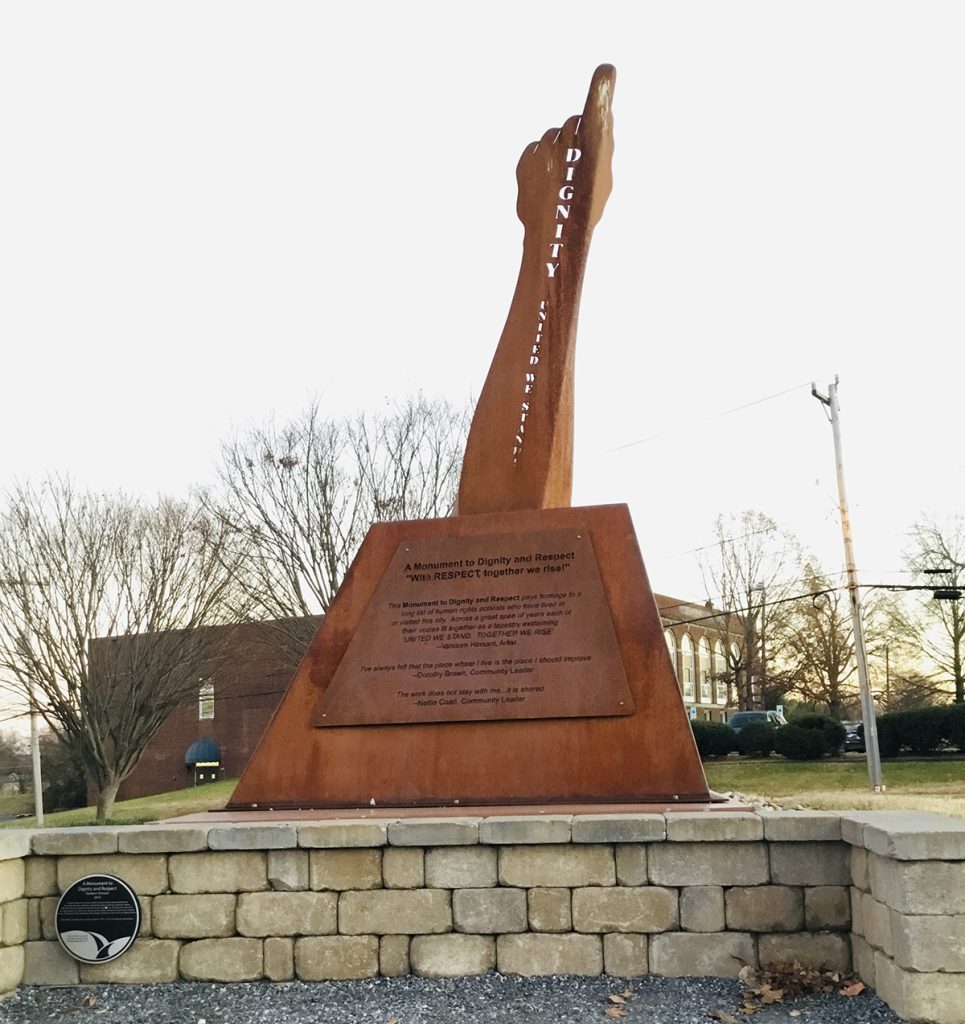
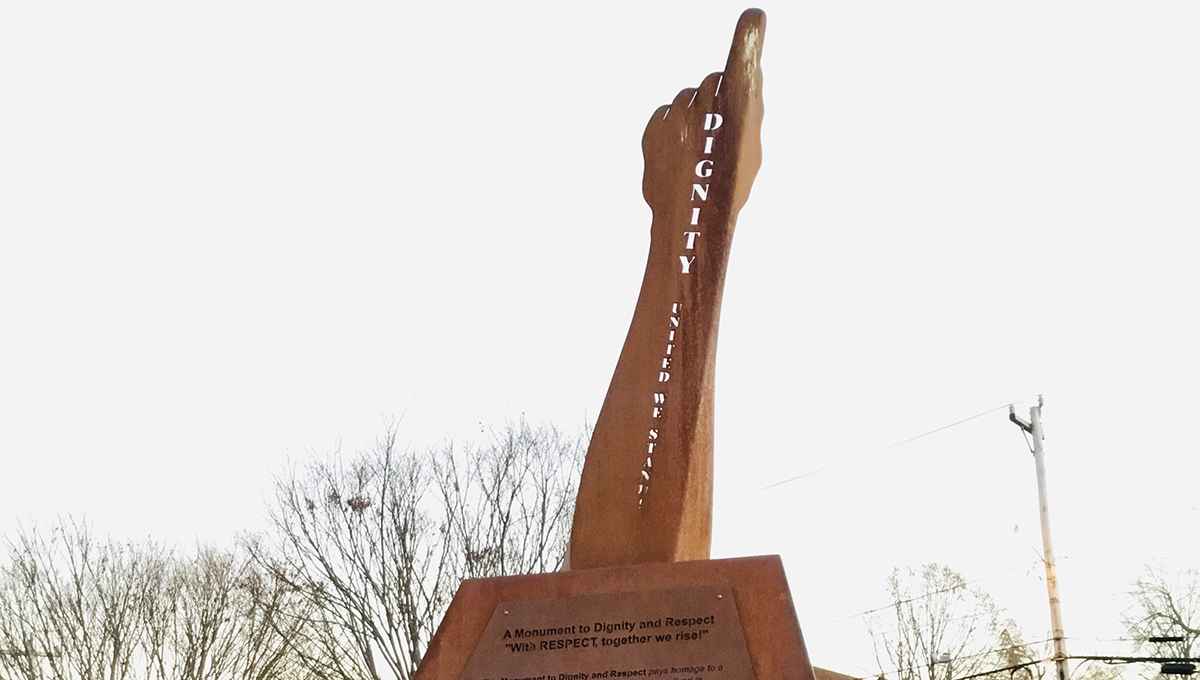
Where the FSU monument reads as one continuous ascent, A Monument to Dignity and Respect works through distance and relationship. Created for Greensboro’s Downtown Greenway and tied to the Ole Asheboro neighborhood where Hinnant grew up, the installation is split into two matching elements placed a block apart, facing each other like a conversation that stretches across the path. Each is a 14-foot Corten steel hand, index finger pointed upward, set on a steel base. One declares: “Dignity — United We Stand.” The other answers: “Respect — Together We Rise.”
The gesture is direct and familiar. A raised finger can signal attention, remembrance, instruction, or affirmation—an invitation to look up and stay awake. The decision to make the work a pair matters. Instead of a single object making a single claim, the two hands create a relationship in space, turning the greenway into the connector. The piece doesn’t feel like a command from above; it feels like a shared statement held in public view.
The base panels deepen that public focus. Quotes from Dorothy Brown and Nettie Coad, along with Hinnant’s own words, are cut into steel, letting language become part of the form. That collaboration keeps the sculpture grounded in real voices and local history, not just broad ideals.
Conclusion
Seen together, these works show how Hinnant thinks: structure first, meaning carried inside it. Symmetry, proportion, and clear directional movement aren’t just design choices—they’re the way the ideas travel. His monuments don’t try to overwhelm; they aim to steady, to remind, and to give shared space a sense of intention—built from memory, shaped by place, and pointed toward what we choose to hold up.
