
David John Hilditch, born in Wolverhampton in 1951, has built a practice that moves between painting and philosophical inquiry. His work does not settle into fixed meaning. Instead, it opens questions—about identity, perception, and the nature of experience itself. Trained through a path that intertwined visual exploration with deeper intellectual reflection, Hilditch approaches the canvas as something active rather than static. Paint is not simply applied; it behaves, shifts, and unfolds across the surface. His compositions seem to exist outside of conventional time, resisting clear beginnings or endings. What emerges is an environment where perception is constantly in motion. The viewer is not asked to observe from a distance, but to enter into a space where form, color, and gesture operate as living forces, continuously reshaping how the image is understood.
The Work
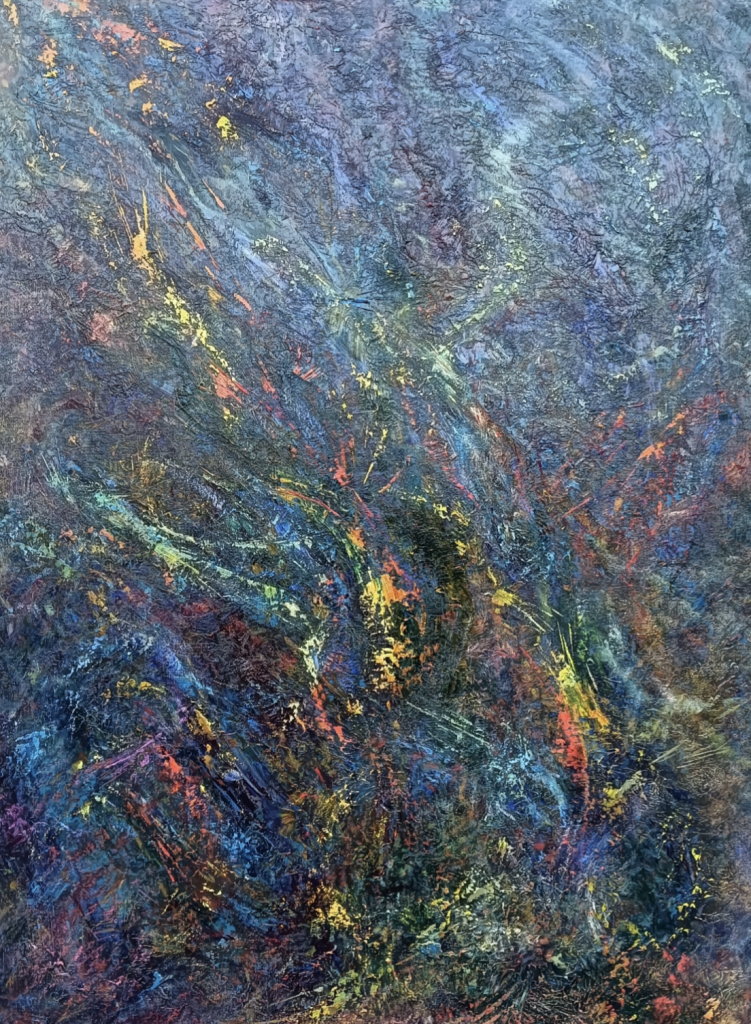
In Cascade 3 and Cascade 9, both oil on canvas at 3 by 4 feet, Hilditch’s approach becomes fully visible. These works are not about depiction in the traditional sense. There is no stable subject anchoring the viewer. Instead, the paintings unfold as fields of movement, where energy seems to gather, disperse, and reconfigure in layered sequences.
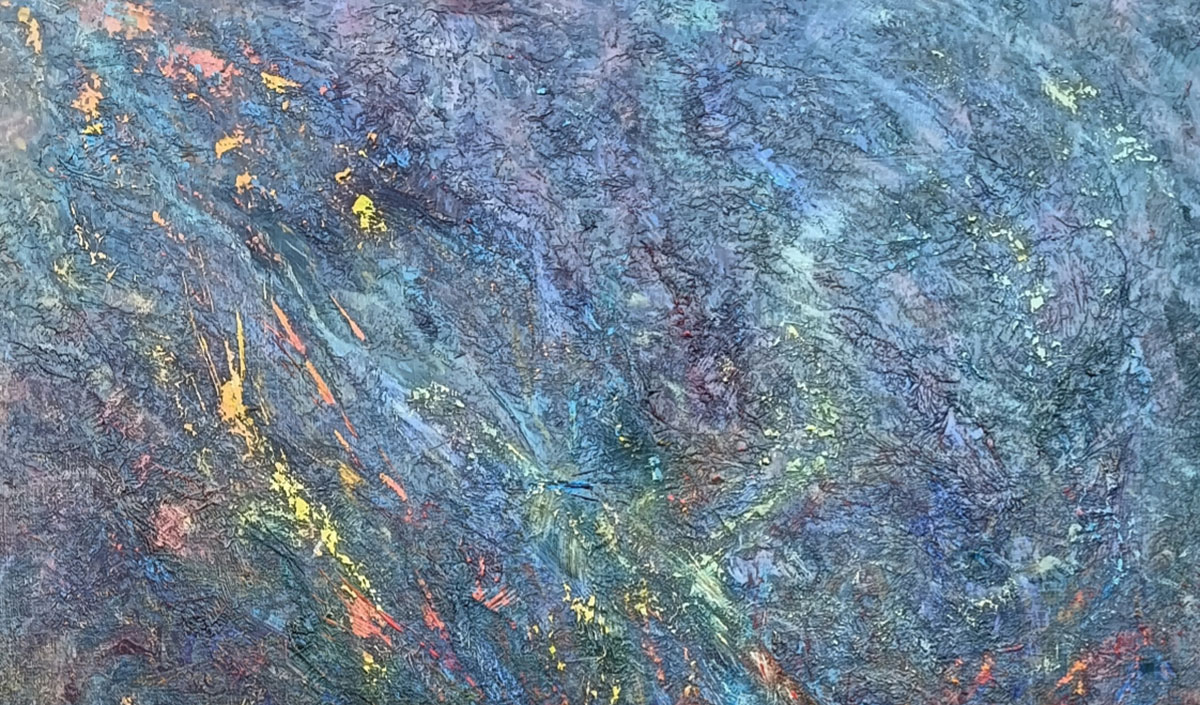
In Cascade 3, the surface is dense, almost turbulent. Deep blues and cooler tones form the underlying structure, while bursts of yellow, red, and green break through in scattered trajectories. The paint appears to surge upward and outward, as if propelled by an internal force. There is a sense of compression at the lower portion of the canvas, where darker hues cluster together, gradually releasing into lighter, more dispersed gestures above. This transition creates a vertical pull, drawing the eye through the painting in a continuous upward motion.
What is striking is the way Hilditch balances control and unpredictability. The gestures feel spontaneous—splashes, streaks, and scratches that suggest immediacy—yet they are held together within a carefully orchestrated composition. Lines intersect without collapsing into chaos. Color accents appear at precise intervals, activating the surface without overwhelming it. The result is a tension between structure and release, where the painting seems to hover between order and disorder.
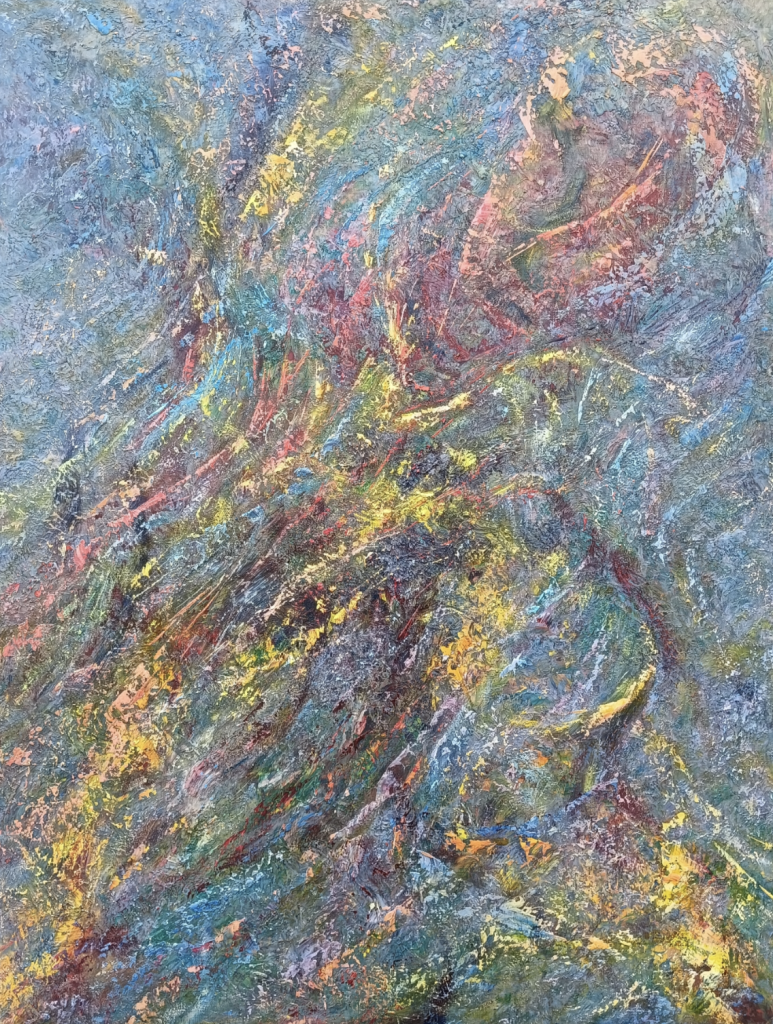
Cascade 9 shifts the atmosphere while maintaining a similar sense of motion. Here, the palette softens slightly, introducing more muted blues and pale undertones. The bursts of color—yellows, reds, and hints of green—still punctuate the surface, but they feel more integrated, less abrupt. The movement spreads laterally as much as it rises, creating a broader, more expansive field.
The paint in Cascade 9 appears to flow rather than erupt. Instead of concentrated bursts, there are sweeping arcs and layered textures that suggest accumulation over time. The surface carries a sense of sediment, as if each mark has settled into place while still retaining traces of its original motion. This creates a different kind of depth—not purely spatial, but temporal. The viewer senses that the painting has developed through stages, each layer interacting with those beneath it.
Across both works, texture plays a central role. The surfaces are not smooth; they are built up, scratched into, and reworked. This physicality reinforces the idea of paint as an active material. It is not just a medium for representation, but a substance that holds memory—of gestures, decisions, and revisions. Light catches on these textures in uneven ways, further animating the surface as the viewer moves in front of it.
There is also an underlying rhythm that connects the two paintings. Despite their differences in tone and movement, both operate through repetition and variation. Certain gestures reappear—diagonal streaks, clustered bursts, layered scrapes—yet they are never identical. Each instance shifts slightly, creating a visual language that evolves within the work itself. This repetition without exact duplication mirrors the broader themes in Hilditch’s practice, where identity and perception are understood as fluid rather than fixed.
Importantly, these paintings do not resolve into a single reading. They resist closure. The viewer may see landscapes, atmospheric phenomena, or purely abstract movement, but none of these interpretations fully contain the work. Instead, the paintings remain open, inviting multiple perspectives to coexist.
In this way, Cascade 3 and Cascade 9 function less as images and more as experiences. They ask the viewer to engage actively, to follow the movement of the paint, to trace the relationships between color and gesture, and to remain within that process without needing a definitive conclusion. Hilditch’s work does not offer answers. It creates a space where perception itself becomes the subject, constantly shifting, never fully settled.
