

Fant Wenger works at an intersection that feels both ancient and futuristic. His art isn’t easily contained within one medium or tradition. Painting, sculpture, and installation merge into something that feels more like a field of energy than a conventional object. Wenger describes his ongoing series, Frequenz, as an exploration of vibrations that shape the world around us. Since 2016, he has been building a visual language around rhythm, resonance, movement, structure, and the unseen forces that pulse beneath physical form. His works ask viewers to step into a space where matter and energy are not opposites but partners.
Wenger’s interest in vibration doesn’t operate as metaphor. It isn’t simply symbolic or poetic. It sits within the actual logic of his process. Each line, each material choice, each shift in color is treated as part of a greater frequency, much like sound waves or electrical currents running through a circuit. There is both discipline and instinct in this approach. He often speaks about balancing intuitive gesture and precise structure, and that balance becomes immediately visible when standing before his work. A painting may appear chaotic and storm-driven at first glance, but the longer one looks, the more a sense of pattern emerges. Movement becomes language. Repetition becomes music. The visual rhythm invites the viewer into a slower way of seeing.
This is where Wenger’s philosophy becomes clear. His paintings function as perceptual fields rather than scenes. They are not windows into a narrative moment, nor are they attempts at pure abstraction. They sit in the space between those definitions. A Wenger piece asks the viewer to feel rather than decode, to experience rather than interpret. The works build an environment where the physical object — the canvas, the paint, the surface — overlaps with something immaterial. It is this overlap that holds the emotional charge in his practice.
When Wenger speaks of frequency, he isn’t referring only to physics. He is also referring to life: communication, ideas, relationships, and nature. Vibrations suggest interaction, exchange, and influence. There is a philosophical awareness running beneath the surface of each piece. Wenger invites people to feel connected to what they are seeing rather than separate from it. In this way, his practice quietly challenges art’s historical focus on static form. Wenger’s artworks are grounded in motion. Even when the surface is still, something inside it feels alive and shifting.
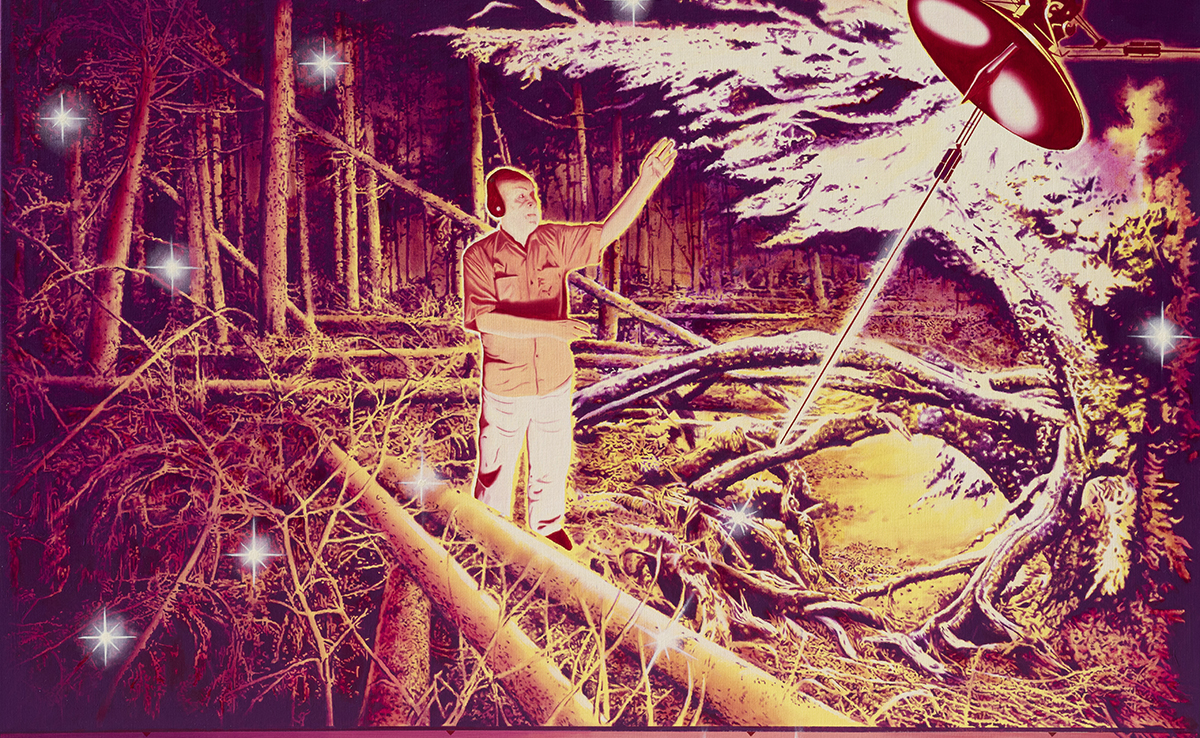
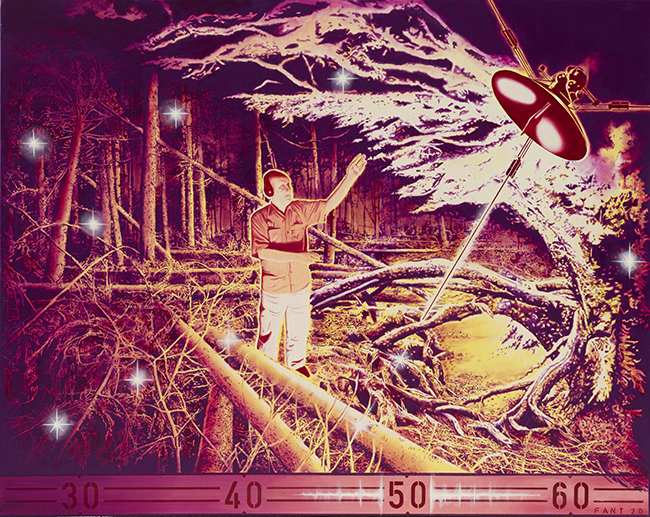
His painting Radiostorm (2021) is a powerful example of the ideas shaping his series. The work blends romantic beauty with technological anxiety. At the center of the scene, a lone man gestures toward a hovering disc structure. The disc emits a red beam that cuts through the dark sky and strikes a forest already fractured by lightning. Fallen trunks lie scattered across the ground like broken radio towers, each one conducting light along its surface. The entire landscape seems to vibrate between ruin and transformation.
A scale marked “30-60” sits embedded within the composition, its pulse suggesting a living heartbeat. It is not simply decoration. It is part of a larger conversation happening inside the image. The forest becomes a communication network. The atmosphere becomes a transmitter. Even the man standing in the scene seems transformed by this exchange. Wenger isn’t illustrating destruction. He is illustrating connection — a cybernetic ecosystem where light, weather, biology, and electrical charge share the same plane of existence.
This sense of interconnectedness carries Wenger’s work away from traditional human-centered imagery. The subject in Radiostorm may be a man, but the emotional center belongs to the landscape and the energy running through it. The posthuman idea appears here not as a dystopian warning but as a widening of perception. In Wenger’s universe, the viewer is not separate from nature or technology. They stand inside a system of flowing information. The painting becomes a reminder that perception itself can be planetary, expanding outward rather than inward.
There is a quiet courage in this approach. Many contemporary artists align themselves with shock, novelty, or rapid commentary. Wenger moves in another direction. His work feels patient, committed to the long arc of understanding. The Frequenz series has continued since 2016 not because it seeks endless variation, but because the subject is infinite. Energy never stops moving. Light never stops shifting. Materials never lose their ability to change. Wenger uses the studio as a laboratory for this fact.
The blending of acrylic and oil in Radiostorm offers another window into his process. Acrylic moves quickly, drying fast enough to capture immediate gestures. Oil slows down the surface and deepens saturation. Together, they echo the central idea of the series: the marriage between intuitive movement and deliberate construction. Wenger builds tension between fast and slow, between precision and improvisation.
Whether viewers encounter his paintings in a gallery, a studio environment, or within a sculptural installation, the experience follows the same arc. First comes the visual impact — the colors, the shapes, the sense of atmosphere. Then comes the awareness of rhythm, the feeling that the work is emitting something intangible. Finally, a stillness forms. The work starts to function less like an image and more like a presence.
Fant Wenger’s Frequenz world continues to grow because it reflects the world we actually live in — full of signals, vibrations, information streams, ecological shifts, and technological interference. Instead of portraying these forces as noise or chaos, he treats them as language. His art suggests that meaning doesn’t always sit on the surface. Sometimes it travels through frequency, through resonance, through the quiet pulse of connection running beneath all things.
