

Based in New England on the east coast of the United States, Karla Wave works at the intersection of observation and quiet transformation. Her practice grows from a sustained attention to light, color, and natural rhythm, drawing from landscapes, floral imagery, and digital processes without privileging one over the other. Rather than treating these elements as separate categories, Wave allows them to overlap, dissolve, and re-form.
Her work reflects a steady curiosity about how environments are experienced rather than documented. Coastal atmospheres, shifting skies, and organic forms appear not as fixed scenes but as impressions shaped by time and movement. Through a combination of traditional visual references and digital integration, she creates images that feel both familiar and slightly untethered. Her work has appeared in gallery exhibitions, international online museum platforms, permanent collections, and contemporary art publications, positioning her practice within an ongoing conversation about perception, place, and visual quiet.

Intertidal unfolds as a meditation on transition. The title itself points to a space that is neither fully land nor fully sea, a zone shaped by repetition, erosion, and return. In this work, Karla Wave translates that idea into a visual language built from softness, flow, and restraint. The image resists immediacy. Instead, it asks for time.
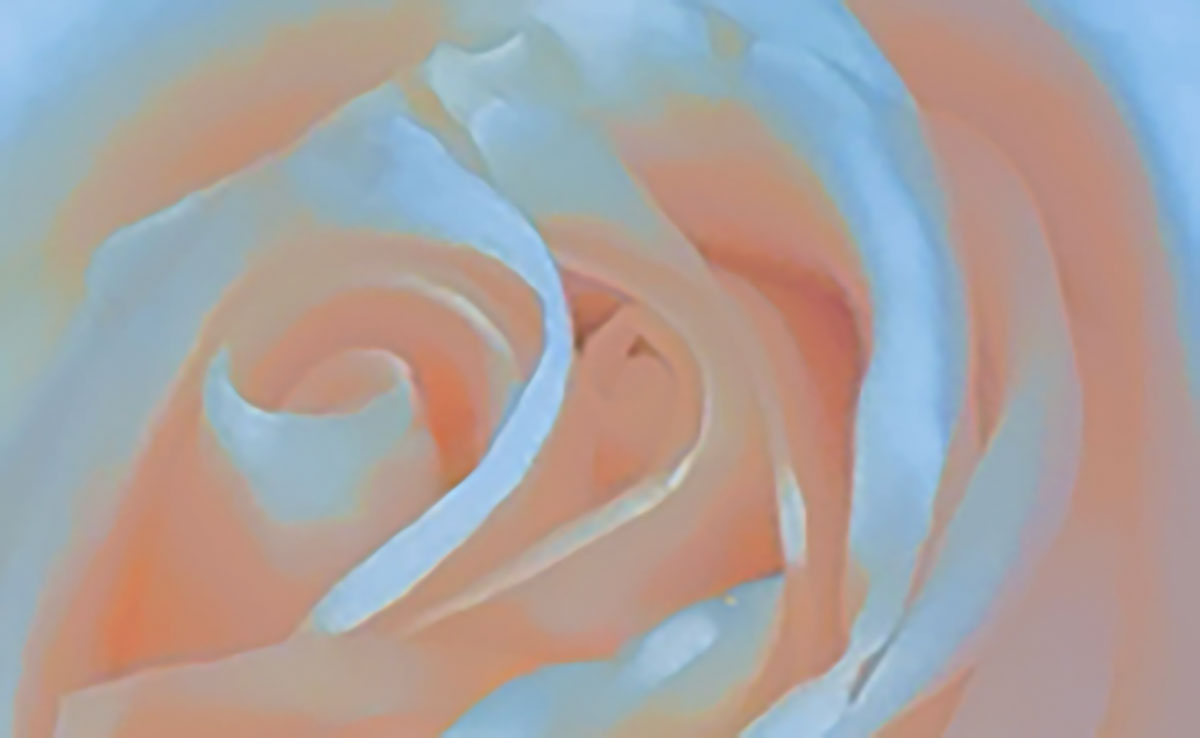
Pastel tones dominate the composition, with layers of pale peach, warm blush, and cool blue moving across the surface in gentle currents. The colors do not compete. They drift into one another, forming slow spirals and open curves that feel more atmospheric than structural. There is no single focal point. The eye moves continuously, following subtle shifts in hue and brightness. This movement mirrors the tidal rhythm suggested by the title, where change happens gradually rather than abruptly.
Wave’s handling of light is central to the work. Light here is not a source or a direction but a condition. It seems to emanate from within the image rather than fall upon it. Highlights appear diffused, as though filtered through water or mist. This approach removes sharp contrast and replaces it with tonal continuity, allowing the image to breathe. The surface feels suspended, caught between emergence and dissolution.
Although Intertidal leans toward abstraction, it carries echoes of Wave’s engagement with landscape and floral photography. The curling forms suggest petals, currents, or cloud formations without committing to any single interpretation. This ambiguity is intentional. Wave does not anchor the image to a recognizable subject. Instead, she creates a visual environment that operates through sensation rather than description.
Digital integration plays a quiet but essential role in the work. Rather than using digital tools to sharpen or intensify the image, Wave employs them to soften transitions and extend tonal range. The result is an image that feels fluid and continuous, free from visible seams. The digital process does not dominate the work; it supports the sense of slow movement and layered time.
Intertidal also reflects Wave’s interest in thresholds. The intertidal zone is a place defined by absence and presence, by what is revealed and concealed depending on the hour. Similarly, this work occupies a space between clarity and obscurity. Forms appear, blur, and reconfigure as the eye moves across the surface. There is a sense that the image is never fully settled, that it remains responsive to how it is viewed.
Emotionally, the work carries a calm that is not passive. There is energy here, but it is dispersed rather than concentrated. The softness of the palette does not weaken the image; it steadies it. This balance allows the viewer to enter the work without being directed or overwhelmed. The image offers space rather than instruction.
Wave’s restraint is deliberate. In an era where visual overload is common, Intertidal moves in the opposite direction. It does not announce itself. It waits. The longer one looks, the more the internal logic of the work becomes apparent. The curves begin to suggest cycles. The color shifts begin to feel intentional rather than decorative. What initially reads as gentleness reveals itself as structure built from repetition and care.
Ultimately, Intertidal is less about depicting a place than about holding a condition. It captures the feeling of being between moments, between tides, between forms. Through light, color, and subtle motion, Karla Wave creates an image that invites slowing down. The work does not seek resolution. It remains open, like the shoreline it references, shaped continuously by forces that are steady, patient, and ongoing.
