

Linda Cancel’s work begins with place, but it does not stay there. Born in 1959 in Moscow, Idaho, she grew up surrounded by the shifting light and open spaces of the Pacific Northwest. Those early impressions continue to shape how she sees and paints. One of her first memories—watching fireworks over the Snake River as a toddler—left a lasting imprint. It was not just the spectacle, but the way light moved across water and dissolved into darkness. That moment echoes through her work today. Her paintings return again and again to atmosphere, to the subtle transitions between shadow and illumination, and to the quiet tension between stillness and change. Over time, her approach has settled into something measured and reflective, grounded in observation but shaped by memory.
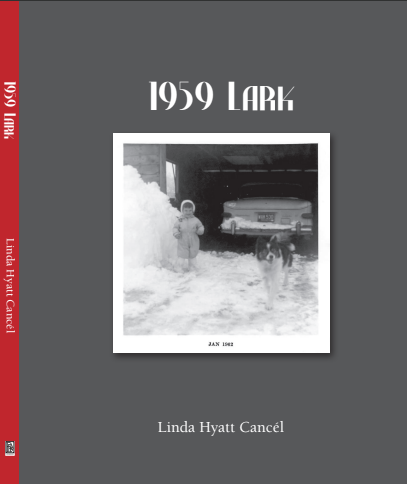
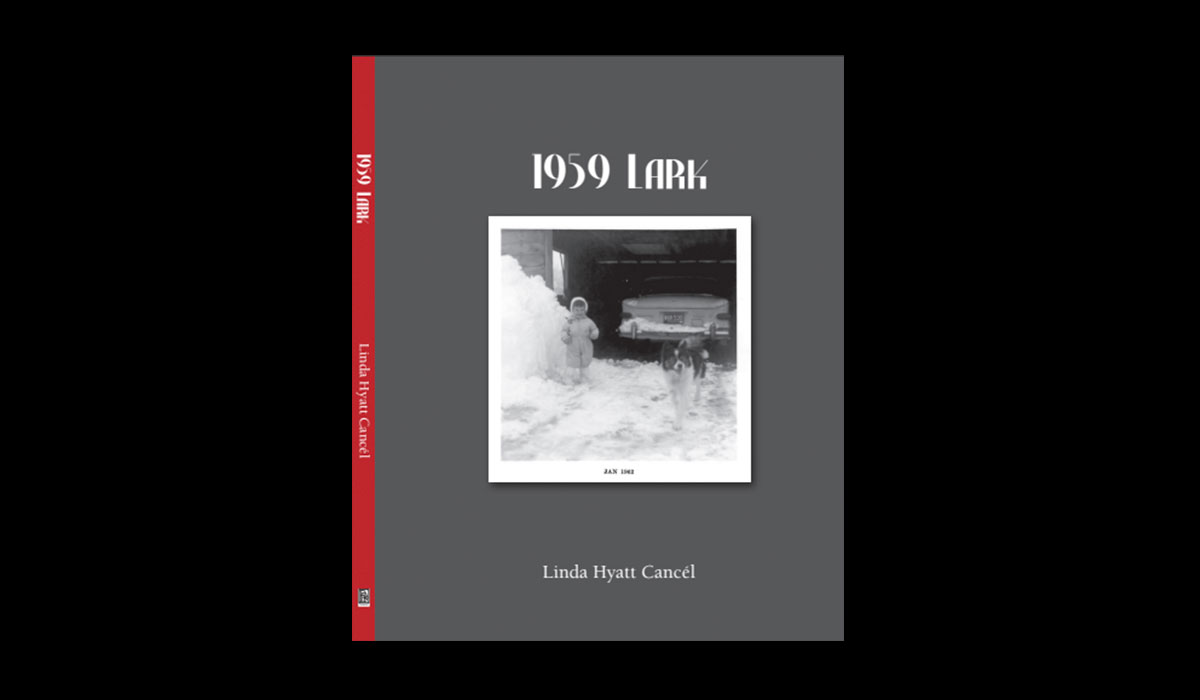
Her recent projects extend beyond the canvas, bringing her personal history into sharper focus. With the publication of her book 1959 Lark in March 2026 by Peanut Butter Publishing, Cancel shifts from painting into writing, though the two remain closely connected. What began as a simple idea—a brochure explaining the inspiration behind her Santa Claus series—expanded into something much more personal. The book traces the arc of her life, not as a linear story, but as a series of moments that continue to inform her work.
In 1959 Lark, Cancel writes about experiences that sit at the core of her artistic perspective. She recalls the birth of her sister on Christmas Eve, followed by the loss that came just a few years later when her sister passed away from a rare form of cancer. That early encounter with grief becomes one of the emotional undercurrents in her work. It is not presented directly, but it exists in the tone of her paintings—in the restraint, in the quiet spaces, and in the sense that something felt is always just beneath the surface.
She also reflects on her introduction to painting at the age of twelve, when oil lessons gave her a way to begin translating what she saw and felt into form. That early discipline carries through her practice today. Her background in Visual Merchandising and Display Design further shaped her sense of composition, giving her an understanding of how elements relate within a space. In her paintings, this comes through in the balance of forms and the careful placement of light, where nothing feels accidental.
Cancel describes her work as rooted in poetic tonalism and naturalism, with still lifes functioning as quiet narratives. These approaches are not separate from her writing; they mirror it. In both, she moves slowly, allowing meaning to build through accumulation rather than declaration. Her Santa Claus series, including seven oil paintings of Santa Cliff Snider, reflects another side of her practice. These works hold a sense of familiarity and cultural memory, yet they are handled with the same attention to mood and atmosphere that defines her landscapes.
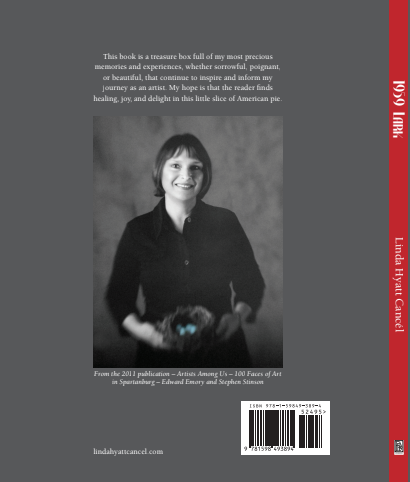
The book itself acts as an extension of her studio. Rather than separating life from work, she brings them together. As she writes in the closing statement, it is “a treasure box full of my most precious memories and experiences,” shaped by both sorrow and joy. The intention is not to resolve those experiences, but to share them in a way that allows others to find their own meaning within them.
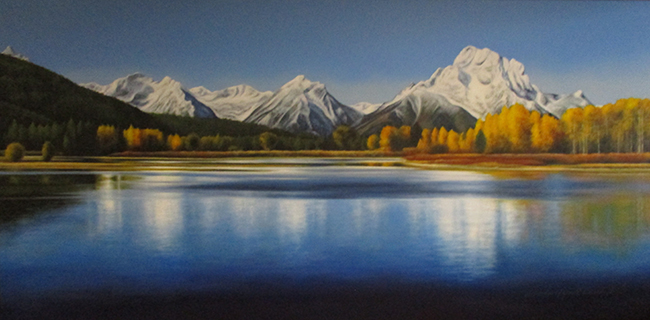
Alongside the book, her recent commission, Mount Moran – Grand Tetons (24″ x 48″, oil on linen), returns to the landscape that has long anchored her practice. The painting presents a wide, open view of the Tetons, with Mount Moran rising in the distance. A still body of water stretches across the foreground, reflecting the mountains and sky above. The composition is direct, but the handling of light gives it depth.
The surface is calm, almost quiet, yet there is a subtle movement in the way color shifts across the canvas. The blues of the water deepen toward the foreground, while the mountains hold a softer, diffused light. Along the shoreline, a band of trees in autumn tones—yellows and warm oranges—introduces contrast without breaking the overall balance. The scene feels suspended in time, as if it exists between moments rather than within one.
What stands out is not just the clarity of the image, but the restraint. Cancel does not push the painting toward drama. Instead, she allows the atmosphere to carry it. The reflections in the water are slightly softened, not exact, suggesting memory rather than direct observation. This aligns with her broader approach. Even when working from a specific location, the final image is shaped by what remains after the experience has passed.
As a commission for a private collection, the painting holds a particular role. It is both a response to a place and a translation of it through her perspective. The scale invites immersion, while the quiet handling of detail encourages a slower reading. It is a work that does not demand attention but holds it.
Across both her book and her recent painting, a consistent thread emerges. Cancel is not interested in separating life from art. Instead, she allows one to inform the other. Her work moves between memory and observation, between personal history and shared experience. Whether through words or paint, she builds a space where light, feeling, and time come together—never fixed, always shifting slightly, and always grounded in something real.
