

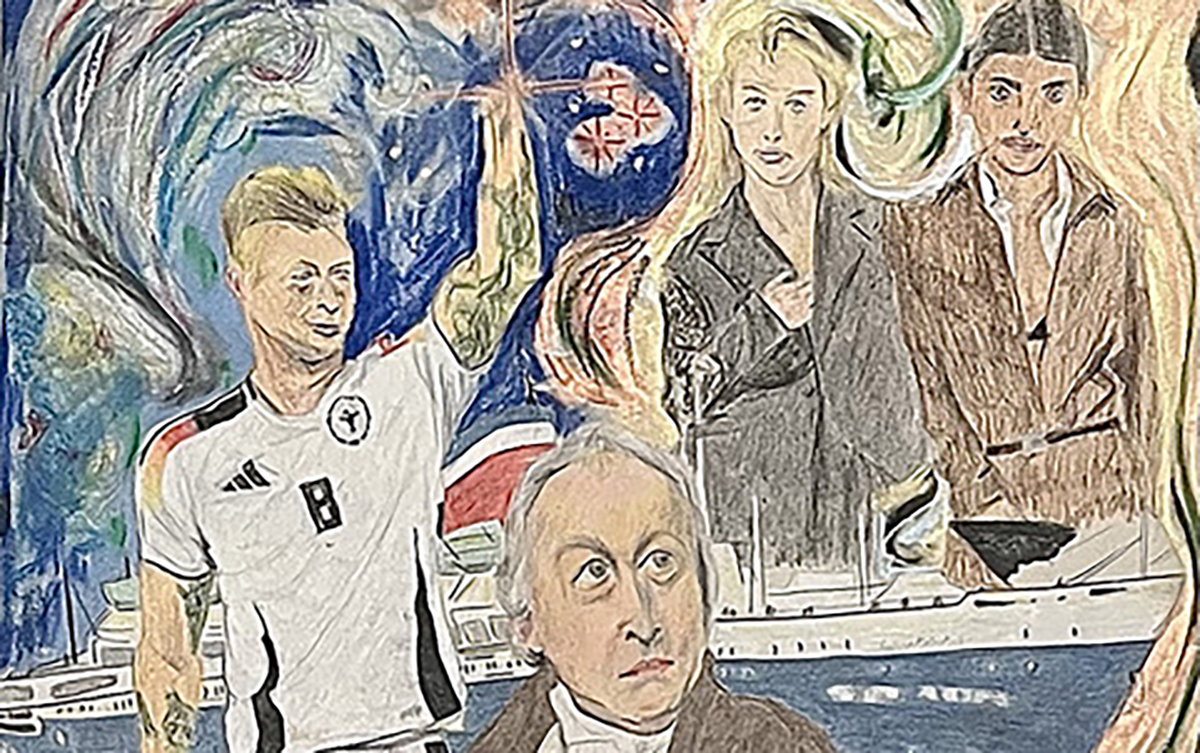
Helena Kotnik treats painting as a form of questioning. With training from both Barcelona University and the Akademie der bildende Künste in Vienna, and a Master’s degree that deepened her conceptual approach, she uses her work to examine—not embellish. She pulls from art history, cultural cues, and private emotion, not to repeat them, but to break them apart and look inside. Her art isn’t about making statements. It’s about creating space where meaning can unfold slowly.
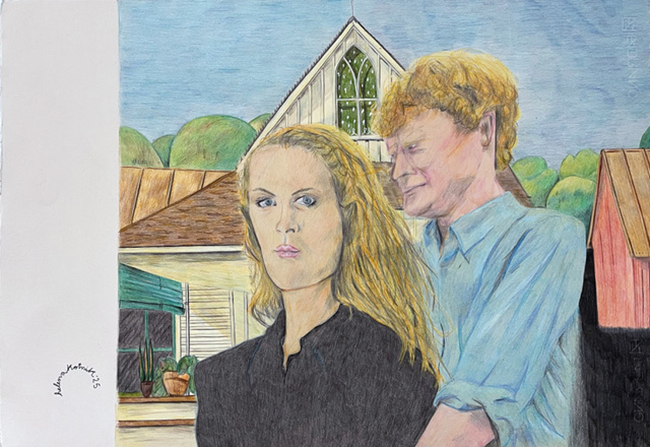
Her 2025 painting Friends revisits American Gothic, but not in the usual way. Rather than parody or quote the original, Kotnik uses it as a foundation to build something new. Gone is the couple in front of the farmhouse. In their place stand two women, contemporary and composed, facing forward with quiet resolve. The medium—gouache and pencil colors—gives the surface a soft, intimate quality, but the questions it raises are sharp: how have women’s roles shifted? And what does “togetherness” mean now?
There’s a sense of stillness in Friends, but it’s not empty. It’s loaded. Kotnik knows how to make a static image feel like it’s holding its breath. That kind of tension—between the present and the weight of what came before—defines the painting. Friends doesn’t echo the past; it reconsiders it.
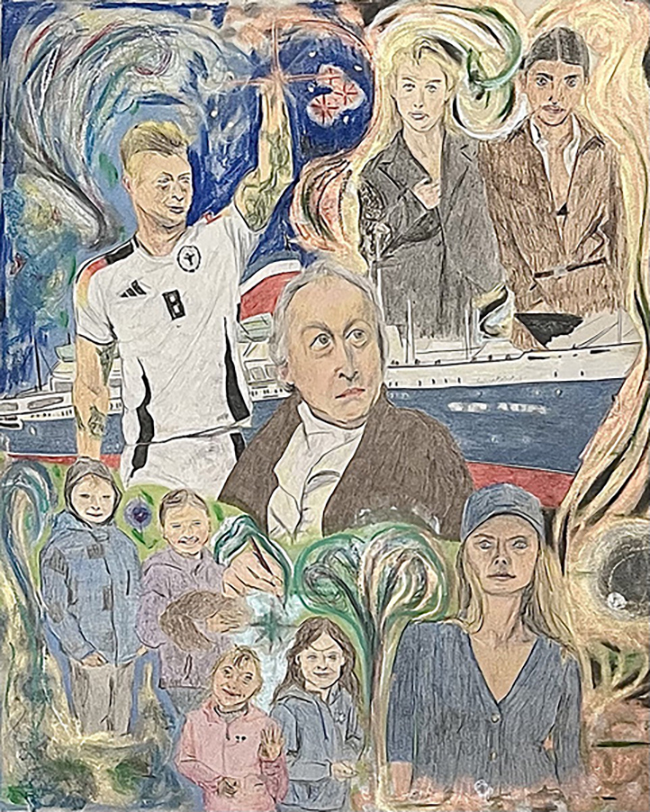
Freedom, another 2025 piece, shifts the mood entirely. Drawn in pencil color and soft pastel, it moves in a lighter, dreamlike register. The 65 x 50 cm piece doesn’t shout. It floats. Kotnik turns her attention inward, focusing on a feeling many people know but few can name—that rare moment of flow, when everything aligns. This is where her work blurs the line between image and emotion. There’s no central scene, no fixed interpretation. The painting works more like a memory that’s still alive.
Rather than a timeline, Freedom suggests layers. It reflects on how events lead into each other, how we find meaning not in milestones but in movement. The effect is almost musical—like verses returning with subtle changes, always circling back but never quite the same.
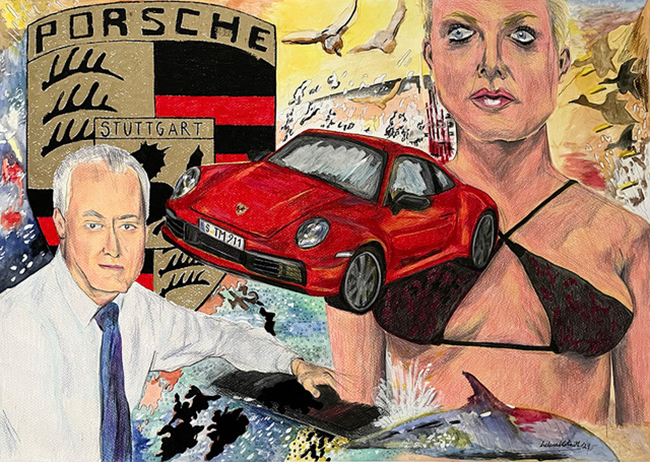
Porsche (2024) brings another pivot. This one’s sharper, both visually and thematically. Using a mix of gouache, ink, pencil, pastel, and watercolor, Kotnik creates a surface rich with texture and complexity. At first glance, the subject appears straightforward: a car. But that’s just the surface. Porsche digs into what the car represents—aspiration, speed, material success. It’s about the symbols we cling to and the illusions we buy into.
Kotnik doesn’t condemn those ideas, but she doesn’t glorify them either. She holds them up, studies them, and lets their contradictions breathe. The piece is sleek but uneasy. Beneath the smooth lines and familiar forms is something uncertain—like a dream that’s starting to fray at the edges. That’s where Kotnik’s strength lies: showing both the surface and the seams at once.
Together, Friends, Freedom, and Porsche form a quiet trio—each addressing a different layer of experience: social structure, internal clarity, cultural myth. They don’t belong to the same category, but they speak to each other. Kotnik’s work isn’t tied down by subject or genre. What holds it together is her approach: thoughtful, layered, and wide open to interpretation.
She doesn’t chase conclusions. Her art leaves space—room for discomfort, recognition, and slow realization. In a world full of fast images and easy tags, Helena Kotnik offers something slower and deeper. Her paintings aren’t answers. They’re invitations to think, and to feel, with patience.
