

Helena Kotnik creates from a place where feeling, perception, and imagination overlap. Her education across leading European institutions gives her a strong foundation, but it never restricts her. She earned a Bachelor’s Degree in Fine Arts from Barcelona University and the Akademie der bildende Künste in Vienna, followed by a Master’s degree. That training is present in her work, though it operates quietly in the background, allowing her to move fluidly between control and intuition.
Her paintings do not present fixed messages. Instead, they act as open fields for thought. They encourage viewers to pause and consider, rather than pointing them toward a single conclusion. Each work reads like a piece of a broader narrative, shaped by memory, culture, and the shifting nature of identity. Kotnik blends personal experience with wider social themes, letting both unfold within the same space. The result feels immediate, yet layered, with meaning that deepens over time.
She refers to her work as “psychological human landscapes,” a description that reflects her focus. Her paintings go beyond depicting figures. They explore the environments people carry within themselves as well as the ones they move through. Emotions, cultural signals, social roles, and fragments of everyday life appear together, without strict order. They overlap and interact in a way that mirrors lived experience.
Color is central to how she communicates these ideas. Her palette is often vivid and inviting, even light in tone, while the subject matter holds more weight beneath the surface. This contrast creates a quiet tension. The eye is first drawn to the color, then held by the complexity within it.
Kotnik’s practice connects with art history, though it does not depend on it. Influences are present, but they are absorbed and transformed. She works across different visual traditions, creating a conversation between past and present. This exchange is not about looking back. It is about considering how earlier ideas continue to shape the current moment, and how painting can reinterpret them.
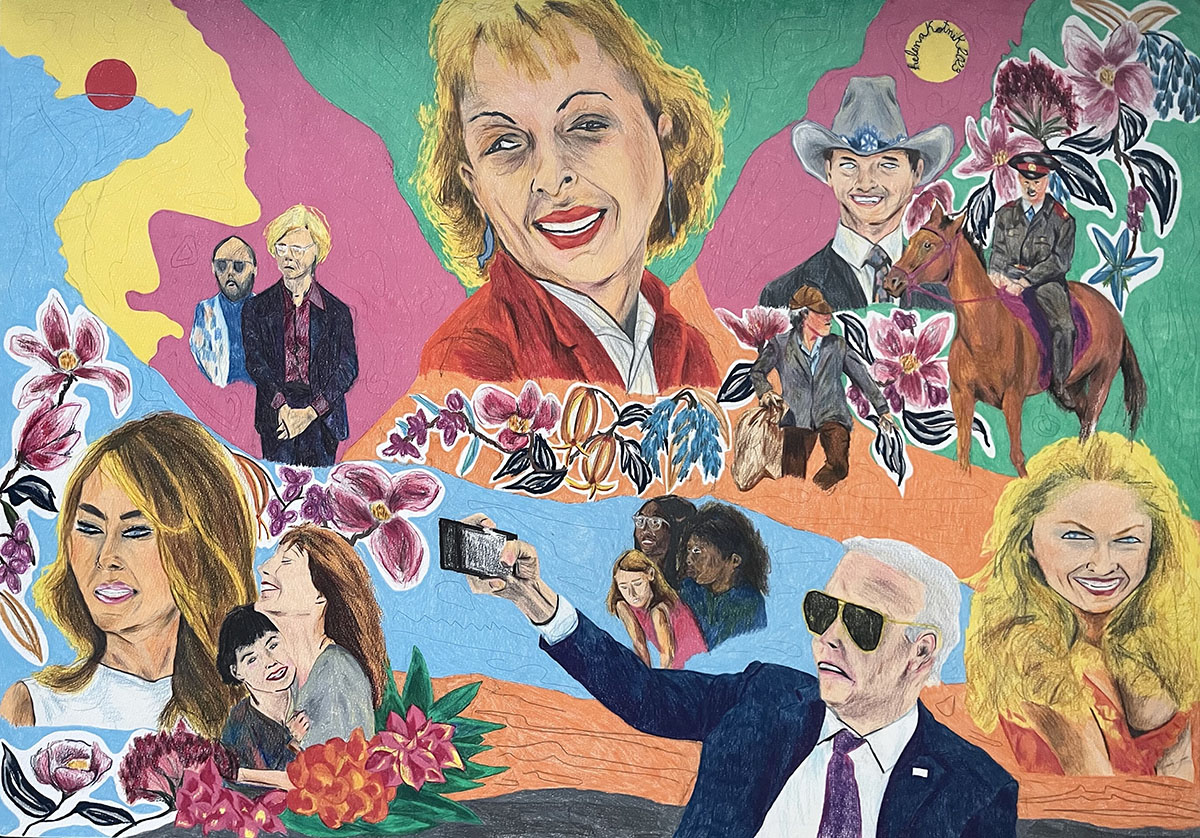
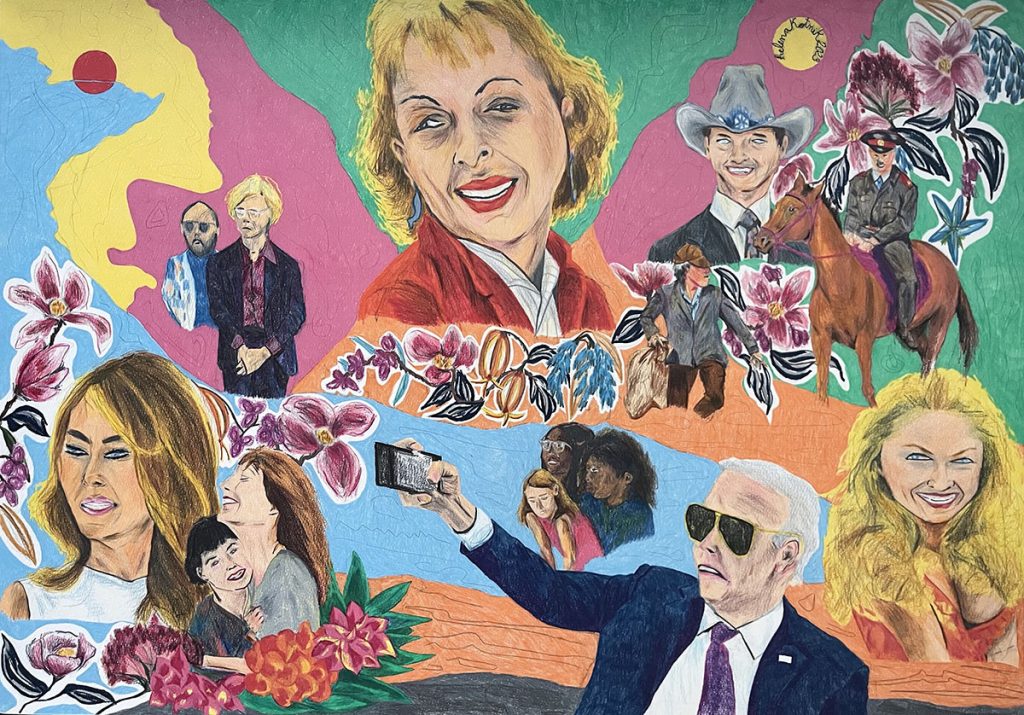
“Cultural Diversity,” made for The Other Art Fair in Dallas, reflects this approach clearly. The painting gathers a wide range of figures and symbols linked to American culture. Familiar faces appear alongside cowboys, floral elements, and pieces of landscape. The composition feels both organized and open. There is no single center. Instead, the viewer’s gaze moves across the surface, discovering relationships between elements.
The work considers identity as something built from many sources rather than something fixed. Dallas becomes more than a setting. It turns into a meeting point for different stories. The figures share the same space, connected visually even when they are not interacting directly. This creates a sense of coexistence, where difference is visible but not divided.
The title offers direction without closing off interpretation. “Cultural Diversity” points toward inclusion, but it also invites questions. How do different identities exist together. What forms a shared culture. How do individual experiences sit within a broader narrative. Kotnik leaves these questions unresolved, allowing viewers to engage with them in their own way.
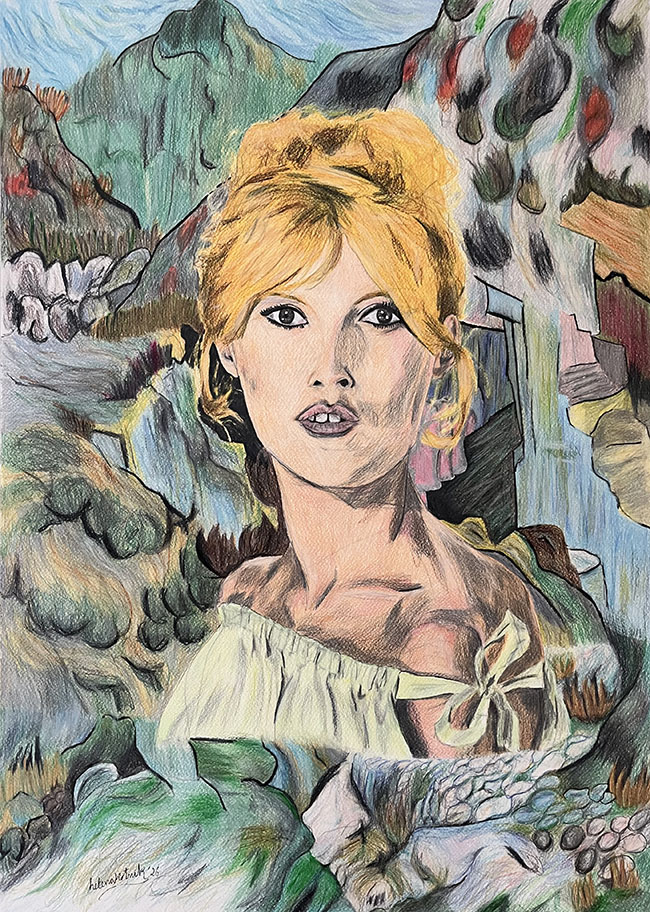
In contrast, the work titled “Shit” turns inward. It presents a more personal and immediate scene. A single figure holds the center, surrounded by a fragmented and unstable environment. The setting feels psychological rather than physical. Shapes merge and shift, and colors move in unexpected ways. There is a sense of tension, as if internal and external pressures are meeting.
The title is direct and unfiltered. It removes distance and sets the tone immediately. This is not a softened or edited view of experience. It is exposed and immediate. The figure appears caught in a moment of uncertainty, neither settled nor overwhelmed. That in-between state gives the work its intensity and keeps it open to interpretation.
In this piece, her line work becomes more visible. The drawing feels raw, almost unguarded. It shows the process instead of concealing it, adding to the emotional quality of the work. The viewer becomes aware not only of the image, but of how it comes into being. The act of making becomes part of the experience.
Across both works, Kotnik holds a careful balance. Her paintings remain clear enough to engage with easily, yet open enough to hold multiple meanings. They invite close attention without becoming obscure. She leaves space for the viewer to enter, to observe, and to interpret from their own perspective.
Her work does not attempt to simplify or resolve the complexities of life. Instead, it reflects them as they are. It creates a space where contradictions can exist side by side. In doing so, her paintings remain active, changing with each viewing and shaped by each person who encounters them.
