

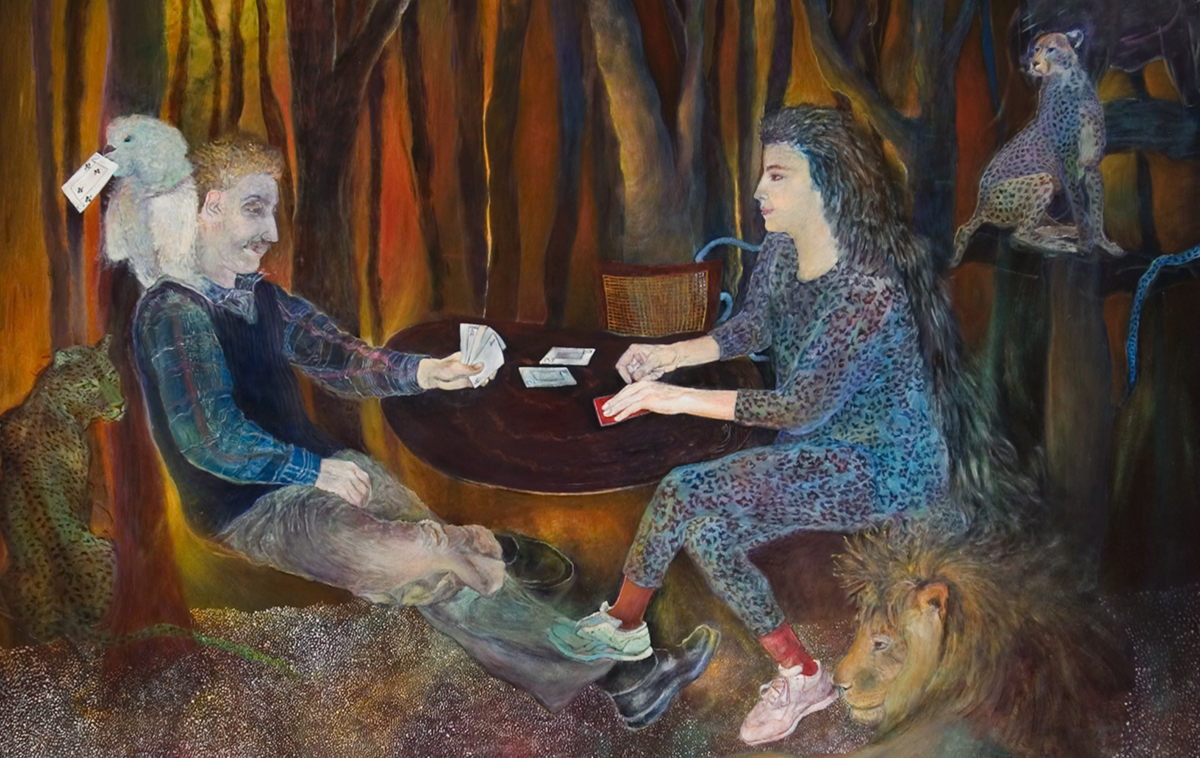
Ruth Poniarski did not step into art through the studio but through the drafting table. She earned her degree in architecture from Pratt Institute in 1982 and spent the next decade immersed in construction—absorbing the rigor of plans, measurements, and precision. Yet those same years sharpened a quiet pull toward another path. By 1988, she shifted to painting, trading linear certainty for a medium where intuition and symbolism could take the lead.
Her paintings carry echoes of that architectural training, but instead of steel and stone, she constructs with myth, philosophy, and dream imagery. Each canvas is a space of paradox: where ancient archetypes meet surreal invention, where memory and time fold into one another. Poniarski paints not to replicate the visible but to uncover what lies beneath—the hidden landscapes of thought, conscience, and imagination.
Atlas and Eve
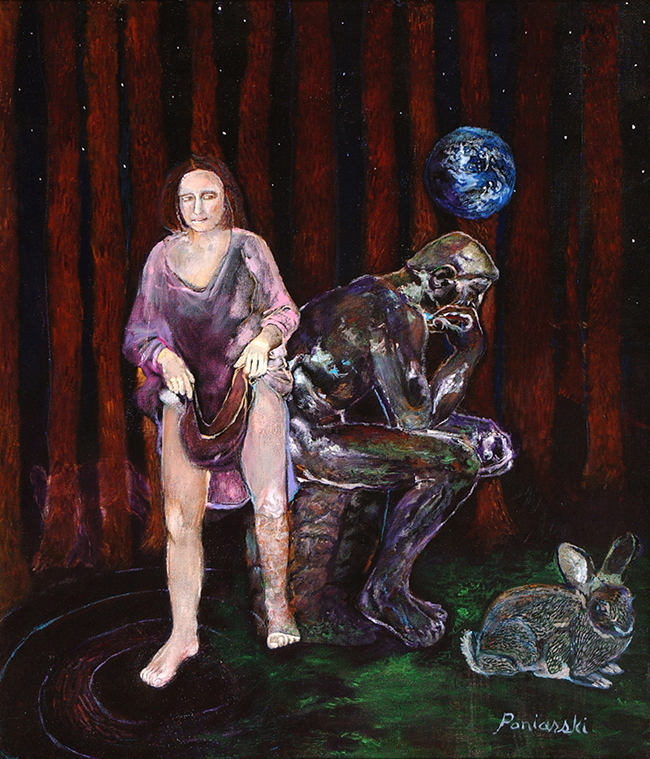
In this work, Poniarski stages a dialogue between two archetypal figures. Eve—traditionally cast as transgressor—is reframed as a “villain of truth,” not condemned but redefined, burdened and resilient. She fashions a branch from a leaf, a small but potent act of renewal in exile.
Opposite her stands Atlas, straining beneath the heavens. Both bear weight, both labor for continuity: Atlas with the cosmos, Eve with the soil. Their parallel struggles become a meditation on survival itself. Spirals of spores, atoms, and consciousness sweep through the composition, suggesting the long climb from wilderness to civilization. Rather than punishment, endurance emerges here as a shared condition of humanity.
Who’s Game #2 Dawn
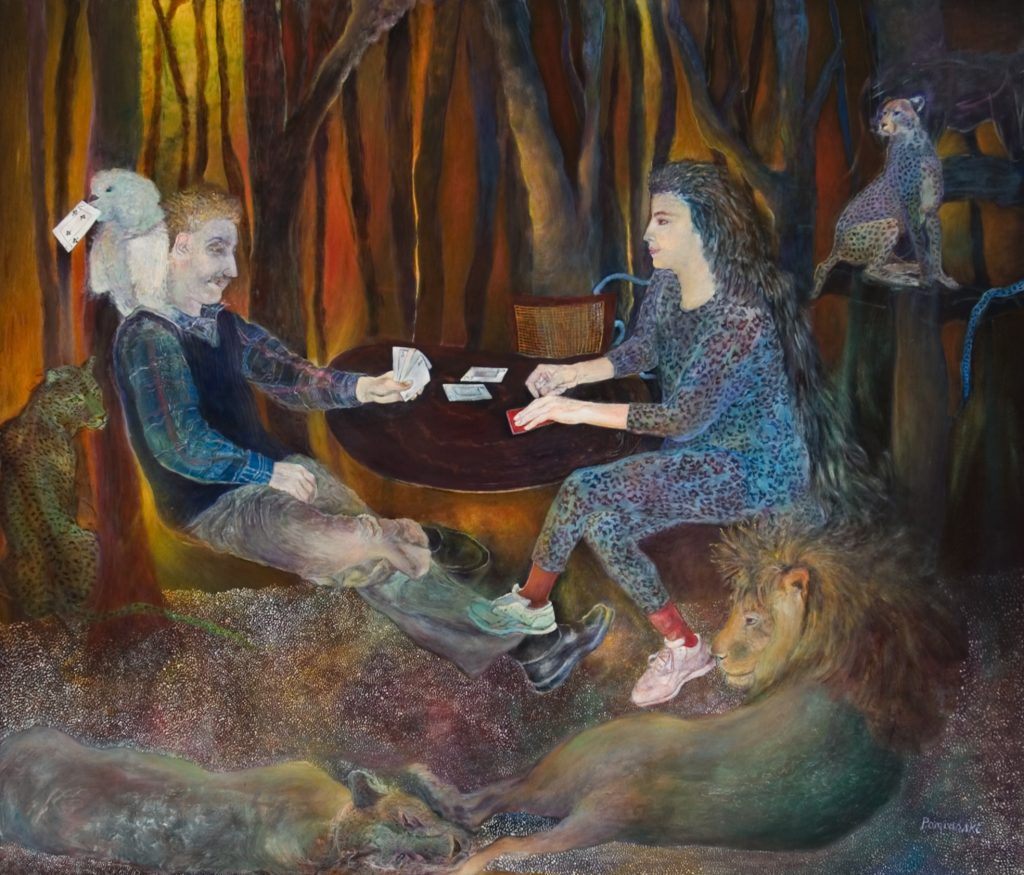
This painting begins in the first light of morning. The horizon glows, creatures stir, and the residue of dreams hovers on the edge of fading. The title frames existence as a game—fragile, unpredictable, but endlessly renewed.
The work captures the threshold between night and day, where identity gathers itself before the world’s noise takes over. Each dawn is a crossing point: hesitation gives way to action, the past to the present. Poniarski shows life not as fixed but as cyclical, a rhythm rehearsed anew with every sunrise.
Tele-Vision, The Endless Couch
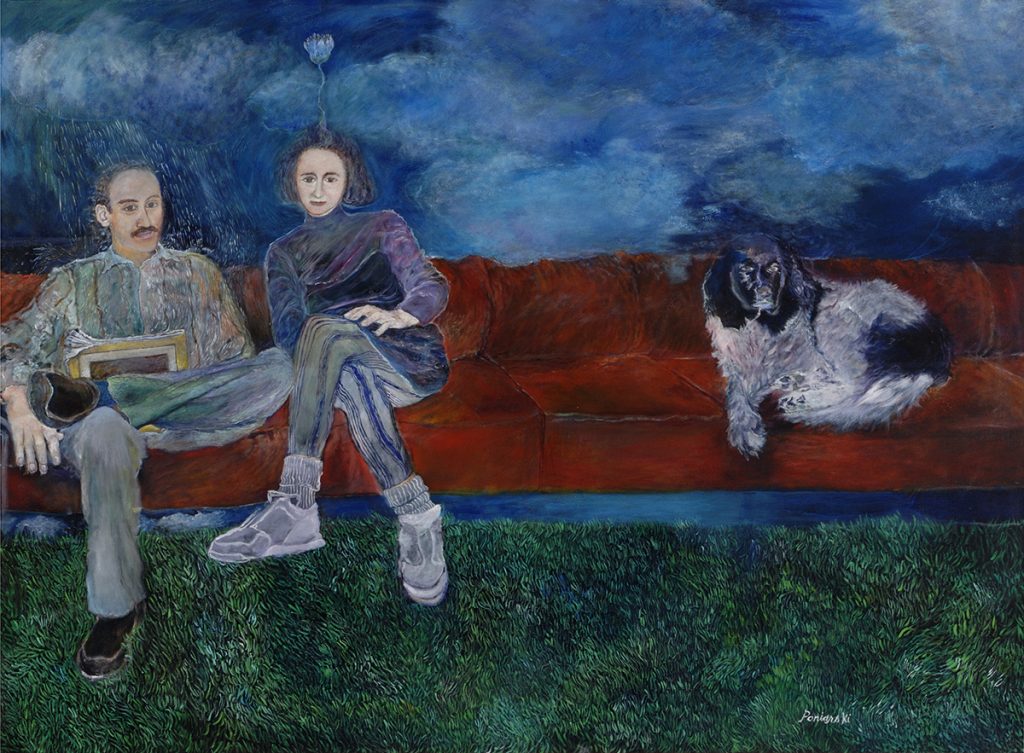
Turning her gaze to modern rituals, Poniarski explores the act of watching. The endless couch becomes both symbol of comfort and emblem of inertia, a stage for passive engagement with history as it plays out on the screen.
Here, time stretches and distorts. Reality is filtered, replayed, remembered differently. Yet, within this passivity, a seed of possibility remains. The phrase “the devoted waters of another” hints that imagination may still flow, that ideas may germinate even in stillness. The endless couch is both trap and threshold—paralysis and potential intertwined.
Closing Thoughts
Taken together, these works chart a vision that is both mythic and immediate. Atlas and Eve reframes exile as perseverance. Who’s Game #2 Dawn captures renewal at the fragile edge of waking. Tele-Vision, The Endless Couchinterrogates how spectatorship shapes our sense of history and self.
Though trained in architecture, Poniarski builds with symbols and stories. Her surrealism is not escape but inquiry—into how myth, ritual, and modernity weave through human experience. Each canvas is its own kind of structure, designed not with beams but with ideas.
She invites us to look inward and outward at once, to see how old narratives and present habits entwine. In her work, myth is never past, and modern life is never free of archetype. Instead, both converge in landscapes that are as much psychological as they are pictorial—blueprints of imagination rendered in paint.
