
Julian Jollon is an American artist whose path into creativity does not follow a straight line. His life and work are shaped by change, interruption, recovery, and a patient return to what he always knew he was meant to do. Formally trained in Fine Arts, Photography, and Painting, Jollon once imagined a future built entirely in the studio. But life intervened. For fifteen years, he stepped away from professional artmaking and entered a very different world: Hospital Epidemiology. During that period, he also underwent a liver transplant—an experience that reshaped his sense of time, mortality, and what it means to remain alive on borrowed grace. When he returned to art, it was not with hesitation or uncertainty, but with a clarity forged through human fragility.

Jollon’s new body of work reveals a deep inquiry into mythology, spirituality, and the endurance found in stories passed through generations. He approaches creativity not as decoration, but as meaning-making—an ongoing conversation between the body, the land, and the unseen world. This artistic shift, born from recovery and reflection, has brought him to subjects that feel ancient and immediate at the same time.
One of his most compelling sources of inspiration comes from Native American mythology and its relationship to place. In these cultural traditions, creation is not separate from the land, nor is spirit separate from environment. A creation story emerges from mountains, rivers, lakes, and rock formations. Each tribe’s history is tied to a specific center point—a landscape that is not symbolic, but literal, anchoring ceremony and identity. The land is living memory. It is a relative, not a possession.
This understanding speaks directly to Jollon’s artistic instincts. His own life teaches him that identity is shaped by context—by what we survive, where we stand, and what forces shape us. Native American belief forms the conceptual ground for his photographic artwork Frozen Stone Spirits, a piece rooted in mythology, cosmology, and cultural displacement.
The written material accompanying the work, drawn from “Native American Myths & Legends,” speaks of a world where emergence, creation, and story come from local mountains, lakes, rivers, and rock outcroppings. It explains how, for Native communities, removal from land becomes removal from narrative. Once the land is severed from the people, the story risks collapsing. This loss is not merely physical—it is spiritual and communal. It removes entire generations from the sacred sites that gave rise to ritual and identity.
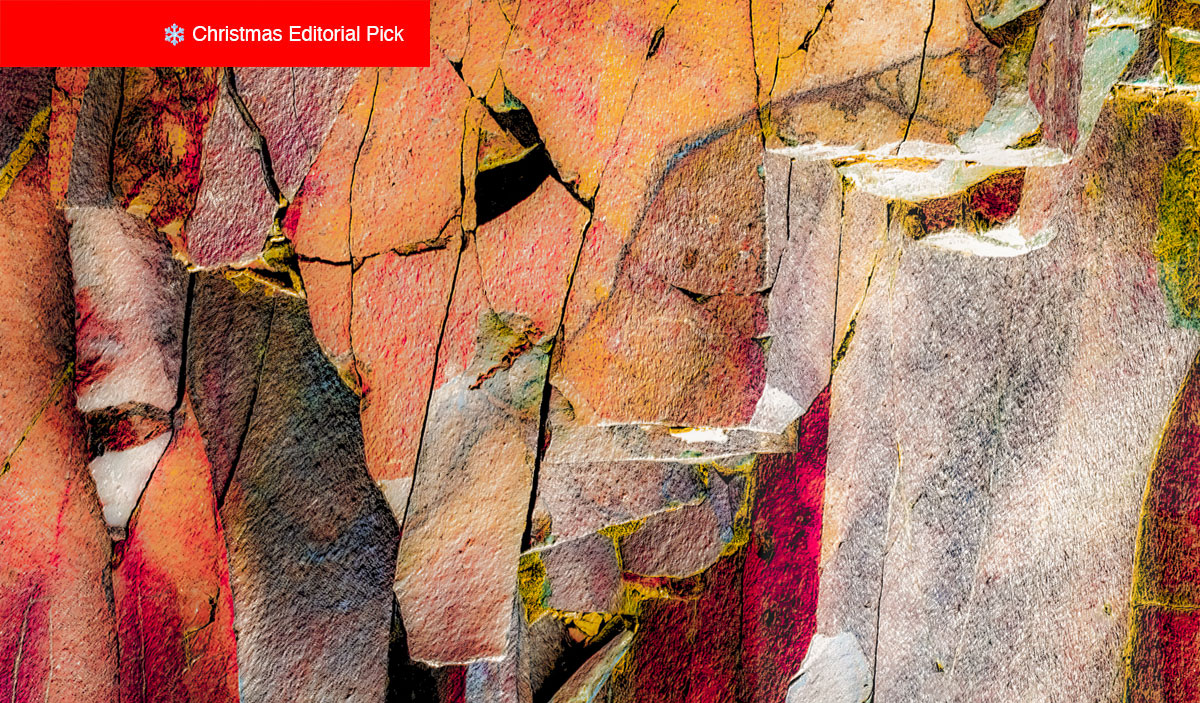
Jollon’s work acknowledges this fracture. Frozen Stone Spirits is not a photograph about rock texture. It is a meditation on memory—specifically, on memories embedded in land. The piece presents a natural rock surface photographed in a way that suggests something beneath the minerals is alive, ancient, and waiting. Shapes emerge out of the stone. Layers suggest figures. Forms feel as though they are surfacing from another moment in time. The viewer is encouraged not simply to look, but to listen.
The rock face itself may be understood as one of the “center points” discussed in Native mythology. Creation stories begin from these places. Ceremony begins from them. Community identity radiates outward from them. To lose such places is to lose the beginning of one’s story. Through this lens, Frozen Stone Spirits becomes a visual space where absence and presence coexist—where the spirits are frozen not because they vanished, but because they are waiting.
The description accompanying the artwork addresses this idea directly:
“Spirits walk this sacred ground,
and I follow the silence back to the center.”
The poem reads like a ritual whisper. It refuses to separate past from present. Instead, Jollon positions the viewer inside a timeless moment. The rock becomes a messenger between worlds—a medium through which the past can speak.
This photographic work also reflects Jollon’s own return to art after illness. Many artists speak through metaphor; here, metaphor becomes personal truth. A body held together by medical intervention becomes a story embedded in new layers. A life on pause becomes a spirit sealed in stone. The return to creative practice echoes the return of breath to something pushed underground.
Photographically, the image is abstract but emotional. It evokes a kind of raw, primal energy. The lines, fractures, and shadows resemble painted gesture, turning the photograph into an expressive surface rather than a literal document. It blurs the border between realism and abstraction, between photography and painting, and between the natural world and spiritual interpretation.
Jollon’s interest in mythology is not confined to cultural admiration; it is a search for continuity between people and place. His post-transplant existence made him acutely aware of how temporary and precious the human body is. In mythology, especially Indigenous mythology, the human body and the landscape are mirrors. One contains story. The other contains the same story. Photography becomes the method by which he records that interdependence.
Frozen Stone Spirits also raises a quiet question: Who are we when our surroundings change? For Native Americans, forced removal reshaped identity and spiritual life. For Jollon, medical intervention reshaped personal life. Both involve survival. Both involve returning to meaning after disruption.
Today Jollon continues exploring myth and spirituality through his camera and through his painterly instincts. His art is reflective rather than performative. It asks the viewer to slow down, to acknowledge silence, and to consider the world beneath the surface of the obvious.
Through photography, he opens a space where memory, land, and spirit meet. Through myth, he honors stories older than modern language. Through his return to art, he demonstrates the resilience of a creative life that refused to disappear, even when buried beneath years of silence.
Julian Jollon stands in conversation with ancient voices—but he does so as someone who has walked through modern struggle. His work is both personal history and shared history, woven into one quiet, resonant image at a time.
