


Judy Gittelsohn’s paintings feel like conversations that happen quietly, without urgency, but with weight. They don’t announce themselves. They wait. Color, gesture, and form come together in a way that suggests lived time rather than a single moment. Her work carries memory, family, longing, and return—not as concepts to decode, but as sensations that linger after you step away.
Born in Portland, Oregon, Gittelsohn has spent much of her life moving through different places, absorbing the emotional climates of each. Painting has been her way of marking those internal shifts. Now, after twenty-eight years away, she has returned to San Francisco. That return isn’t just geographical. It’s emotional, physical, and deeply personal. She describes it as a tender moment—one where painting, exhibiting, and being seen all come together at once. The city is not simply where she lives again; it’s where she feels grounded. Home, for her, is no longer abstract. It’s specific. It’s this corner, this hill, this light.
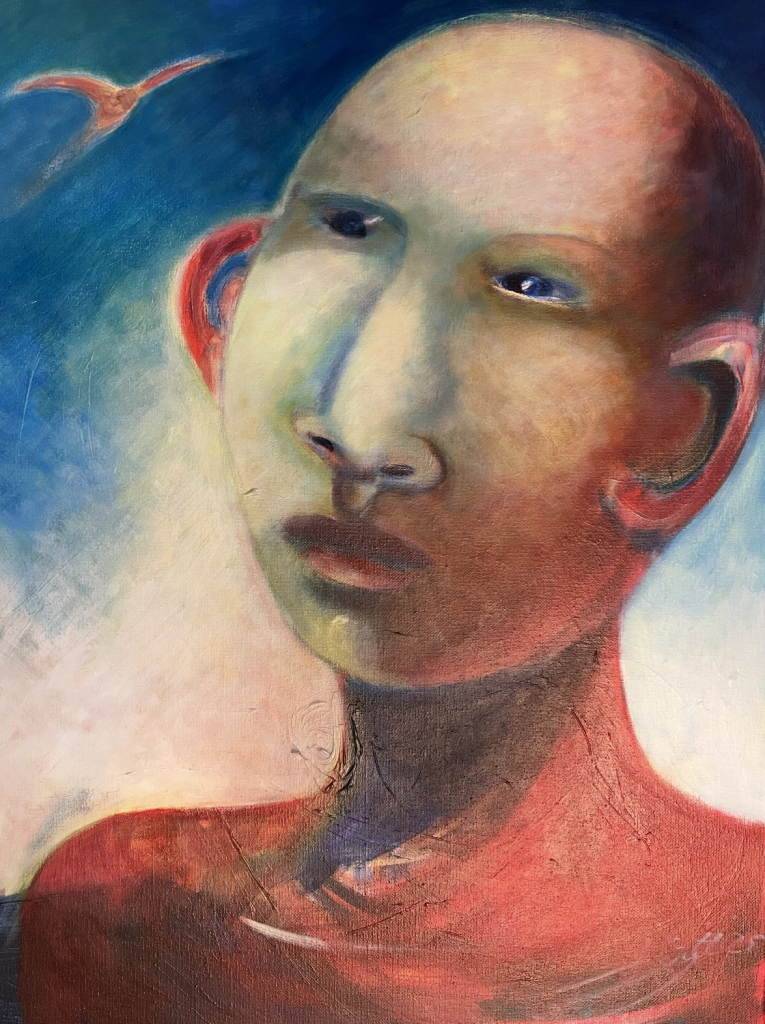
Her recent work reflects that sense of arrival. There’s a calm confidence in the way her figures occupy space, even when their expressions remain ambiguous. Gittelsohn doesn’t rush to explain them. She allows uncertainty to stay present. Faces emerge through layered acrylic strokes, sometimes soft, sometimes abrasive, often both at once. Color becomes emotional weather—cool blues pressing against warm reds, translucent passages sitting beside denser marks. Nothing feels accidental, but nothing feels overworked.
The painting HARKEN (2025) is a clear example of this balance. The figure’s gaze is steady but not confrontational. The head tilts slightly, as if listening rather than speaking. The palette moves between fleshy warmth and cooler, atmospheric blues, creating a sense of interior and exterior space colliding. The ears glow red, almost exaggerated, reinforcing the title’s call to listen. This is not passive listening. It’s active, alert, embodied. The figure seems to be absorbing the world—sound, memory, emotion—without reacting outwardly.
Gittelsohn’s approach to the human form isn’t about likeness. It’s about presence. Her figures feel familiar without being identifiable. They could be anyone, or no one in particular. This universality allows viewers to project themselves into the work, not through narrative clues, but through mood. The faces hold experiences rather than stories. You sense that something has happened, or is happening, but you’re not told what it is.
There’s also a strong poetic undercurrent in her practice. The words she shares about her return to San Francisco read like fragments of a personal manifesto: ardor and rancor, crests and swells, places and feelings folded into one lived body. That rhythm finds its way into the paintings. Brushstrokes swell and recede. Forms tighten, then loosen. The surface becomes a record of movement—both physical and emotional.
What stands out in Gittelsohn’s work is restraint. Even when the colors are bold, the tone remains measured. She trusts the viewer to sit with the painting rather than consume it quickly. This is work that rewards slowing down. The longer you look, the more subtle shifts you notice: a faint line suggesting a neck, a soft blend that suddenly sharpens, a quiet contrast that holds the composition together.
Her return to San Francisco has also brought renewed visibility. Exhibiting again in a city she loves has given the work space to breathe. There’s a sense that this chapter is less about proving anything and more about inhabiting her own voice fully. The paintings don’t feel nostalgic, even though they are rooted in memory. They feel present. Grounded. Aware of where they stand.
Gittelsohn’s art doesn’t ask for attention—it earns it through honesty. It listens before it speaks. It holds complexity without turning it into spectacle. In HARKEN, and in her broader body of work, she reminds us that paying attention—to place, to feeling, to the quiet pull of home—is itself a form of devotion. And sometimes, returning is not about going back, but about finally arriving where you’ve been all along.
