

Randa Hijazi is a contemporary Syrian-Canadian painter based in Laval, Quebec. Her life and work have been shaped by movement—geographical, cultural, and emotional. Born in Damascus, Syria, she graduated from the Faculty of Fine Arts at the University of Damascus in 2000, grounding her practice in classical training while remaining open to experimentation. Her path then expanded beyond painting. In 2008, she completed further studies in Mass Communication and the Science of Media at the same university, an education that sharpened her visual awareness and narrative instincts. Hijazi’s journey took her from Damascus to Dubai, and eventually to Canada in 2017, where a new chapter began. This layered background allows her to approach painting with the sensitivity of an artist and the perceptiveness of a visual storyteller. Her work moves between tradition and the present, carrying cultural memory forward while speaking in a language that feels immediate and shared.
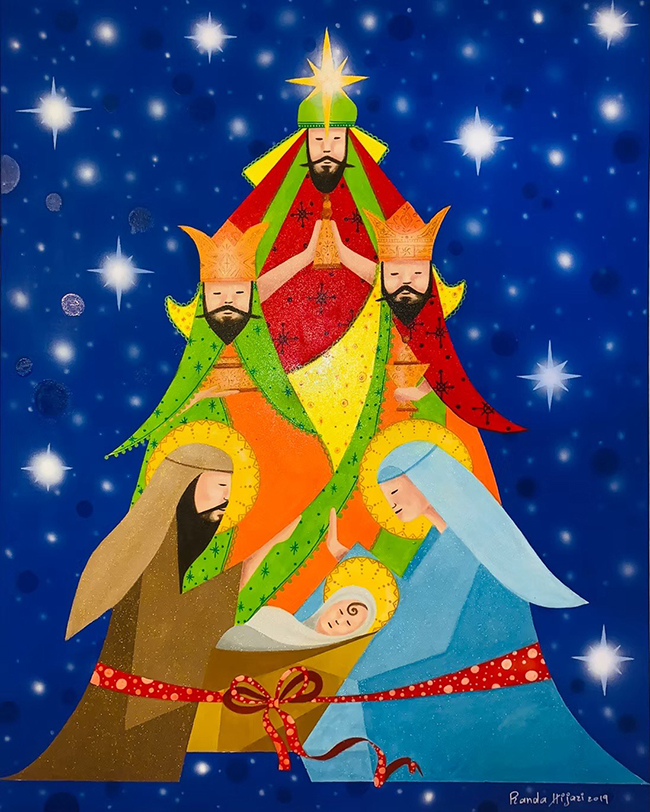
In Holy Family, Randa Hijazi revisits one of the most enduring subjects in art history—the Nativity of Christ—through a contemporary iconographic lens. Rather than treating the scene as a historical moment fixed in the past, she reframes it as a living symbol, one that continues to resonate across cultures and time. The painting balances reverence with accessibility, inviting viewers into a space where sacred meaning and modern visual language coexist.
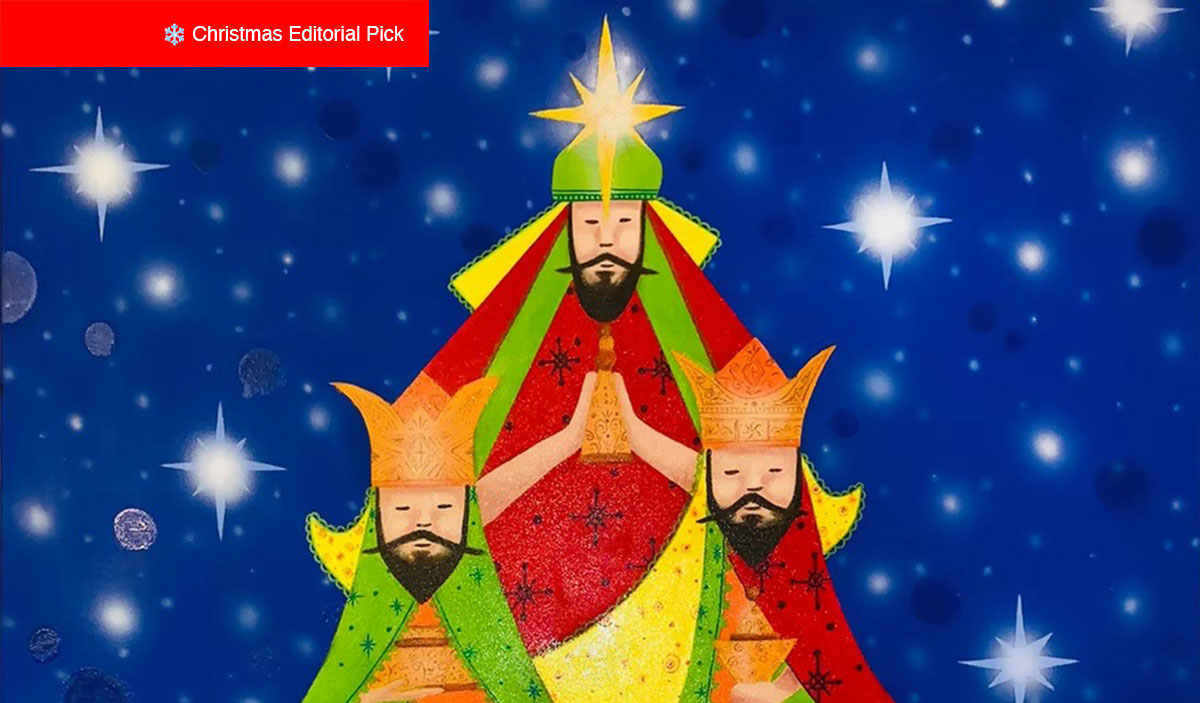
The composition is carefully structured yet emotionally open. The figures are arranged in a pyramidal formation, a classical device often associated with stability, harmony, and spiritual ascent. At the apex of this structure shines a radiant star, a central symbol of divine guidance and promise. The star does more than illuminate the scene; it anchors the composition and draws the eye upward, suggesting a movement from human tenderness toward something greater and unseen.
Each figure is encircled by a golden halo, a clear reference to traditional iconography. Yet Hijazi’s use of gold avoids rigidity. The halos do not isolate the figures; instead, they connect them. The light seems to flow between bodies, reinforcing a sense of unity rather than hierarchy. This shared glow suggests sanctity as a collective state—something formed through relationship, care, and presence.
One of the most striking conceptual choices in Holy Family is the subtle silhouette created by the interwoven figures. Together, they evoke the shape of a Christmas tree, an image deeply embedded in global celebrations of the season. This visual echo transforms the Holy Family into a symbol of life, growth, and continuity. The tree shape rises gently from the base of the composition, reinforcing ideas of rootedness and upward movement. In this way, Hijazi bridges the spiritual meaning of the Nativity with a universal symbol recognized far beyond religious boundaries.
Color plays a central role in shaping the emotional atmosphere of the work. Deep celestial blues dominate the background, opening the scene into a vast, star-filled space. These blues are paired with saturated reds, greens, and golds—colors traditionally associated with celebration, warmth, and renewal. The palette conveys joy without excess, calm without stillness. It reflects both the intimacy of the family and the wider, almost cosmic significance of the event being depicted.
The background itself extends the narrative beyond a specific location. By placing the figures within a starry expanse, Hijazi removes the Nativity from a single point in history or geography. The birth of Christ becomes a moment suspended in time, both cosmic and deeply human. This choice aligns with her broader artistic approach, where themes of belonging and displacement often surface subtly through spatial and symbolic decisions.
The figures’ faces are simplified and gently abstracted. Individual features are softened, allowing the emphasis to shift from personal identity to shared meaning. This abstraction encourages viewers to see the Holy Family not as distant icons, but as universal symbols of love, protection, and new beginnings. The calm gestures and soft lines reinforce an atmosphere of care and quiet connection. There is no drama in posture or expression—only presence, closeness, and trust.
Holy Family carries significance beyond the canvas. The artwork was officially selected by the Government of Canada and the House of Commons of Canada as the official greeting card for Christmas and New Year celebrations for the years 2025–2026. This recognition speaks to the painting’s ability to communicate across cultures and beliefs. Its message of peace, inclusivity, and shared human values aligns with a broader public context, where art serves as a bridge rather than a boundary.
Within Randa Hijazi’s practice, Holy Family reflects her ongoing dialogue between tradition and the present. Drawing from iconographic roots while speaking through a contemporary visual language, the work embodies her lived experience of movement and adaptation. It does not ask viewers to belong to a specific faith or history; instead, it offers an image of tenderness, hope, and light—qualities that remain relevant, especially in times shaped by change and uncertainty.
Through this painting, Hijazi demonstrates how sacred themes can be reimagined without losing their depth. Holy Familystands as a quiet yet resonant statement, reminding us that new beginnings often emerge from intimacy, care, and a shared search for light.
