

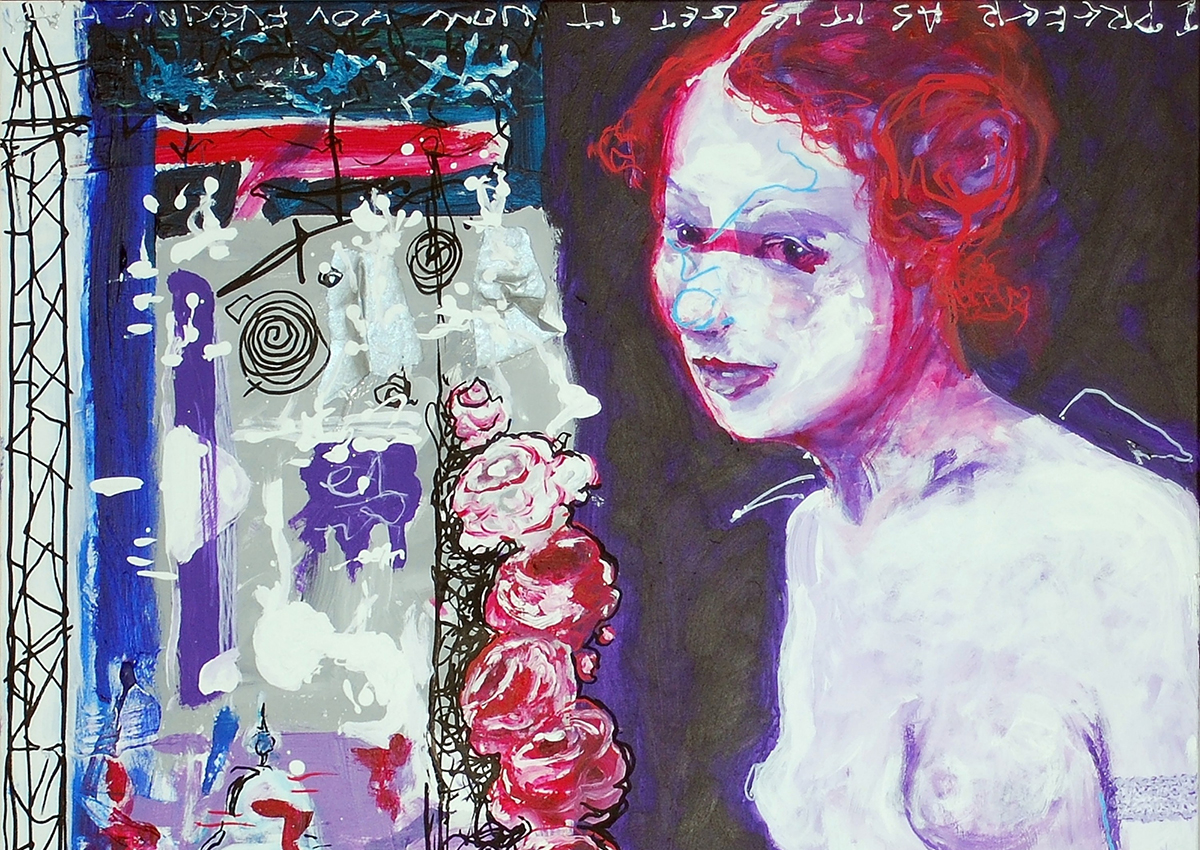
Luigi Francischello was born in Zurich and spent his early life between Switzerland and Australia before eventually settling in Italy, where he now continues his creative journey. His work has traveled across borders as much as he has, finding homes in exhibitions in London, Paris, Alice Springs, Amsterdam, Montecarlo, Rome, Porto, and Venice. Francischello often describes his practice as a channel of energy, shaped toward a purpose: reaching a state of aesthetic bliss through art. He is deeply engaged with art history, fascinated by its depth, its beauty, and the endless range of references it holds. In his paintings, layers of ornaments, symbols, and forms come together to create narratives where ambiguity and paradox are not problems to solve but engines that drive meaning. For him, art is communication, experience, and belonging—a way of connecting inner worlds with shared spaces.
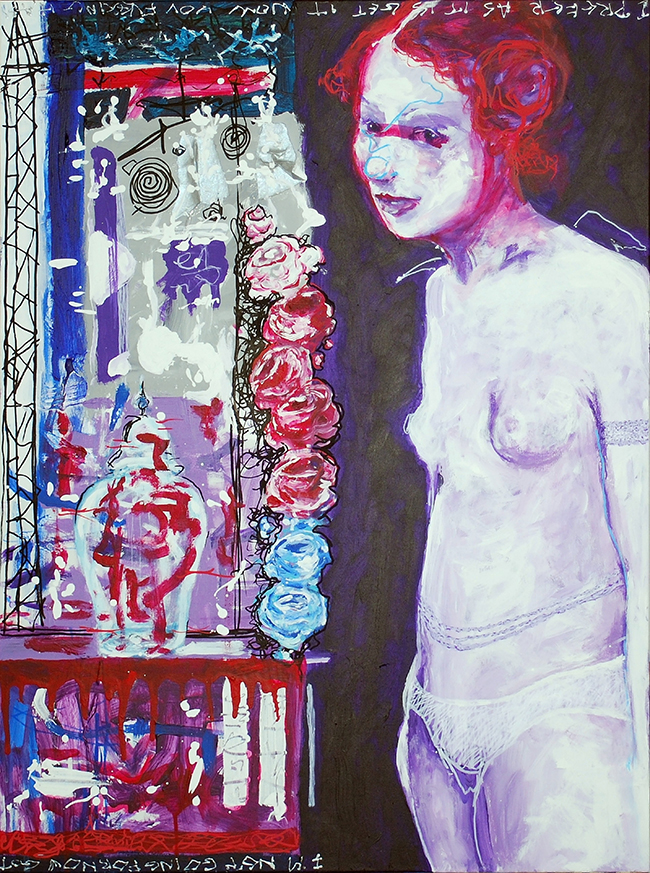
Francischello views art as something alive, something that happens between thought, instinct, and a kind of emotional electricity that cannot be fully predicted. He believes that painting is not simply the execution of an idea but a journey through impulse, reflection, and risk. That belief sits at the heart of his work. When he says art is “experience and expression of the soul,” he is pointing toward art as a living encounter rather than a static object. The canvas becomes a place where thoughts move, collide, and occasionally resolve themselves in unexpected ways.
His paintings often feel as though they are emerging in real time. Images come forward through swift gestures and expressive marks, as if speed itself were part of the language. The brushstrokes are confident yet restless, leaning toward energy rather than calm. This sense of urgency is not chaos; it is a deliberate embrace of movement. It suggests that creation does not follow a linear script. It unfolds the way thought does—shifting, layering, doubling back, jumping ahead.
Art history plays a major role in his practice, not as a museum archive, but as a living conversation. Fragments of visual memory, echoes of classical painting, symbolic decoration, and historical references weave through his works, yet they never feel nostalgic. Instead, they become raw material. They are not quoted politely; they are absorbed, reinterpreted, and pushed into fresh terrain. That is why his paintings feel both familiar and unexpected. One senses traces of the past, but they appear filtered through a contemporary sensibility that values intuition as highly as structure.
Francischello talks about his paintings as “emergent fields,” and that phrase describes them well. They are not closed compositions; they are spaces that feel as though they are still forming, still becoming. The elements inside them do not sit quietly. They interact. Ornamental shapes mingle with suggestive forms. Narrative hints appear and dissolve. Humor and gravity share room. What might initially seem decorative soon reveals conceptual play beneath its surface. Ambiguity becomes central. Meaning is not handed over in a single statement; it unfurls as the viewer spends time inside the work.
Color plays a key role in shaping that experience. It does not only describe space; it creates it. Through color, Francischello builds idealized environments, atmospheres where imagination can move freely. His use of color is expressive rather than literal. It opens emotional climate rather than recording physical reality. In this sense, his paintings are less about depicting the world and more about inventing new inner landscapes.
At the same time, his work is not detached from life. He speaks clearly about art as communication, as something that belongs to lived experience and shared human presence. For him, painting connects to places, to people, to the sense of belonging and relation that defines human existence. There is an introspective dimension, but it is never sealed off. The inward gaze becomes a bridge to something social, collective, and open. Art, in his view, is not isolation. It is a conversation with others, even when it begins in solitude.
That is also why paradox and complexity remain important in his paintings. They mirror how life actually feels—layered, contradictory, layered with signals that do not always line up neatly. Instead of simplifying that reality, Francischello welcomes it. The unexpected becomes part of the structure. Randomness is not disorder; it is the honest presence of life’s unpredictability inside the painting.
In the end, Luigi Francischello’s work invites viewers into a space that is at once thoughtful and emotionally charged. His paintings breathe. They think. They wander. They draw from art history, imagination, and lived experience, then fuse them into visual fields that remain open, alive, and generous. Through rapid marks, layered ideas, and a constant dialogue with beauty and complexity, he creates paintings that do not simply represent something—they create a space in which thought, feeling, memory, and imagination can meet.
