

Alexandra Jicol creates from a place of connection—between inner life and outer world, between memory and the present moment. She grew up in Bucharest in a period marked by limitation and social pressure. Her early years held contrasts: the quiet of mountains and rural landscapes set against the restraint of city life shaped by control. This duality left an imprint. You can sense it in how her paintings hold both calm and tension at once. There is space, yet also compression; softness beside unease. Jicol approaches art as an act of observing, feeling, and translating lived experience into color and form. Rather than chasing spectacle, she turns inward. Her pieces often read like visual diaries, where reflection, restraint, and release meet on the same surface. The result is art that feels personal yet open, inviting viewers to find their own meanings inside her layered worlds.
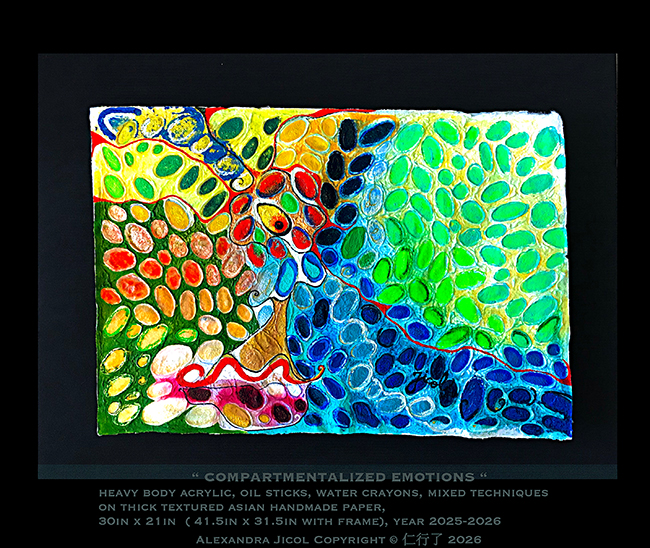
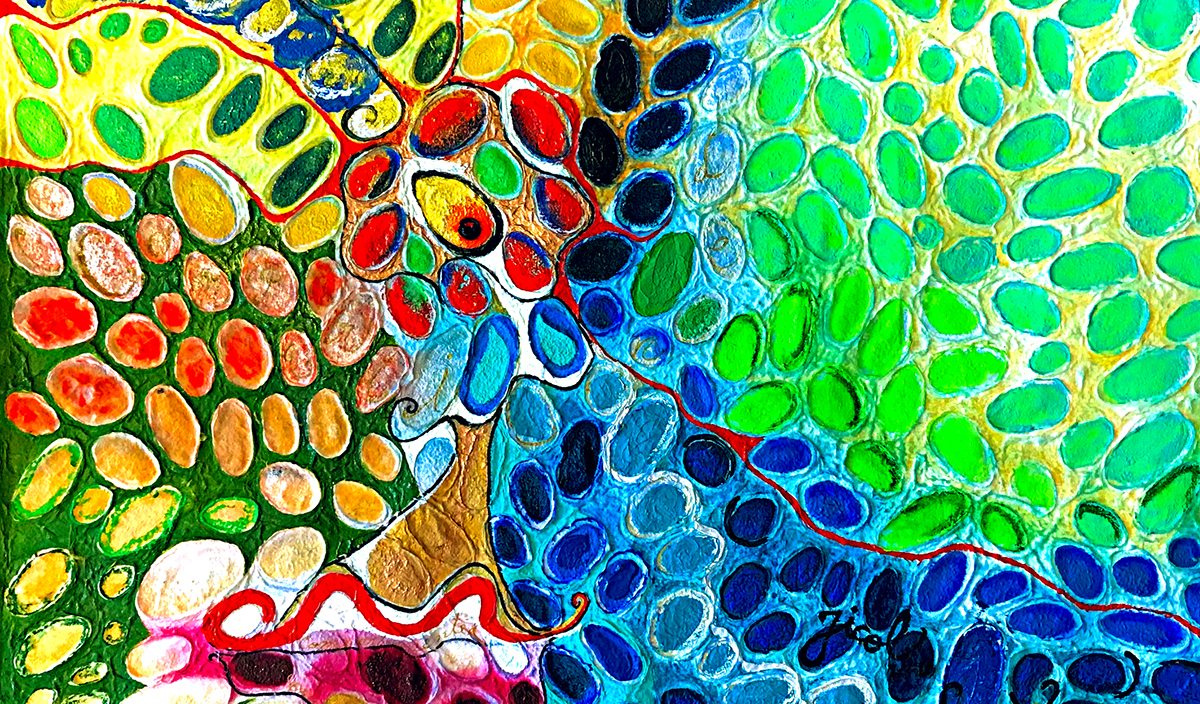
Jicol’s painting “Compartmentalized Emotions” (2025–2026) sits at the center of her current direction. Created with heavy body acrylic, oil sticks, water crayons, and mixed techniques on thick textured Asian handmade paper, the piece immediately communicates weight and layering. The surface is not smooth; it carries the physical record of its making. Marks build over marks. Colors press against each other. Nothing feels accidental.
The title offers a direct entry point. The idea of compartmentalizing is familiar to many people: feelings sorted, hidden, postponed, or sealed away so daily life can continue. Jicol takes that mental habit and turns it into visual language. Blocks of color act like containers. Some shapes feel closed, others cracked open. There are hints of words embedded under layers—partly visible, partly obscured. They behave like thoughts we try to bury but that still leak through.
Red filaments appear to bleed and travel across space. They suggest emotional residue, traces that do not disappear. Yet the painting is not only about heaviness. Jicol speaks about hope, passion, and generosity as what remains in the end. That sense comes through in the brighter intervals where color lifts and breathes. The painting does not resolve emotions neatly. Instead, it accepts that human feeling is layered, sometimes messy, often unresolved.
Importantly, Jicol sells only originals. No copies or lithographs. That decision aligns with the theme of individuality in the piece. Each painting stands as a single emotional record, not something to be repeated. Even the note that colors shift under daylight or artificial light fits the concept: perception changes, just like feelings do.
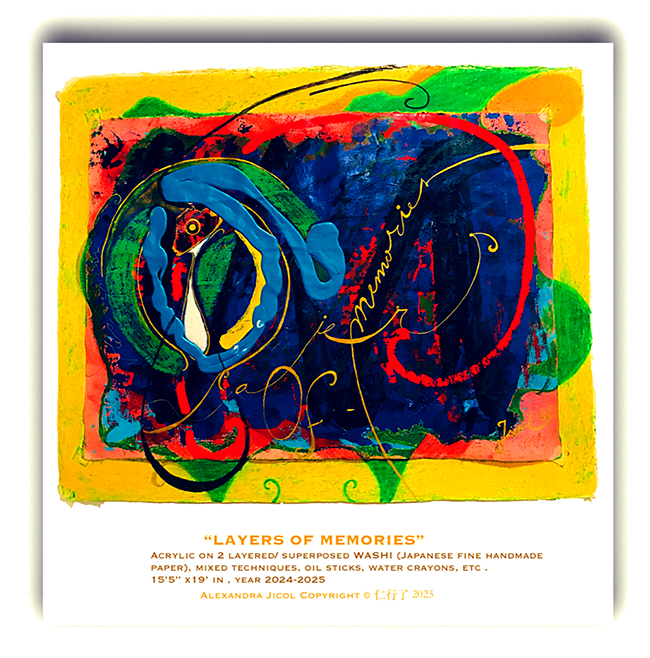
Where “Compartmentalized Emotions” deals with sorting and containing, “Layers Of Memories” (2024–2025) explores accumulation. Built on two superposed sheets of Japanese handmade paper with acrylic, oil sticks, and water crayons, the painting reflects how memory stacks over time. Nothing is erased; it is covered, softened, or reinterpreted.
Jicol describes memories as ranging from grief to tenderness, from trust to longing. That range appears in the painting’s tonal shifts. Some areas feel dense and saturated, others light and open. The layering of paper itself becomes metaphor. One sheet supports another, just as past experiences support the present self.
There is also a sense of return. The idea of being “teleported” into the past speaks to how memory can be sudden and physical. A color, a texture, or a fragment of text can trigger recall. Jicol does not illustrate specific events; she leaves them abstract. This allows viewers to project their own histories into the work. A painting becomes less about her story and more about shared human recall.
Across both pieces, Jicol’s process matters as much as the result. Mixed media allows correction, covering, and rediscovery. A mark can be hidden and later reappear at the edge. This mirrors how people process life—rarely in straight lines. Her use of handmade papers adds fragility and tactility. These surfaces absorb pigment differently, creating depth without heavy polish.
What stands out in Jicol’s approach is her role as observer. She often describes herself as someone who looks, listens, and learns without judgment. That attitude carries into the paintings. They do not instruct the viewer what to feel. They present a field of emotion and let the viewer navigate.
There is also restraint in her palette choices. Even when colors intensify, they do not shout. They hold. This gives space for contemplation. The viewer can stay with a painting and notice shifts rather than receiving everything at once.
Jicol’s art circles around a simple but demanding idea: to acknowledge the inner landscape honestly. Emotions sorted or unsorted. Memories joyful or painful. Connection and disconnection happening at the same time. Her paintings do not promise closure. They offer recognition. In that recognition, many viewers may find their own reflections—quietly layered, like the paintings themselves.
