

Born in Japan in 1948, Kiyomitsu Saito has built an artistic practice shaped by curiosity, doubt, and a persistent questioning of how humans construct meaning. From his early exhibitions in Tokyo and Osaka to his later move to New York, Saito’s path reflects a steady refusal to settle into fixed answers. His work often circles language, symbols, and social structures—not to clarify them, but to unsettle them. A key moment came in 1990, when he relocated to New York, entering an environment that encouraged risk, friction, and experimentation. While the shift expanded his visual and conceptual range, Saito never abandoned the sensibilities rooted in Japanese thought, particularly its comfort with ambiguity and impermanence. This balance between cultures runs quietly through his practice, allowing his art to sit in an in-between space where logic loosens and new ways of seeing begin.
The Work: pera pera art (foolish drawing)
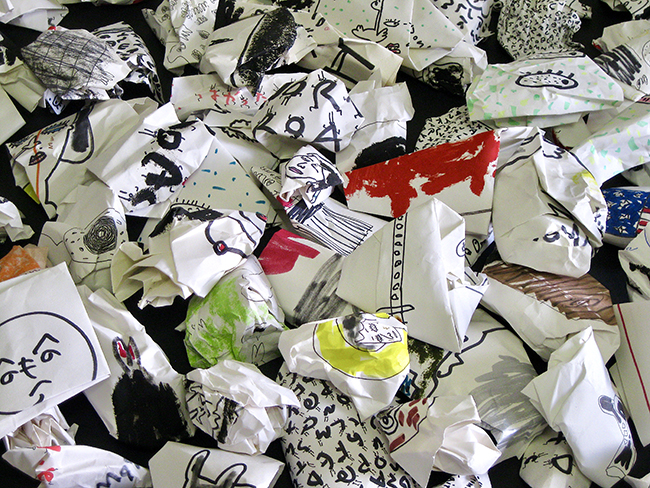
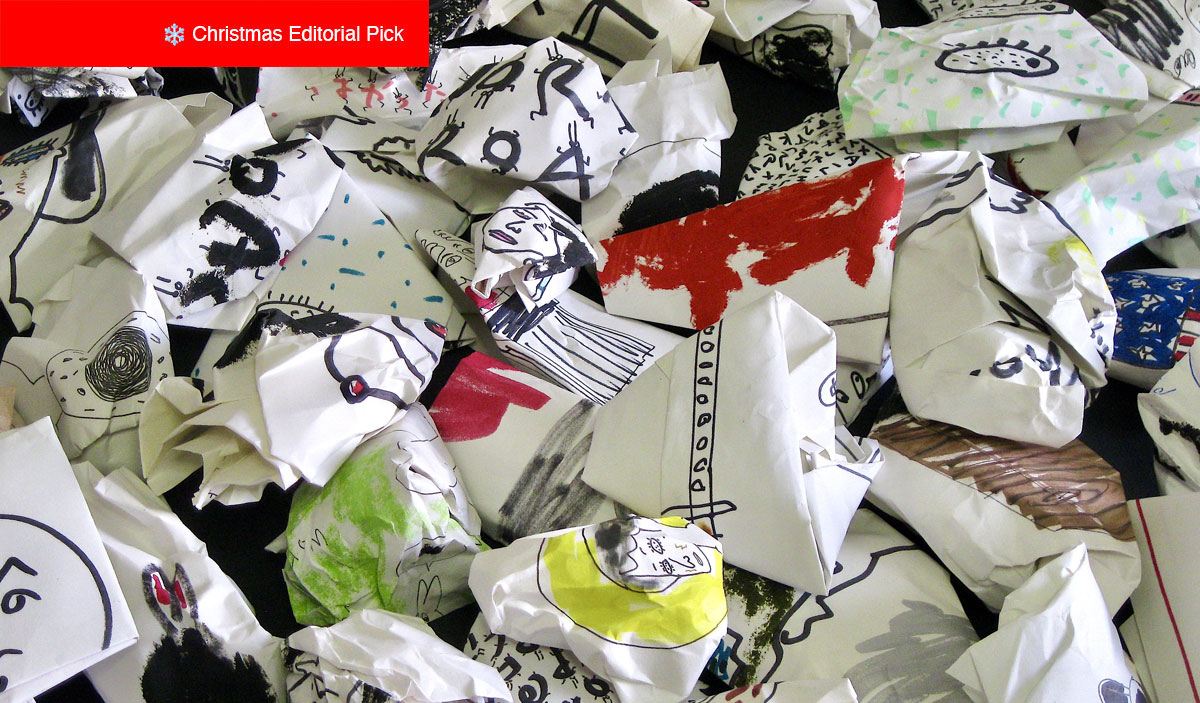
pera pera art (foolish drawing), created in 2023, offers a clear view into how Kiyomitsu Saito approaches image-making and thought. Built as an installation using marker, oil stick, and acrylic on paper, the work extends into three dimensions, refusing the limits of a single surface or neat composition. At first glance, the drawings appear casual, even careless—lines overlap, forms collide, and color behaves unpredictably. Yet this looseness is intentional. Saito has described the concept simply: he was careful not to make sense.
That statement is not a dismissal of intention; it is the intention itself. In pera pera art, Saito leans into what he calls the “meaningfulness of meaningless.” Rather than guiding the viewer toward a conclusion, the work opens a field of uncertainty. Images do not explain themselves. Symbols resist interpretation. The installation asks the viewer to stay with confusion instead of resolving it.
The term “pera pera” in Japanese can suggest lightness, thinness, or even chatter—something that flows quickly without depth. Saito adopts this idea as a strategy. By presenting drawings that seem foolish or unfiltered, he sidesteps the pressure for seriousness that often surrounds contemporary art. This foolishness, however, is deliberate. It functions as a tool to disrupt habits of reading, labeling, and judging.
Material plays an important role here. Marker lines feel immediate and irreversible. Oil stick adds density and smudge, while acrylic introduces blocks of color that interrupt the drawing beneath. Paper, bent or arranged in space, becomes sculptural rather than passive. The installation format encourages movement; viewers encounter fragments rather than a single viewpoint. Meaning shifts depending on where one stands, what one notices, and what one ignores.
This refusal to stabilize meaning connects closely to Saito’s long-standing interest in language. Earlier works, including WORD-ROACH, explored how words behave like living organisms—multiplying, mutating, and sometimes becoming pests within social systems. In pera pera art, language dissolves further. Words, if present at all, lose authority. Images act like broken sentences, offering rhythm without grammar.
There is also a cultural tension embedded in the work. Japanese aesthetics often accept emptiness, imperfection, and transience as essential rather than flawed. At the same time, Saito’s decades in New York exposed him to environments that reward boldness, noise, and constant production. pera pera art sits between these worlds. It is neither meditative nor aggressive. Instead, it hovers in a space of playful resistance.
The idea of being “careful not to make sense” is especially relevant now, in a time when images are expected to explain themselves instantly. Saito pushes against that demand. His installation slows the act of looking, not by offering clarity, but by withholding it. Viewers may feel uncertainty, humor, irritation, or curiosity—none of which are resolved by the work itself.
Importantly, the foolishness in pera pera art is not about ignorance. It is about choosing not to perform intelligence in conventional ways. By stepping away from explanation, Saito invites a different kind of engagement—one that values presence over interpretation. The work does not ask what it means; it asks how it feels to encounter something that refuses to mean.
In this sense, pera pera art (foolish drawing) reflects a core thread in Saito’s practice: a steady questioning of how meaning is constructed, enforced, and consumed. Through simple materials and an open structure, the installation creates space for doubt. And within that doubt, something quietly generous emerges—the freedom to look without needing to understand.
