
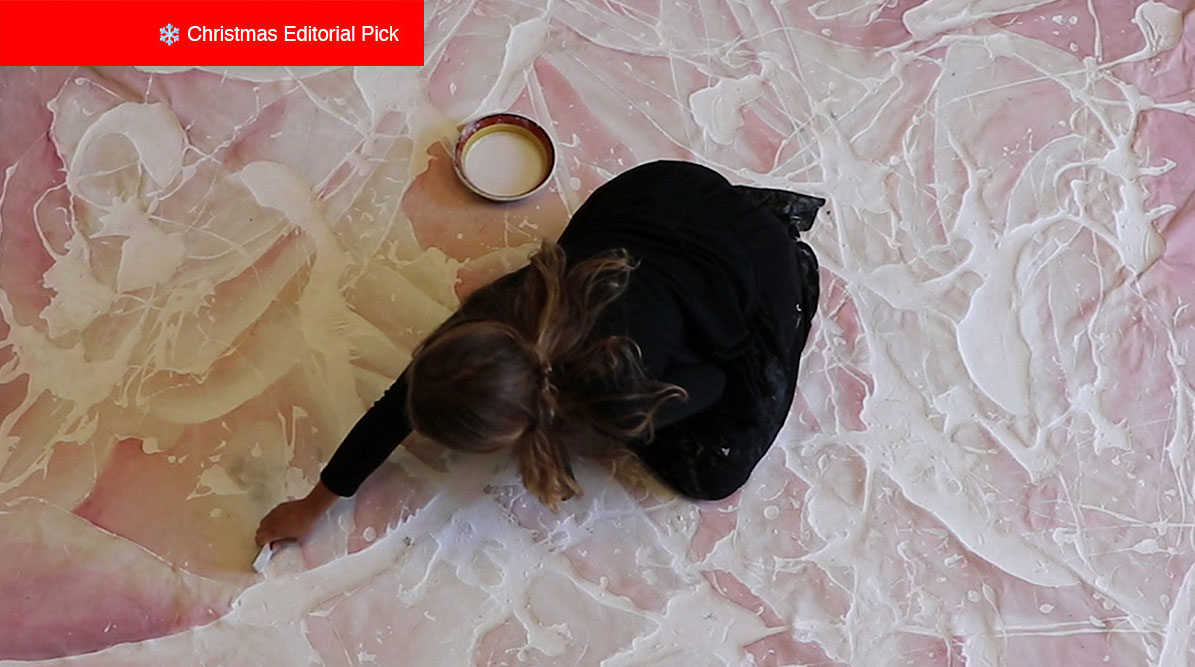
Carolin Rechberg is an interdisciplinary artist whose practice unfolds across materials, sensations, and states of awareness. Born in Starnberg, Germany, her work moves fluidly through ceramics, drawing, installation, illustration, painting, performance, printmaking, photography, poetry, sculpture, sound art, textiles, and voice. Rather than treating these mediums as separate categories, Rechberg approaches them as interconnected languages—each one offering a different way of listening, sensing, and responding. For her, making art is not only about producing an object, but about entering a process that shapes perception and presence. The act of creation becomes a way of moving through the world with heightened attention. Multisensory experience sits at the core of her practice, guiding both her artistic decisions and her understanding of life as a continuous unfolding rather than a fixed destination.
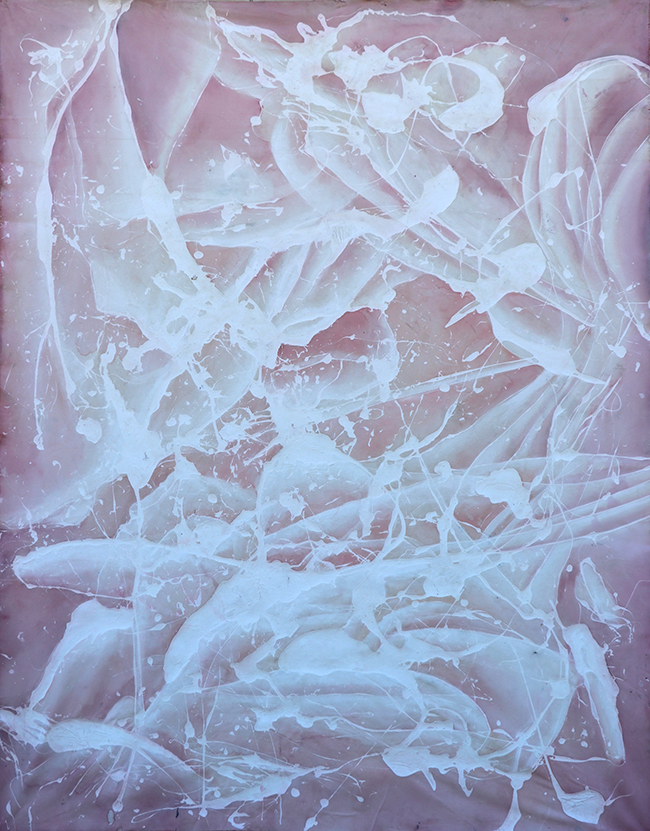
Origin is a large-scale mixed media painting created in 2016 during Carolin Rechberg’s residency at The Lucid Art Foundation. Measuring 213 by 269 centimeters, the work immediately establishes itself as an immersive field rather than an image meant to be read quickly. Its scale invites the viewer into a physical relationship, encouraging stillness, proximity, and time. This is not a painting that reveals itself all at once; it asks to be encountered slowly, much like the internal processes it reflects.
The title, Origin, points toward beginnings, but not in a linear or historical sense. Instead, the work speaks to cyclical emergence—an idea Rechberg articulates through her reflection that “we live in cycles,” and that a decade later she found herself entering another phase of becoming. The painting holds this sense of recurrence and renewal, suggesting that origin is not a singular event but something continually revisited. Birth, in this context, is not confined to biology or myth; it becomes an ongoing internal condition.
While working on Origin, Rechberg describes experiencing a state of rebirth and re-emergence, accompanied by a heightened sense of presence. This internal shift is not illustrated literally in the painting. Rather, it is embedded in the way forms gather, soften, and coalesce. At the center of the composition, shapes appear to move toward one another, neither fully defined nor entirely abstract. They seem to hover at the threshold between form and formlessness, suggesting the moment just before something takes shape.
The surface of the painting carries evidence of its making. Layers accumulate, dissolve, and reappear, creating a visual rhythm that mirrors breathing or gestation. Mixed media allows Rechberg to work beyond the constraints of a single material logic, letting texture, opacity, and subtle shifts in tone guide the process. This openness to material response aligns with her broader practice, where the artwork emerges through dialogue rather than control.
A key aspect of Origin is its tenderness. Despite its scale, the work does not dominate the viewer. Instead, it holds a quiet intensity, as if protecting the fragile moment it depicts. Rechberg speaks of feeling as though she were “in the womb of the creation of my own spirit” while working on the piece. This sensation translates into a visual space that feels enclosed yet expansive, intimate yet vast. The painting does not dramatize birth; it dwells within it.
At the heart of the composition lies what Rechberg describes as “the coming together of essence, of shape, of form itself.” This convergence is not rendered as a fixed symbol but as a living condition—an event still unfolding. The image resists narrative closure. There is no before or after, only presence. In this way, Origin reflects Rechberg’s belief that being is not something we arrive at, but something we continuously enter.
The residency context at The Lucid Art Foundation plays a quiet but meaningful role in the work’s formation. Residencies often provide artists with temporal and mental space, and in this case, that space seems to have allowed Rechberg to attune deeply to her internal rhythms. Origin carries the imprint of sustained attention, of days spent listening rather than producing for an external outcome.
Ultimately, Origin can be understood as both a personal and universal meditation. While rooted in Rechberg’s own experience of emergence, the painting leaves room for viewers to encounter their own cycles of becoming. It does not instruct or explain. Instead, it offers a place to pause—to sense the moment where something begins, not with certainty, but with openness. In this way, Origin stands as a quiet affirmation of presence itself: the fragile, powerful instant where existence recognizes itself in the act of forming.
