


Kyukun Kang’s paintings begin with a simple moment most artists would dismiss: light hitting a wet canvas in the wrong way. One day, he walked into his studio, switched on the overhead lamp, and saw the glare stretch across the surface of a half-finished painting. It distorted the image just enough to unsettle him. What should have been a clear reflection of reality suddenly felt unfamiliar—almost like seeing a place he knew for the first time. This quiet disruption pushed Kang toward a new direction.
He had spent years studying how light defines objects, shapes figures, and draws the line between what is visible and what disappears into darkness. But that moment in the studio opened a door. Instead of staying loyal to factual light, he began letting imagination seep in. The figures in his work started drifting between reality and something more elusive. For Kang, painting became less about perfect accuracy and more about exploring everything that remains uncertain.
The Art of Kyukun Kang: Where Reality Thins and Imagination Enters
Kang’s practice sits on a fault line—between what the eye sees and what the mind invents. For him, painting used to be an exercise in precision. Light had rules. Matter responded to it. Forms took shape according to what the eye could confirm. He worked inside that structure for a long time, using contrast, shadow, and brightness to make the visible world feel grounded and honest.
But the glare on that canvas changed something. It introduced a kind of visual contradiction: the painting was still real, but the light made it feel foreign. That tension was new. It also refused to go away. Kang began wondering what would happen if he allowed that unfamiliarity to become part of the work rather than something to correct.
He started stripping away backgrounds. Leaving blank, soft areas that hold space instead of detail. He painted figures and then erased parts of them. He removed facial features, wiped out surfaces, and brought in new sources of light that didn’t belong to any real setting. In doing so, he discovered a different kind of clarity—one that didn’t depend on accuracy.
Kang approached each piece as a negotiation. On one side was the world exactly as it is. On the other was the world as it might appear in a half-remembered dream or a moment of hesitation. The figures that emerged from this process feel present but slightly out of reach. They look like people you might pass on the street but not entirely recognize. They inhabit the space between presence and absence, between standing somewhere specific and being nowhere at all.
What Kang found in this in-between zone was freedom. Once he stopped treating representation as a fixed responsibility, his paintings loosened. They breathed. He allowed the canvas to remain unresolved in places, letting emptiness speak as loudly as detail. The contrast between the seen and the unseen became the heart of his visual language.
**WAITING PERSON, 2022
Oil on canvas, 91.0 × 72.7 cm (approx. 600 words)**
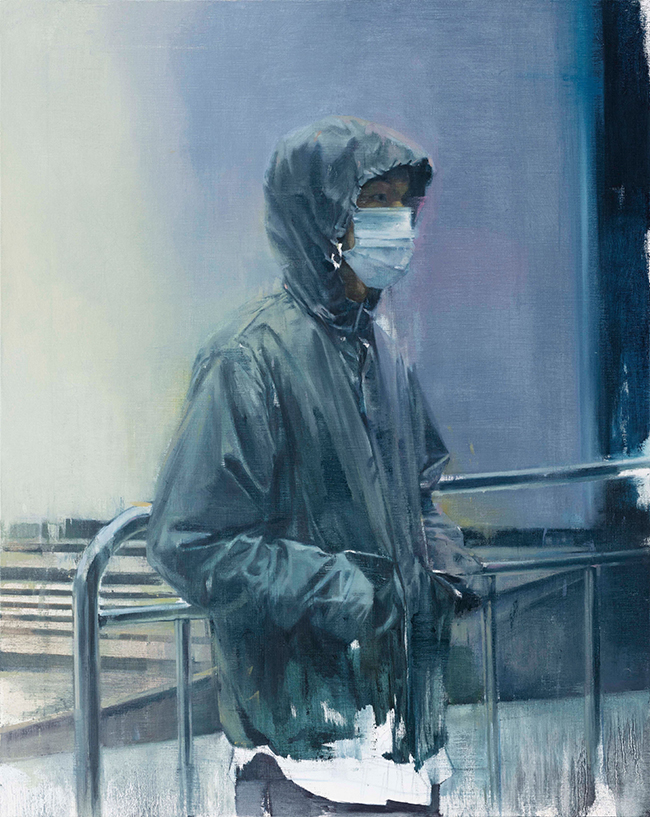
Waiting Person captures a mood that feels instantly relatable, even if the setting is vague and the figure is partially obscured. Kang presents a hooded person standing in what appears to be an urban space—rails, concrete, and muted tones suggest a public area, but nothing is defined enough to anchor it to a specific place. The figure wears a mask, hands tucked in pockets, body angled slightly away. The atmosphere is cool, washed in grays and pale blues. Everything feels quiet, suspended.
Kang describes the work as an exploration of how humans can only perceive the present moment, even as the past and future press into it. That tension is alive in the painting. The figure looks outward, but we don’t know what they’re waiting for. The uncertainty becomes the subject.
The mask is an obvious marker of a specific global period, yet Kang doesn’t treat it as a direct commentary. Instead, it becomes part of the larger idea of partial visibility—how much of a person you can know when half their face is hidden, how much of their inner life remains sealed away. The mask isn’t just protective; it’s symbolic of the limits of perception.
What stands out most is Kang’s handling of light. The illumination is soft but ambiguous. It doesn’t come from a clear source. It glows across the jacket, diffuses through the air, and fades into a pale emptiness on the left side of the canvas. The blank area isn’t an omission—it’s an intentional pause, almost like a deep inhale that hasn’t yet been released. This emptiness contrasts sharply with the more structured right side of the canvas, where rails and vertical lines give a sense of direction.
This split—empty versus defined—mirrors the inner condition of waiting. When a person waits, time stretches. The present becomes thick. The mind drifts between what has happened and what might happen, even though the body is stuck in one exact place. Kang paints that psychological state rather than the literal act of standing still.
The figure’s posture reinforces this mood. Hands buried in pockets suggest self-containment. The slightly forward tilt of the head hints at focus or concern. The hood drawn over the head creates a barrier between the figure and the environment. The painting gives you just enough to sense the mood, but never enough to fully decode it.
Kang’s brushwork adds another layer. The jacket is painted with loose strokes that create motion without actually showing movement. The bottom portion fades into rough, abstract marks. It’s as if the figure is dissolving into the environment—or emerging from it. This instability matches the emotional tone: waiting often feels like being halfway between two states.
The background has similar qualities. Some areas are sharp and metallic, while others melt into soft gradients. The effect is a world that feels real but slightly unmoored. This reflects Kang’s interest in blending factual observation with imagination. The setting is recognizable, but the looseness in the paint destabilizes it just enough to create uncertainty.
What makes Waiting Person resonate is its honesty. It doesn’t dramatize emotion; it quietly acknowledges it. The unrest Kang mentions is subtle but present. The painting taps into the universal experience of standing in a moment that feels suspended, without answers, without clarity, but still undeniably real.
In the end, Waiting Person becomes more than an image of someone looking out. It becomes a mirror of the human condition—aware of the now but unable to escape the weight of what came before and what might arrive next. Kang captures that moment with restraint, sensitivity, and a calm kind of truth.
