


Linda Cancel was born in 1959 in Moscow, Idaho, and her way of seeing the world has been shaped early on by the quiet drama of the Pacific Northwest. Landscape, atmosphere, and the slow movement of light across land and water have stayed with her since childhood. One of her earliest memories—watching fireworks bloom over the Snake River when she was just over a year old—became a kind of visual imprint. That moment of light against darkness still echoes through her paintings. Cancel’s work is grounded in observation, but it is never detached. She paints from lived experience, from moments that carry emotional weight, and from relationships that define her inner life. Light, shadow, and form are not decorative elements in her practice; they are tools for attention and meaning. Her paintings often feel intimate and deliberate, inviting the viewer into spaces shaped by care, memory, and human connection.
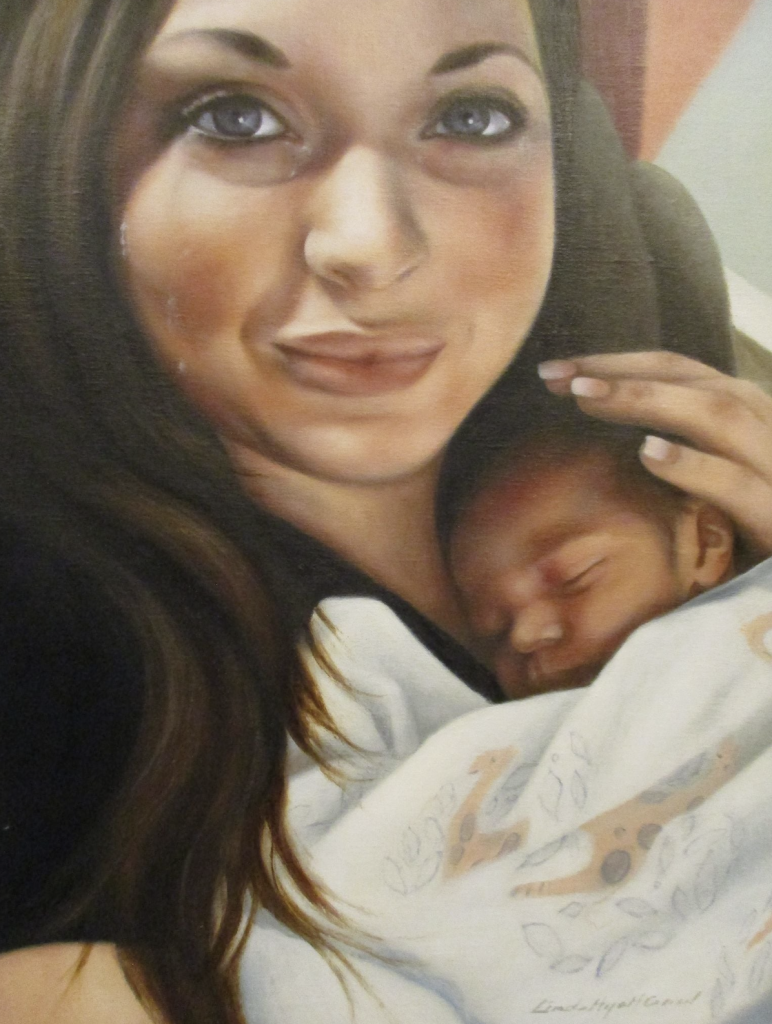
Linda Cancel’s painting Amor Matris was created in 2020, during a time when private moments were shaped by public crisis. The work is a portrait of her daughter Maria and Maria’s newborn son, Theo, painted in oil on linen mounted on aluminum, measuring 16 x 12 inches. On the surface, it depicts a quiet homecoming. Beneath that, it carries the weight of uncertainty, relief, and maternal bond forged under pressure.
The story behind the painting is inseparable from the image itself. Maria went into labor on June 13th—her birthday—at the height of the COVID-19 pandemic. Hospital access was restricted. Only medical staff and one immediate family member were allowed inside. When complications arose, an emergency C-section became necessary. Theo arrived the following day, healthy, on Flag Day. Relief came not in celebration, but in survival: mother and child returning home safely, together, after an experience defined by separation and fear.
Cancel does not dramatize this moment. Instead, she slows it down. Amor Matris focuses on the stillness after crisis—the quiet that follows when the body can finally rest. The composition draws the viewer inward rather than outward. There is no spectacle here, no attempt to explain the event. The painting trusts the power of proximity: a mother holding her child, the intimacy of shared breath, the simplicity of being home.
The title, Amor Matris—Latin for “a mother’s love”—signals the work’s deeper reference. Cancel painted the piece as an allusion to the Madonna and Child, a subject that has appeared throughout art history as a symbol of care, protection, and continuity. By referencing this tradition, she places a contemporary, personal moment into a much longer visual conversation. This is not about idealization. It is about endurance. The Madonna reference becomes a framework for acknowledging the strength required simply to arrive at safety.
Material choices matter here. Oil on linen allows for softness and density at once. The surface holds warmth without becoming sentimental. Mounted on aluminum, the work gains quiet stability—an underlying firmness that mirrors the emotional grounding the painting represents. Cancel’s handling of paint remains restrained. She avoids excess detail, allowing form and tone to do the work. The result feels deliberate, patient, and honest.
Light plays a central role, as it does throughout Cancel’s practice. In Amor Matris, light does not announce itself. It settles. It moves gently across figures, reinforcing the sense of shelter rather than exposure. Shadows are present but not threatening. They suggest depth, not danger. This careful balance reflects Cancel’s long-standing interest in how light and shadow carry emotional meaning.
What makes the painting resonate is its refusal to separate the personal from the universal. While the subject is her daughter and grandson, the experience it conveys is widely shared: the vulnerability of childbirth, the fear of uncertainty, and the profound relief of holding someone safe. The pandemic context sharpens this experience without overwhelming it. Viewers do not need to know the details to feel the stakes.
Cancel’s decision to frame this moment through a historical reference rather than a documentary approach speaks to her broader way of working. She is not interested in recording events as they happen. She is interested in how they are held in memory, how they settle into the body, and how they can be carried forward through paint. Amor Matris is less about a single day in June than it is about what remains after—a bond affirmed, a return made possible.
The painting also reflects Cancel’s sensitivity to scale. At 16 by 12 inches, the work asks for closeness. It does not dominate a room. It invites a one-on-one encounter. This choice reinforces the subject matter. The viewer must come near, slow down, and pay attention, mirroring the act of care depicted within the image.
In Amor Matris, Linda Cancel offers a meditation on motherhood that is grounded, restrained, and deeply felt. The painting does not argue or persuade. It simply holds space—for love shaped by fear, for relief earned through endurance, and for the quiet strength found in returning home together.
