
Born in Cuba in 1983, Reynier Leyva Novo approaches art as a method of inquiry—one that questions how power, memory, and belief take shape in everyday life. Working across sculpture, installation, sound, painting, and research-driven processes, Novo examines how histories are constructed, erased, and quietly sustained. His practice often focuses on symbols tied to authority and ideology, asking what remains once their public certainty fades. Rather than presenting fixed narratives, he works through fragments: dust, sound, damaged architecture, and overlooked records. These materials become entry points into broader reflections on collective experience, especially within the Caribbean and diasporic contexts shaped by displacement, faith, and political tension. Novo’s work resists spectacle. It operates through accumulation and attention, tracing how personal and communal histories linger in places long after their visible markers have disappeared. At its core, his practice is grounded in observation, movement, and a sustained engagement with the environments he inhabits.
Gut It, Forget It. Invisible Houston
Gut It, Forget It. Invisible Houston, Reynier Leyva Novo’s solo exhibition at the Transart Foundation for Art and Anthropology, unfolds as a layered study of place, loss, and endurance. Developed in collaboration with Sicardi | Ayers | Bacino, the exhibition grows out of long-term, on-the-ground research across Houston’s wards and historic neighborhoods, with a particular focus on the Third Ward, where Novo lives and works. Rather than approaching the city through abstract theory, Novo builds the project through walking, listening, collecting, and observing the pace at which Houston reshapes itself.
The exhibition brings together three interconnected bodies of work—False Calm, Invisible Houston, and Sacred Dust—each operating through a distinct material language while sharing a concern with what is overlooked, erased, or quietly sustained. Together, they form a portrait of a city understood not as a fixed map but as an active field of memory and transformation.
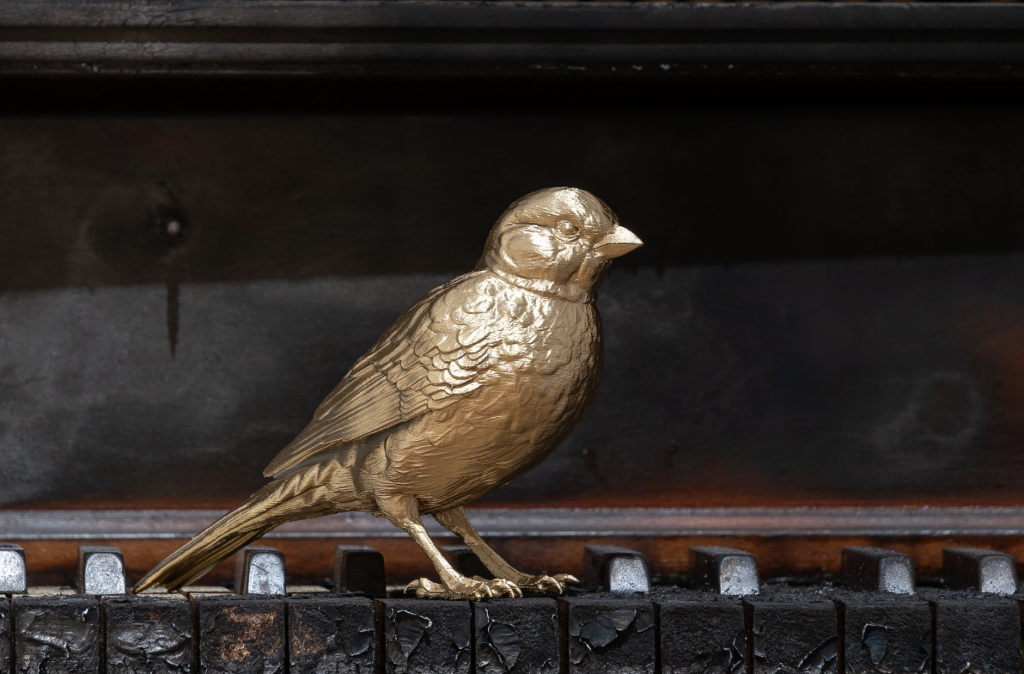
False Calm is a large-scale installation composed of charred domestic furniture arranged throughout the space. These burned remnants suggest interruption and aftermath, but they are not presented as ruins frozen in time. Perched across the furniture are 3D replicas of birds native to Houston, paired with their recorded calls. Sound becomes a structural element, filling the gallery with overlapping bird songs that shift from gentle to dissonant. The installation draws from Novo’s daily movement through the Third Ward, where cycles of demolition, construction, and displacement unfold alongside ordinary life. The burned furniture carries a domestic intimacy, while the birds introduce a fragile persistence—life continuing amid damage. The work does not dramatize destruction; instead, it registers it quietly, through texture, sound, and repetition.
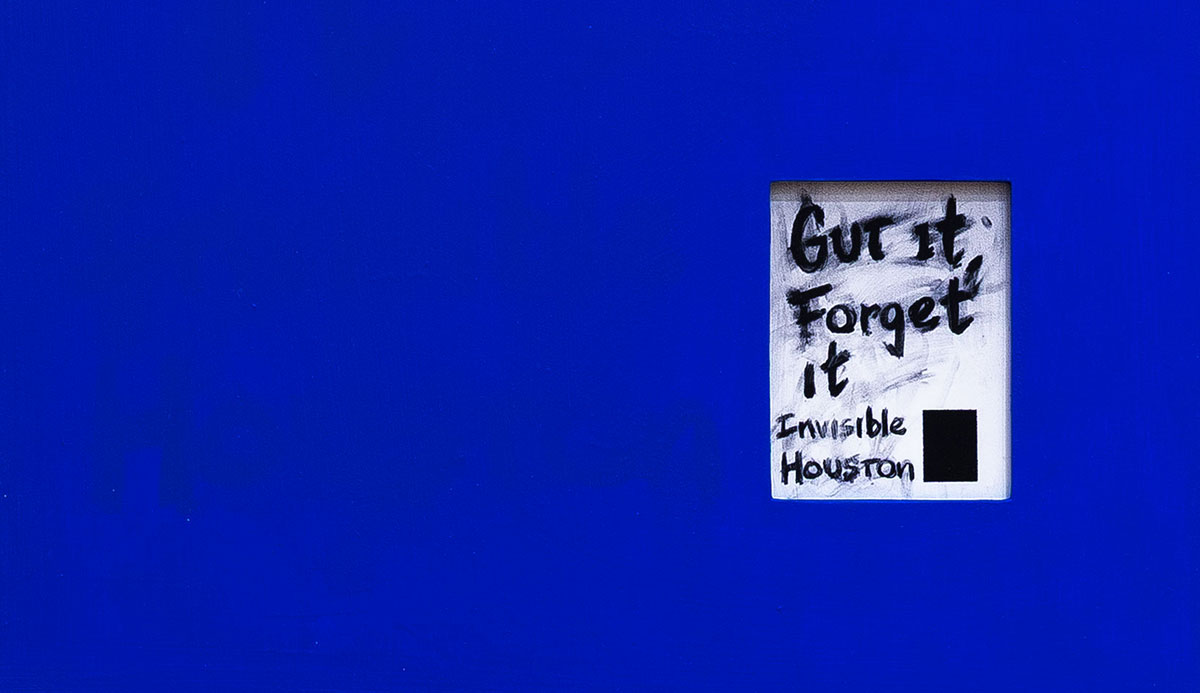
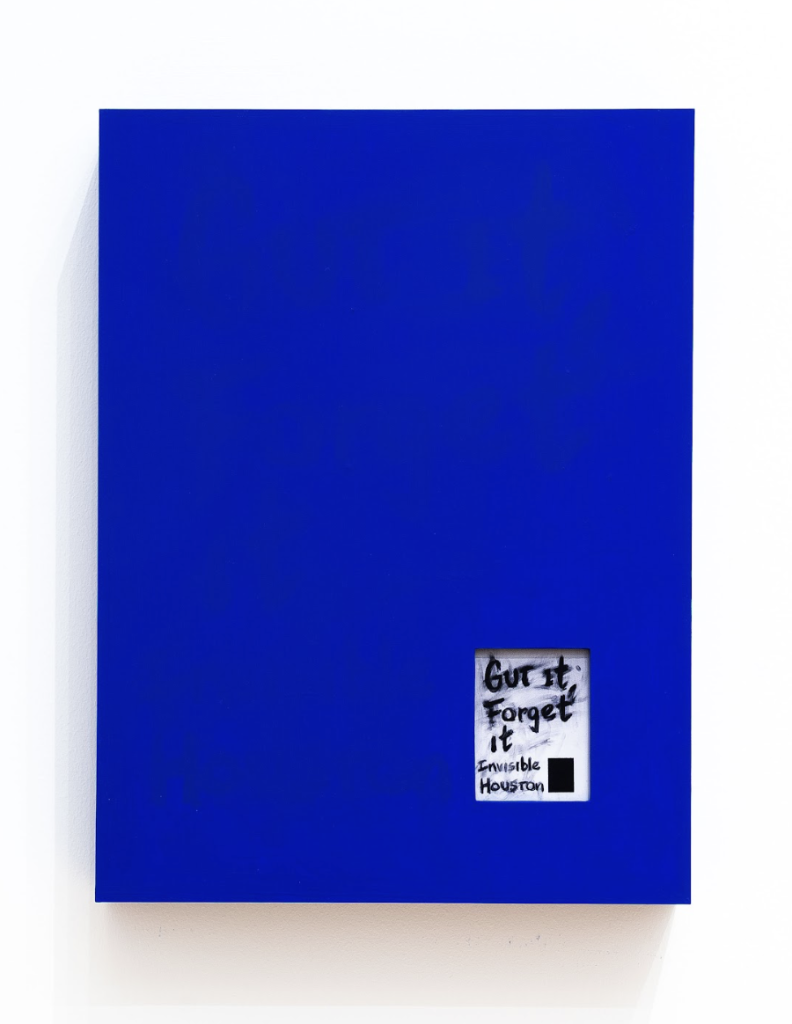
Invisible Houston centers on a monumental painting measuring nine by thirteen feet. At first glance, the surface appears restrained and monochromatic, dominated by a dense field of blue. Yet beneath this surface lies a concealed inventory: a list of historical buildings in Houston that have been gutted, erased, or repurposed beyond recognition. These hidden elements are not immediately visible. Instead, they emerge only through infrared imaging devices available in the gallery, allowing viewers to reveal a second visual register embedded within the painting. This delayed visibility mirrors the way urban histories often persist—present but unreadable without specific tools or knowledge.
Hovering over this concealed memorial is the image of a cosmonaut, drawn from a mural that once appeared on the façade of a now-demolished building in Houston’s former Graffiti Park. The cosmonaut, traditionally associated with futurity and exploration, here becomes an ironic witness to disappearance. Once a public image, it now survives as a spectral reference, embedded within a painting that requires technological mediation to be seen. The work frames progress not as a forward march, but as a process that frequently depends on forgetting.
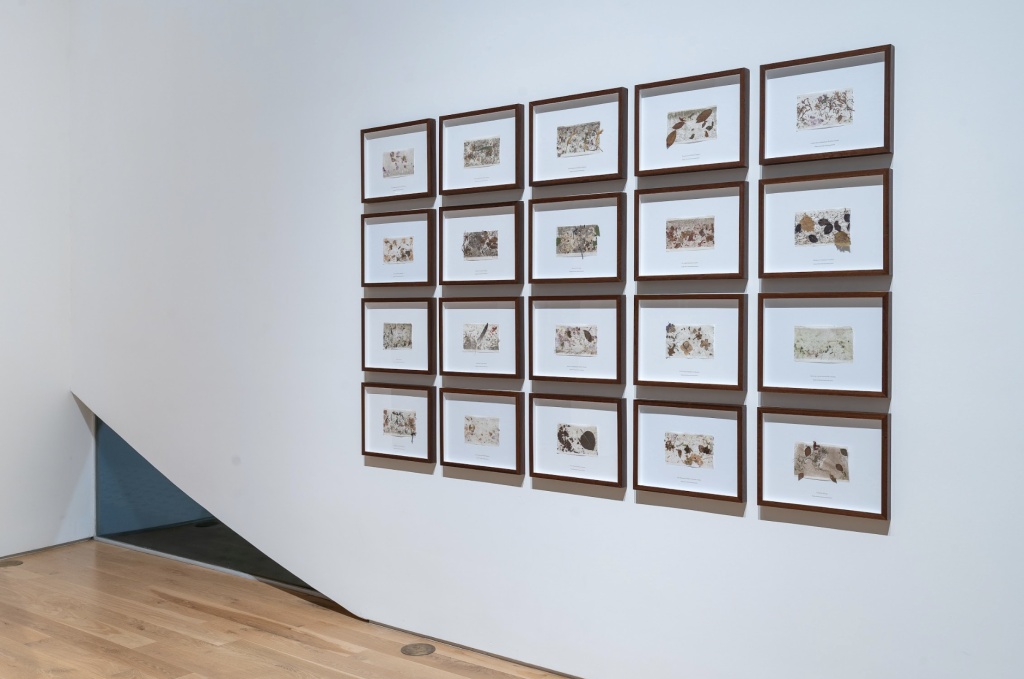
Sacred Dust expands Novo’s long-running Global Active Dust Collection Center into the specific religious landscape of Houston. The city’s dense network of places of worship—spanning evangelical churches, synagogues, mosques, and Buddhist, Taoist, and Hindu temples—becomes the source material for this body of work. Novo collected dust from these sites, treating it as a material record shaped by collective presence, ritual, and time. The dust is presented alongside documentary videos that trace the process of collection, grounding the material in lived interaction rather than abstraction. In this context, dust functions as evidence: a quiet accumulation of bodies, gestures, and belief systems coexisting within a single urban environment.
Extending beyond the gallery, Novo initiated Open Archive: Third Ward, a year-long public call inviting residents and local organizations to contribute personal records connected to neighborhood life. Photographs, documents, audio recordings, and ephemera are gathered not as supplements to the exhibition, but as an integral part of its structure. The archive grows horizontally, shaped by participation rather than curatorial authority, and reflects Novo’s ongoing interest in how histories are written—and who gets to write them.
The title Gut It, Forget It captures the exhibition’s central tension. To gut a building is to strip it of use and memory; to forget is to normalize that loss. Novo’s work interrupts this cycle, offering not restoration or nostalgia, but attention. Through sound, dust, hidden images, and shared archives, Invisible Houston asks viewers to notice what persists beneath surfaces—and to consider how cities remember, even when they appear not to.
