

Shubhi Gupta, an Indian artist based in Singapore, has spent nearly ten years developing a distinctive voice within contemporary art. Her practice moves fluidly between still life and portraiture, creating images that feel intimate yet universal. She approaches her subjects with curiosity, closely observing the small rituals, emotions, and gestures that shape daily human experience. This attentive way of seeing has brought her work into respected circles: her paintings have been acquired by Standard Chartered Bank globally, as well as by private collectors around the world.
Living away from her homeland for over two decades, Gupta draws insight from cultural movement, memory, and the layered identity formed through crossing borders and adapting to new environments. Her approach to painting is rooted in material play and emotional reflection, using portraiture to open windows into human behaviour and shared values.
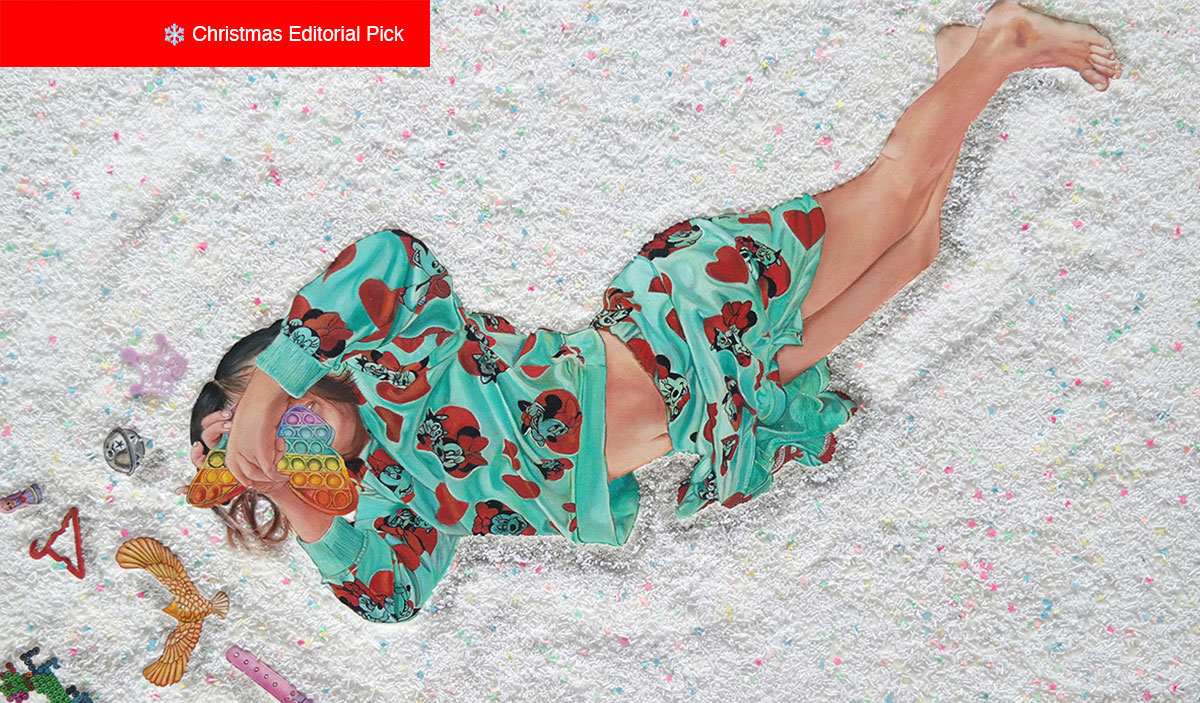
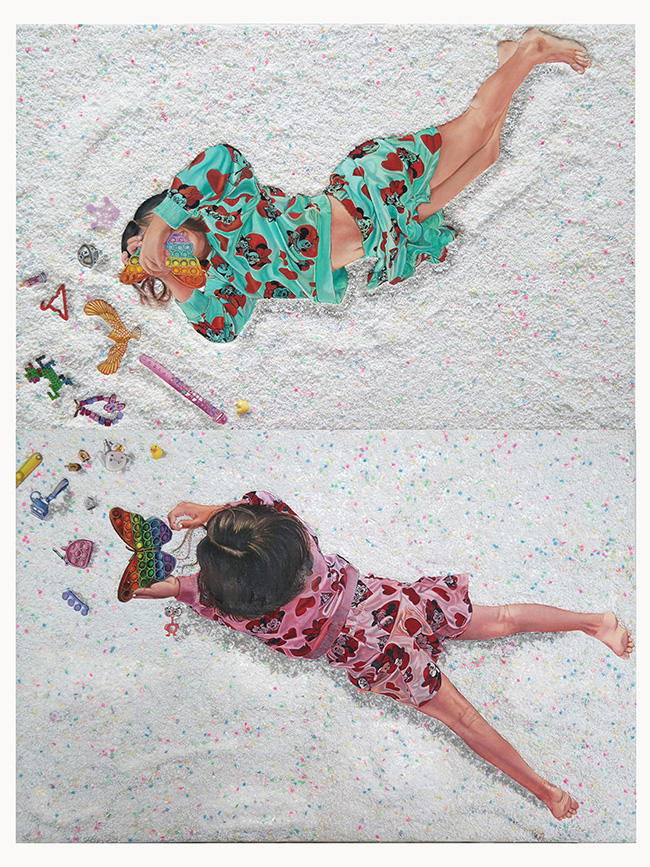
Scattered Wonder 2 & 3 (2025) sit at the centre of her artistic direction, bringing together painting, sculptural elements, and symbolic storytelling. Through these works, Gupta continues her interest in the emotional depth found within ordinary moments. Rather than presenting childhood as nostalgia or fantasy, she draws attention to the small psychological truths that take shape in a child’s mind before language fully develops.
The works depict a young girl at play, bending toward tiny sprinkles scattered across a textured surface. She is not a portrait of a specific individual, but a familiar figure that allows viewers to reconnect with their own memories. Gupta uses this imagined presence as a way to explore freedom, focus, and inner life.
The materials—oil paint, synthetic hair, toys, clay sprinkles, and 3D printing filament—are not decorative experiments but essential parts of the narrative. They introduce physical depth and tactility, echoing the scattered nature of free play. The clay sprinkles lie across the linen like fragments of thought, giving form to imagination, while the synthetic hair adds a sense of presence, like memory stitched into the surface. The result is a world that feels more tactile than illusory, inviting viewers into a sensory experience.
Oil paint sets the emotional tone of the works. Applied with softness and restraint, it allows subtle shifts in colour to create atmosphere. The girl exists within a dreamlike space that is neither home, landscape, nor playground—a setting free from adult structure. By removing clear context, Gupta directs attention toward the child’s internal world rather than her surroundings.
The young girl leans into her task with full attention, reflecting a state that exists before self-consciousness forms. She is not performing or aware of being watched; she is fully absorbed. Gupta highlights this deep focus as the source of joy—a natural quality in children that often fades in adulthood.
The works also reveal a balance between fragility and strength. The sprinkles are tiny and easily lost, yet they hold meaning. Through imagination, small objects become powerful symbols: a sprinkle turns into a mountain, a toy into a companion. Gupta honours this transformation, presenting imagination as an essential way children make sense of the world.
Texture plays an important role in this experience. By embedding materials directly into the painted surface, Gupta blurs the boundary between image and object. The sprinkles create a surface the viewer almost wants to touch, echoing the physical closeness children have with their surroundings.
What gives these works their emotional weight is their stillness. The girl appears comfortable in solitude, content to explore without instruction or direction. This quiet attention challenges modern anxieties around structured learning and productivity, suggesting that wonder grows naturally when a child is allowed to wander.
Overall, Scattered Wonder 2 & 3 celebrate simple discovery. Joy emerges through touching, sorting, and seeing. The child’s world is not a metaphor for adulthood; it belongs entirely to her. Gupta encourages viewers to recognise that curiosity does not need explanation or improvement—it needs space.
These paintings remind us that the most meaningful joys are often quiet, private, and unguarded. Through layered materials and a gentle gaze, Gupta gives shape to a truth that often fades with age: that small things, when approached with curiosity, can become enormous.
