


Sue Nicholas is a British artist whose path through art has been shaped by both intellectual rigor and intuitive exploration. She studied at Goldsmiths’ College and Imperial College, University of London—institutions known for encouraging critical thinking across disciplines. While this academic grounding informs her practice, it is not what defines it. Nicholas is less concerned with surface identity or outward narrative and more interested in the internal terrain of human awareness. Her work moves inward, toward the shifting, elusive experience of consciousness itself.
Rather than describing the self as something fixed, Nicholas treats it as fluid—an energy that expands, contracts, and reconfigures over time. Through abstraction, geometry, and vibrant color, she seeks to give form to states of being that are usually felt rather than seen. Her paintings operate like visual meditations, offering a space where perception slows and attention turns inward. What emerges is not an explanation, but an encounter.
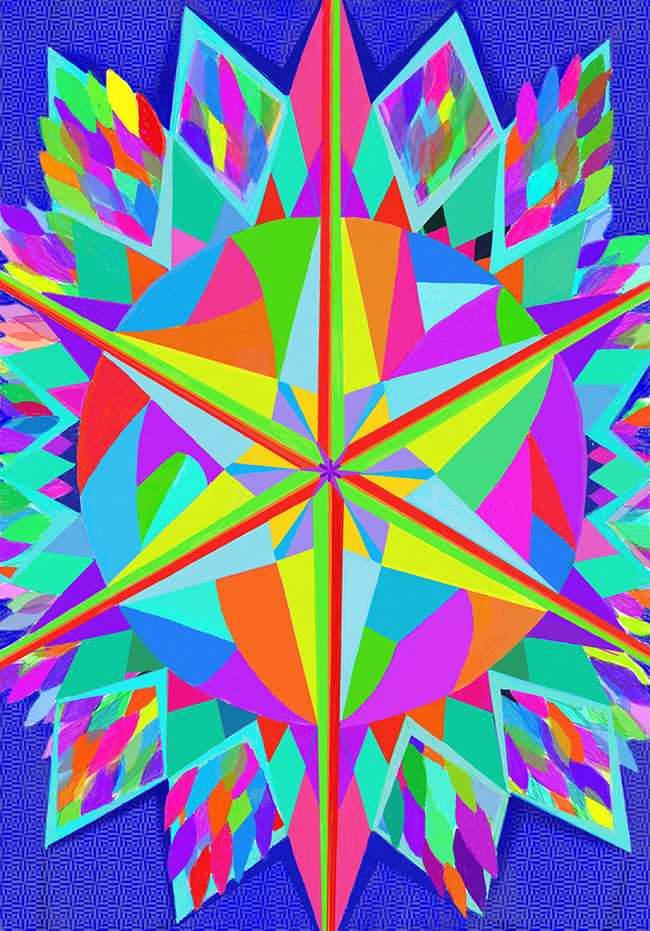
Sue Nicholas’s work resists easy categorization. At first glance, the compositions feel structured—precise geometry, strong symmetry, and carefully balanced color relationships. But the longer one looks, the more these paintings reveal a sense of motion, as if the forms are gently rotating, breathing, or unfolding. This tension between control and openness sits at the center of her practice.
Nicholas does not approach abstraction as a formal exercise alone. For her, geometry is not cold or detached; it is a language capable of holding emotional and psychological depth. Circles, radiating lines, and repeating patterns appear frequently in her work, not as symbols with fixed meanings, but as tools for mapping internal experience. These forms echo natural rhythms—heartbeat, breath, cycles of growth—and suggest continuity rather than resolution.
Color plays a central role in this process. Nicholas uses bold, saturated palettes that feel both energizing and grounding. Colors intersect, overlap, and push against one another, creating moments of harmony and friction. Rather than guiding the viewer toward a single focal point, her paintings encourage movement across the surface. The eye travels, pauses, and returns, mirroring the way attention behaves during moments of reflection or meditation.
What distinguishes Nicholas’s work is her focus on consciousness as something lived rather than defined. She does not present identity as a stable image or personal narrative. Instead, she explores the sensation of being—how awareness shifts in response to thought, emotion, and environment. In this sense, her paintings function less as statements and more as environments. They invite viewers to enter, rather than to decode.
The layered nature of her compositions reinforces this idea. Shapes often appear to exist on multiple planes at once, creating a sense of depth without illusionistic space. This layering suggests inner complexity—the coexistence of clarity and confusion, calm and intensity. The paintings do not resolve these contrasts; they allow them to exist together. This openness gives the work a quiet strength.
There is also a strong sense of balance running through Nicholas’s practice, though it is never rigid. Symmetry is present, but it is softened by variation and nuance. Lines may radiate from a central point, yet they remain flexible, responsive, alive. This balance reflects an understanding of equilibrium not as stillness, but as ongoing adjustment.
Her academic background quietly supports this approach. Exposure to scientific thinking, systems, and structure can be felt beneath the surface of her work, yet it never overwhelms the intuitive dimension. Nicholas allows process to guide outcome. The paintings seem to grow through attentive engagement, responding to what unfolds rather than following a predetermined plan.
Importantly, Nicholas does not attempt to instruct the viewer on how to feel or what to think. The work does not demand interpretation. Instead, it offers space. Viewers may experience a sense of calm, energy, or heightened awareness, but these responses remain personal. The paintings act as mirrors, reflecting whatever state the viewer brings to them.
In a cultural moment often dominated by noise, speed, and outward performance, Nicholas’s work moves in the opposite direction. It asks for presence. It rewards slowness. The visual intensity draws the viewer in, but it is the quiet undercurrent of thoughtfulness that sustains attention.
Sue Nicholas’s paintings remind us that abstraction can still speak directly to lived experience. By focusing on inner states rather than external narratives, she creates work that feels both personal and universal. Her art does not seek to define consciousness—it invites us to notice it.
