

Toni Silber-Delerive was born in Philadelphia, a place filled with movement, color, and the kind of layered urban stories that eventually found their way into her art. She studied painting at the Philadelphia College of Art and continued her path through Kean College of NJ, earning both a certificate in art education and a BFA in painting from the Philadelphia College of Art, followed by a MA in art education from Kean College in New Jersey. My studies expanded in New York City, where I honed my skills in graphic design and silkscreen printing at the School of Visual Arts.
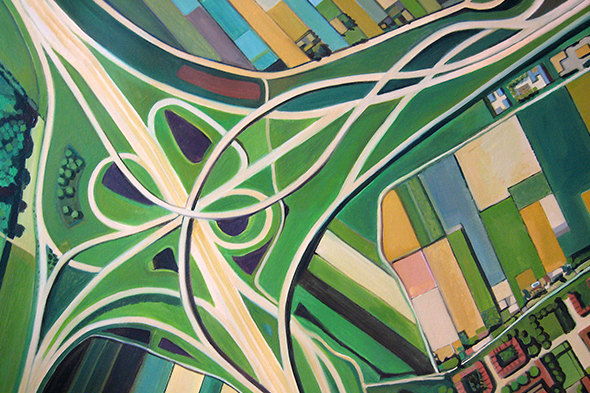
Her journey reflects the steps of an artist who loves to experiment and shift perspective. She paints, designs, and observes form with the eye of someone who sees structure not as confinement, but as a language. Above all, Toni’s work deals with how the world looks from a distance—how buildings, streets, and landscapes turn into shapes once you rise above them, revealing patterns most people never notice.
Airport and Train Station, Lyons — Aerial Viewing as Storytelling
Looking at Airport and Train Station, Lyons, you immediately sense that Toni Silber-Delerive enjoys guiding the eye to unusual angles—especially the overhead view. At 36 x 48 inches, the painting is large enough that the viewer feels drawn into its spatial grid. It is not a bird’s-eye view meant simply to be clever or decorative, and it is not just a technical exercise. It is a narrative choice. By shifting the vantage point upward, Toni reshapes how we understand place and structure.
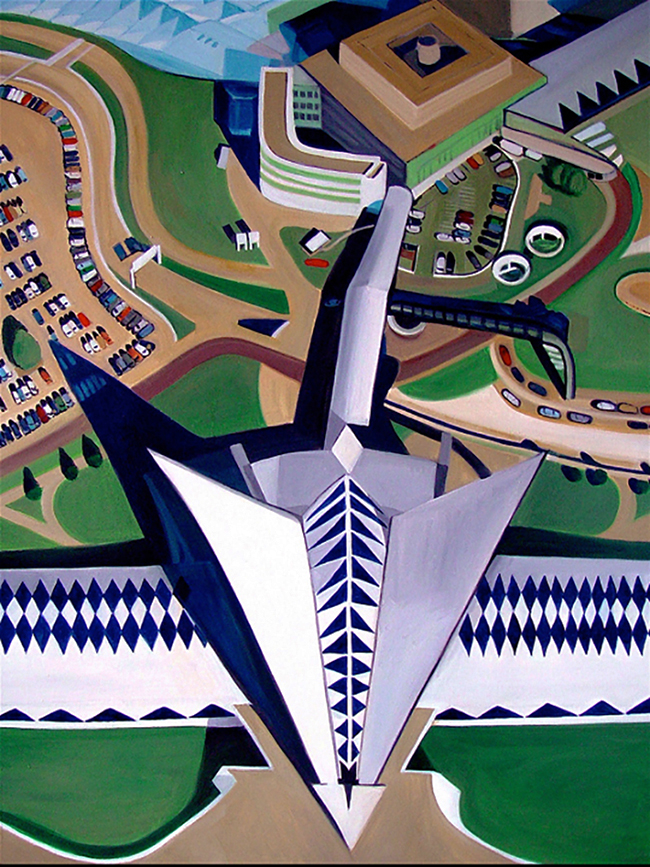
The setting is Lyon, France—a city already known for its layered history and layered movement. But Toni removes the noise and close-up detail that usually define travel hubs. The airport and the train station become bold shapes. A roof, normally crowded with signage and windows, becomes a graphic block of color and form. Parking lots, rail lines, roads, and architectural features flatten into a rhythm of squares and stripes.
Through abstraction, the city finds a new rhythm.
The work feels almost like a map, yet it is never cold or mechanical. From above, the airport resembles a dramatic sculpture shaped by sweeping curves, stretching outward like wings in motion. The comparison to a bird in flight feels natural. Airports are places of departure, arrival, and transition. They are symbols of forward movement. They also represent modern architecture’s urge to look sleek, smooth, and weightless. Toni captures that spirit without painting literal detail. The structure becomes form—clean, open, dynamic.
Next to it sits the train station, embedded into the urban fabric. It looks grounded, linear, and direct. Through Toni’s abstraction, the viewer immediately understands the difference in energy: the airport floats, the station connects. One speaks to the sky, the other to the land. That contrast is the core conversation inside this work.
This is where Toni’s background in design comes through. She knows how to balance geometry without letting it stiffen into rigid form. She understands pattern, color choices, and the power of reduction. When she removes small details, she is not simplifying the subject—she is sharpening it.
The aerial perspective also changes the emotional tone. Seen from the ground, an airport can feel chaotic, loud, and overwhelming. From above, the same place is calm, organized into grids and shapes that slot together with logic and beauty. The painting reminds us that the world becomes more understandable when distance is introduced.
This is a recurring idea in Toni’s art: the view from above reveals a truth that the normal point of view hides. Many of her works take this approach, turning familiar locations into structured visual puzzles. Airport and Train Station, Lyonscontinues that exploration. She shows a busy travel environment stripped of people, movement, and day-to-day stress, leaving us with a reordered version of reality.
The patterns carry meaning. Grids suggest order. Repeated visual beats mimic the routines of transportation: schedules, tickets, tracks, routes, flights. The very idea of rail lines and runways fits easily into the visual language of line and angle. Toni leans into those connections. Even without illustration, the viewer understands the function of space—the airport reaching outward like an idea of possibility, and the rail station threading itself into the city like a spine.
Color blocks add another layer. The painting does not depend on natural realism; instead, it leans into controlled tones. In an aerial painting, colors are less about atmosphere and more about structure. They anchor each shape so the viewer reads the composition clearly. The simplicity feels intentional.
What stands out most is how the painting invites slow looking. You start by recognizing the subject—airport, station, France—but then the painting pulls you deeper. The roof shapes start forming patterns. The runway becomes part of a larger sweep. The train tracks keep tightening the visual rhythm. Every part feels placed with steady purpose.
The painting asks a quiet question: what happens when we stop trying to see the world up close, and instead learn from the patterns that only reveal themselves at a distance?
In the end, Airport and Train Station, Lyons is a portrait of motion without movement, activity without people, and architecture without noise. It reduces a huge urban space into a beautifully organized structure. Through Toni Silber-Delerive’s eyes, a scene most people overlook becomes something to study, appreciate, and rethink.
The work does not shout. It doesn’t preach. It guides the viewer to a new angle—one that feels steady, thoughtful, and grounded in observation. It holds onto mystery and clarity at the same time, offering a view not many people get to see, yet one everyone can understand once they are looking.
