

Vandorn Hinnant entered the world in 1953 in Greensboro, North Carolina, and came of age in an environment filled with gentle rhythms, open spaces, and the understated shifts of Southern life. Those surroundings shaped his eye early. They trained him to notice structure, balance, and the subtle patterns that sit behind what we usually call “the real world.” He went on to study Art Design at North Carolina A&T State University, finishing with a BA, and later deepened his sculptural training at the University of North Carolina at Greensboro. The education gave him tools, but it was curiosity that opened the path forward. Over the decades, he has moved through sculpture, drawing, installation, and geometric exploration as if the boundaries between those disciplines never existed.
For Hinnant, geometry is not an academic subject. It’s a living vocabulary. He treats proportion, shape, and symmetry as carriers of memory—echoes from nature, architecture, and old belief systems. His long study of Platonic solids, the golden ratio, and sacred geometry gives his work a sense of permanence. Nothing he makes feels tied to a trend or moment. Instead, his work sits inside a wider continuum, as though he’s stepping into a much older conversation and adding his own line to it.
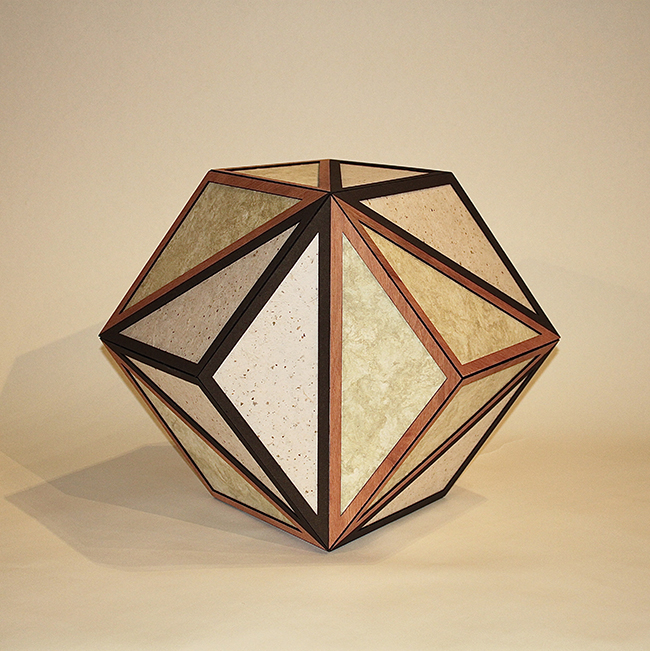
His sculpture “Platonic Symmetries of Truth, Beauty, and Goodness” (2014) makes this clear. Built from exotic papers and polychromed wood, it centers on the rhombic dodecahedron, a form he sees as essential to the geometric language that guides much of his practice. The golden ratio gives the piece its internal rhythm. Hinnant doesn’t treat that ratio as a number; he treats it as something with pulse—something you can find in the bending of a leaf, the inner structure of a seashell, or the layout of ancient temples. In this work, the proportion holds the sculpture together in a way that feels organic. The surfaces meet like something grown, not assembled.
Hinnant has spoken about a mystic who once suggested that his work in this lifetime involves bringing ancient Egyptian geometries into the present. He doesn’t lean on that claim literally, but he admits that many forms arriving through his practice feel strangely familiar. They carry the tone of something rediscovered rather than invented, as if they once lived in a hidden lineage. That sense of recognition runs through the sculpture. It feels like a return to something we haven’t seen in centuries but somehow already know.
Even with such strong mathematical bones, the work doesn’t feel cold. The materials bring warmth, giving the piece a grounded, patient presence. Hinnant channels the ideas named in its title—truth, beauty, goodness—through proportion rather than metaphor. They show up not as grand statements but as quiet alignments.
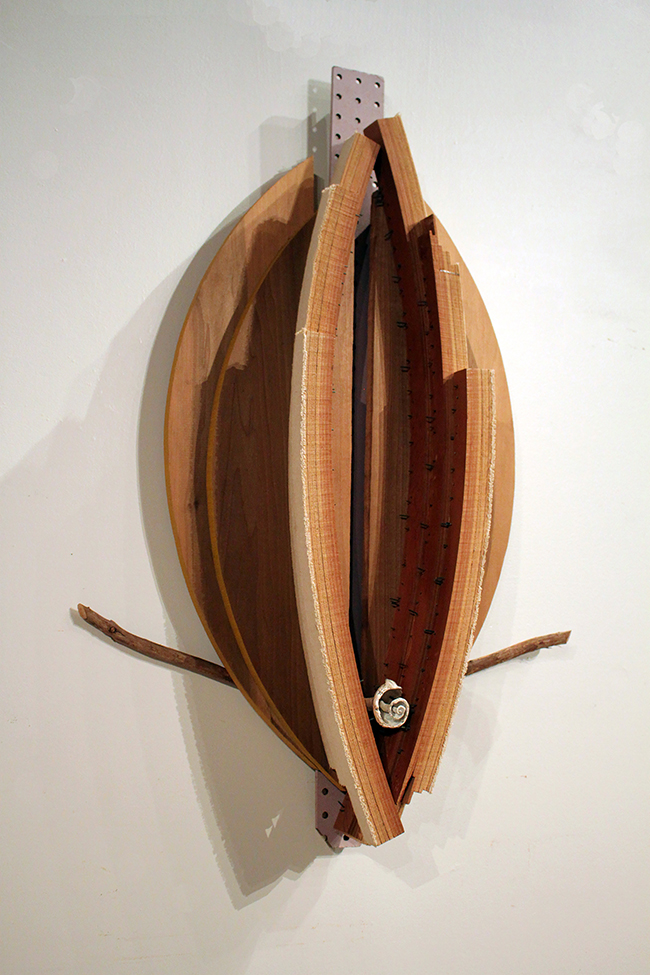
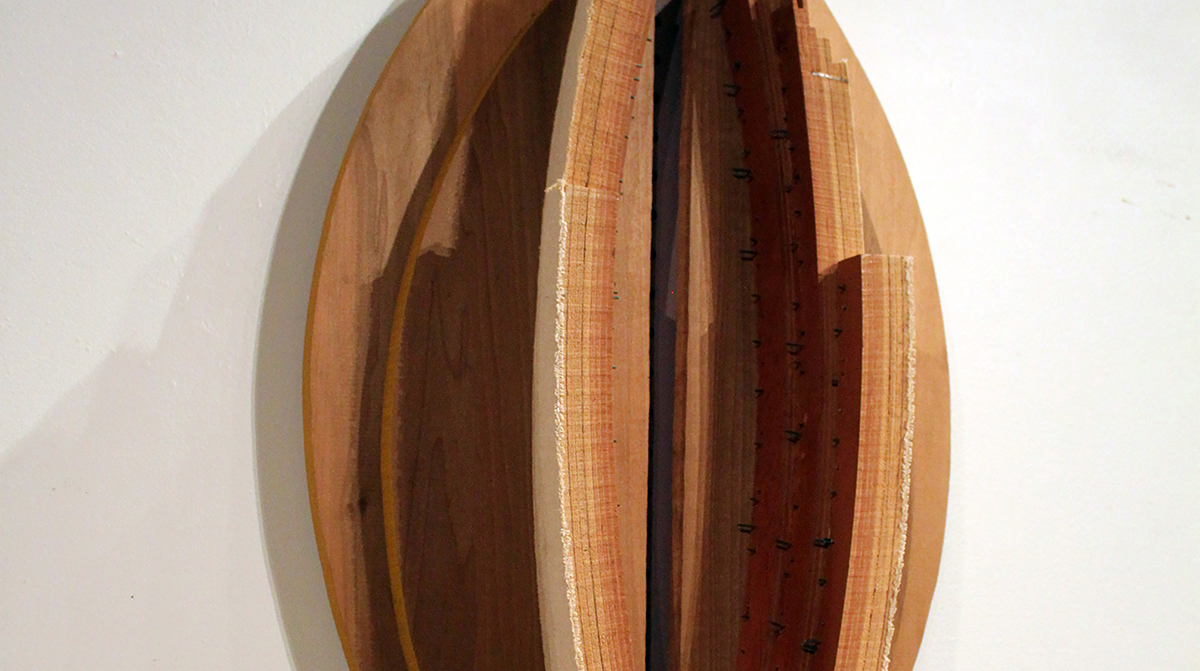
His interest in form also touches memory and cultural tribute. This is clear in “MERIDIAN: Hanging From The Learning Tree (A Song for Ms Cicely Tyson)” (2023), made from polychromed wood, metal, canvas, and a seashell. Here, Hinnant honors Cicely Tyson—her film legacy, her strength during the Civil Rights Movement, and her insistence on roles that broke clichés. The sculpture rises along a vertical line, giving it the feel of dignity and upward movement.
At the work’s center is a layered vesica piscis, a shape tied to the feminine and to generative power. Hinnant reworks the geometry in a way that feels more expansive than conventional symbols. A cedar branch crosses the form, holding a weathered conch shell. Together, these elements reinforce the presence of the natural feminine—resonance, growth, and ancient knowledge wrapped inside organic material. The sculpture reads like a quiet blooming, a nod to a woman who elevated others with grace rather than noise.
Throughout his practice, Hinnant trusts both structure and instinct. Geometry sets the framework; intuition guides the movement. His pieces feel considered but never rigid. They hold space. They breathe. They invite you to slow down and sit with proportion.
Curiosity runs through everything he makes. He returns to the same families of forms because each encounter opens another door. His work charts an ongoing relationship between the physical world and the unseen patterns shaping it. Through geometry, memory, homage, and intention, Hinnant has built a body of work that feels steady and open—anchored in structure yet always reaching toward something larger than itself.
