

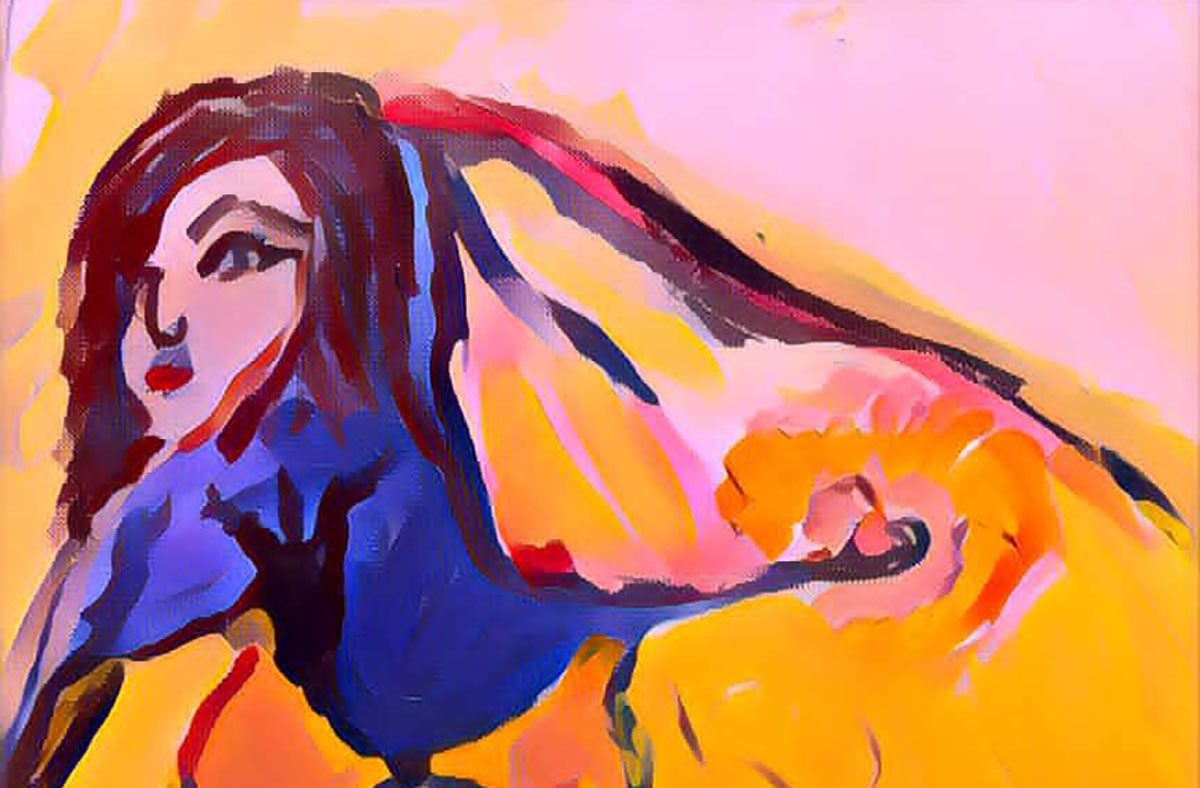
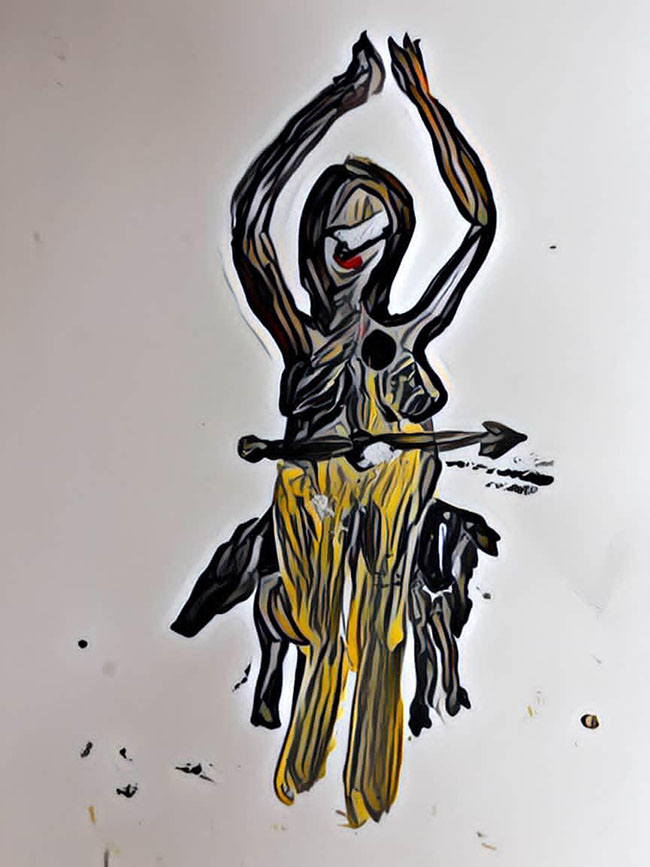
Jana Livingston’s work includes many figures rendered in abstract form, where the body becomes less about realism and more about expression. Rather than focusing on precise anatomy, she distorts, stretches, and simplifies the human figure to explore movement, tension, and emotion. In these two pieces, that approach is clear from the start. While they differ in tone and composition—one open and saturated with color, the other stripped down and raw—they share a common language. Both figures feel unsettled and in transition, as if they exist somewhere between control and release.
The first piece is dominated by a vivid yellow ground that immediately sets a tone of heat and openness. Against this field stands a female figure rendered in loose, gestural strokes. Her body twists slightly, her torso angled, her face turned outward with a calm but distant expression. The blue of her clothing cuts sharply against the yellow, creating a strong visual contrast that pulls the eye back and forth across the canvas. There is a sense of motion in the way the paint is applied—nothing feels fixed. The edges blur, the brushwork is quick, and parts of the figure dissolve into the background.
What stands out is the way Livingston treats the figure not as a stable form, but as something in flux. The elongated limbs, the exaggerated proportions, and the trailing lines suggest movement, almost like the figure is being stretched across space. The hair or extensions flowing from her head add to this sense of expansion. They feel less like a physical attribute and more like an extension of energy, pushing outward into the surrounding space.
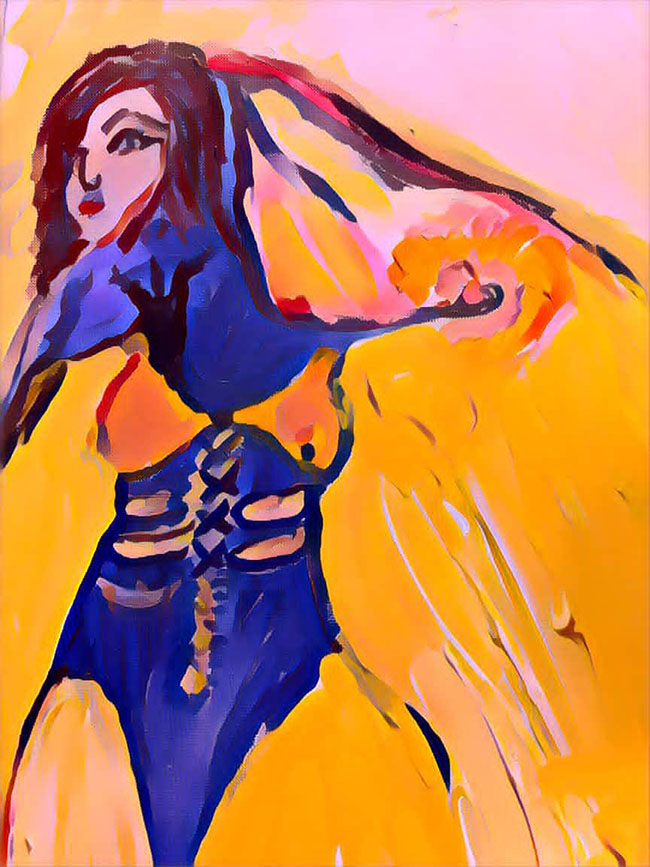
There is also a quiet confidence in the posture. Despite the distortions, the figure does not appear fragile. Instead, she holds her ground, her stance anchored even as her form shifts. The use of color reinforces this. The warm yellow background creates a kind of aura, while the cooler tones of the figure carve out her presence. The painting feels open, but not passive. It carries a sense of self-awareness without needing to define it too clearly
