

Huang YI Min’s life and artistic direction are closely tied to the layered history of China, shaped by personal experience and cultural memory. Born in 1950, she grew up during a time of major social and political shifts, which left a lasting imprint on how she observes and interprets the world. She later studied at Beijing Normal University, where she trained in fine arts before continuing her path abroad. In 1997, she moved to the United States, carrying with her not only formal training but also lived experience that informs her visual language. Her work reflects a continuous dialogue between past and present, between physical environments and inner reflection. Rather than separating these influences, Huang allows them to overlap, creating images that feel both grounded in reality and shaped by memory.
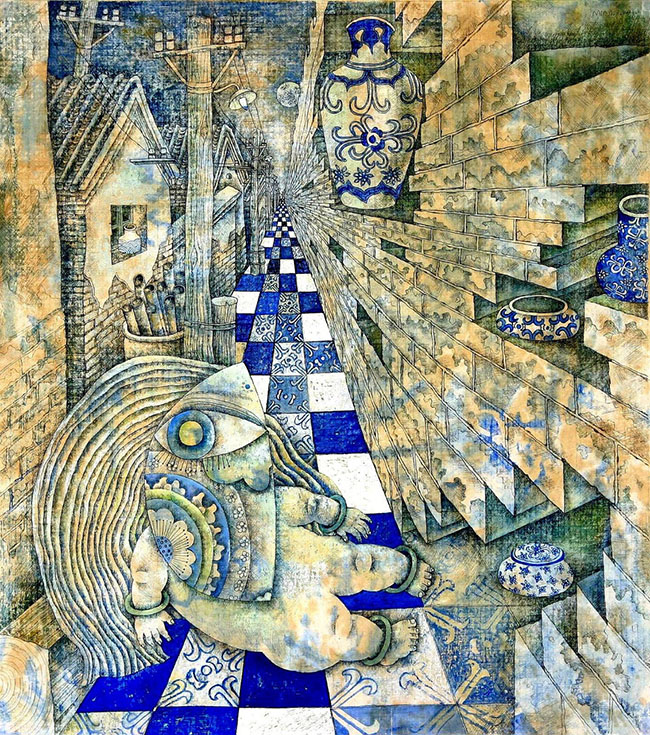
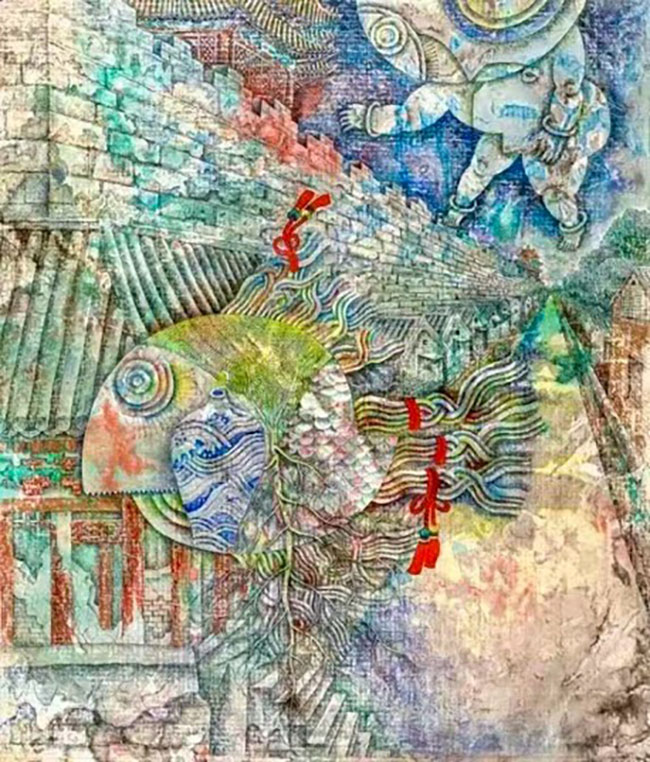
The two works from the Forbidden City Freedom series—The Moon Outside the Palace Museum Wall (80 x 86 cm, mixed media on paper) and Windless Day (82 x 90 cm, mixed media on paper)—offer a close look into how Huang constructs space, meaning, and narrative through layered imagery.
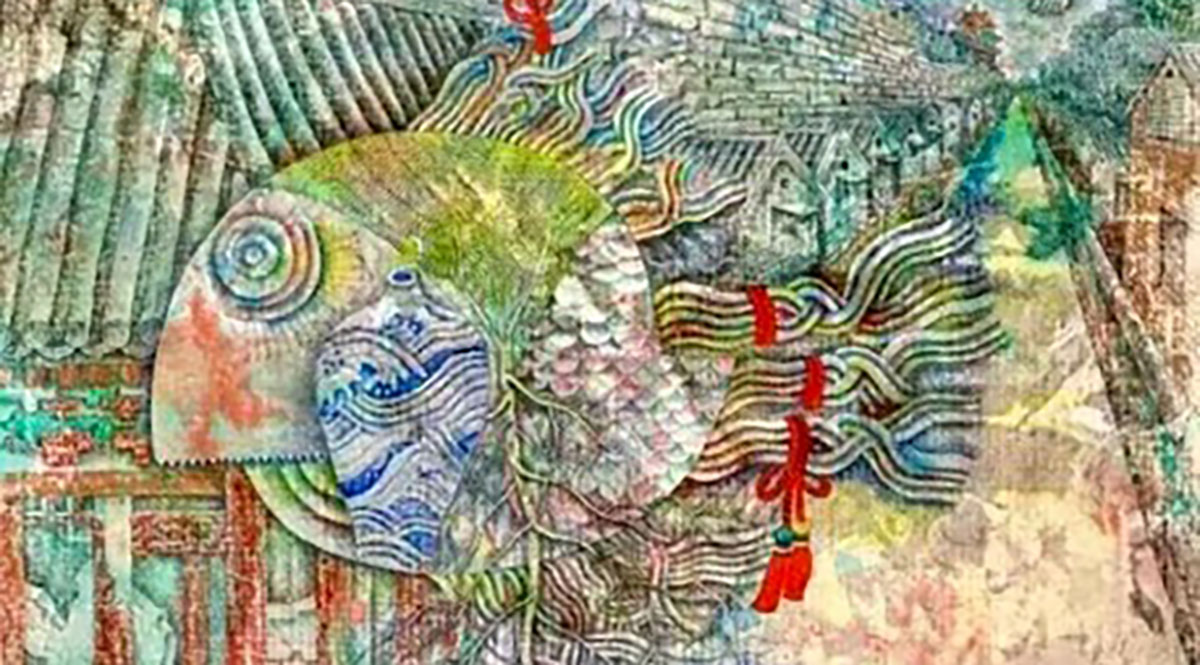
In The Moon Outside the Palace Museum Wall, the composition unfolds as a dense visual field where architectural fragments, symbolic forms, and organic elements coexist. A large fish dominates the center, its body filled with intricate patterns that echo traditional Chinese decorative motifs. The fish appears suspended within a shifting environment—neither fully grounded nor entirely floating. Around it, textures resembling old walls, rooftops, and faded surfaces suggest the presence of the Forbidden City, though not in a literal or documentary sense. Instead, the setting feels reconstructed, as if remembered rather than observed directly.
The inclusion of a floating astronaut introduces a subtle disruption. This figure, detached from gravity, contrasts with the historical weight of the surrounding environment. It suggests a break from fixed time, or perhaps a quiet questioning of place and belonging. The astronaut does not dominate the scene but exists within it, hinting at movement beyond tradition without rejecting it. Small accents of red appear sparingly, drawing attention without overwhelming the muted palette. These marks act almost like signals—brief, intentional interruptions within the broader surface.
The work carries a sense of stillness, yet it is not static. Lines and textures move across the surface, guiding the eye through different layers. The fish, often associated with abundance or continuity, here becomes something more ambiguous. It feels like a carrier of memory, holding patterns and references within its form. Huang avoids clear narrative resolution, allowing the viewer to move between elements without a fixed conclusion.
Windless Day takes a different structural approach but continues similar concerns. The composition is organized around a strong perspective, with a tiled pathway extending into the distance. The use of blue-and-white patterns recalls porcelain traditions, immediately connecting the work to cultural objects tied to history and craftsmanship. Along the right side, a brick wall stretches into depth, its surface worn and uneven. Objects such as vases are embedded within or placed along the structure, blending decorative form with architectural space.
In the foreground, a figure sits with a posture that suggests rest or pause. The body is stylized, with rounded forms and simplified features, echoing the patterned surfaces around it. Hair flows outward in curved lines, merging with the surrounding textures. This figure does not appear isolated but integrated into the environment, almost as if shaped by it.
The perspective creates a sense of movement, pulling the viewer inward. Yet the title, Windless Day, emphasizes stillness. There is no visible motion in the scene—no shifting air, no external force—only the quiet extension of space. This contrast between visual depth and atmospheric calm gives the work its tension. It feels both expansive and contained.
Throughout the piece, Huang uses repetition and pattern to unify different elements. The tiled ground, the decorative surfaces, and the architectural lines all echo one another. At the same time, irregularities in texture and color prevent the composition from becoming rigid. The surfaces appear aged, worn, and layered, suggesting time passing across them.
Across both works, Huang YI Min does not aim for a direct representation of the Forbidden City or its surroundings. Instead, she builds a space where memory, observation, and imagination overlap. Her use of mixed media allows for variation in texture, giving each area of the surface its own presence. Lines remain visible, surfaces feel worked and reworked, and the compositions hold traces of process.
There is a quiet tension in these works—between history and present, structure and fluidity, stillness and movement. Huang does not resolve these contrasts. She leaves them open, allowing the viewer to navigate the space in their own way.
