

Sebastian Di Mauro’s practice begins with distance. Originally from Australia, he relocated to the United States, entering a space that was both familiar and unfamiliar at once. What had once existed as a mediated vision—formed through films, television, and the idea of the American Dream—shifted into something more layered when experienced firsthand. Living in a new country, alongside a partner with roots in Wilmington, Delaware, Di Mauro found himself navigating between memory and reality, between what was imagined and what was lived.
This shift became central to his work. Rather than treating identity as fixed, he approaches it as something in flux, shaped by movement, displacement, and contradiction. His materials reflect this thinking. Found textiles, layered imagery, and hand-stitched interventions allow him to work directly into surfaces that already carry histories. Through this process, memory, place, and narrative are not simply depicted—they are reworked, interrupted, and reconsidered.
Di Mauro’s artworks operate through a quiet but deliberate tension between what is visible and what is embedded beneath. The use of found tapestry is key. These textiles arrive with their own imagery, often tied to pastoral or historical scenes that feel settled and resolved. Instead of preserving them as they are, he intervenes. Stitching becomes both a physical and conceptual act, one that disrupts the surface while also adding to it. The result is not a replacement of the original image, but a negotiation with it.
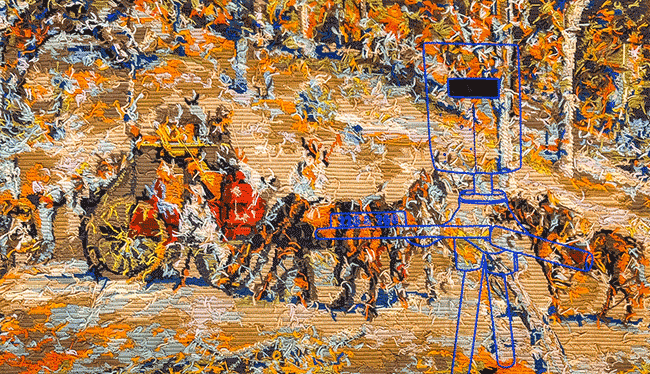
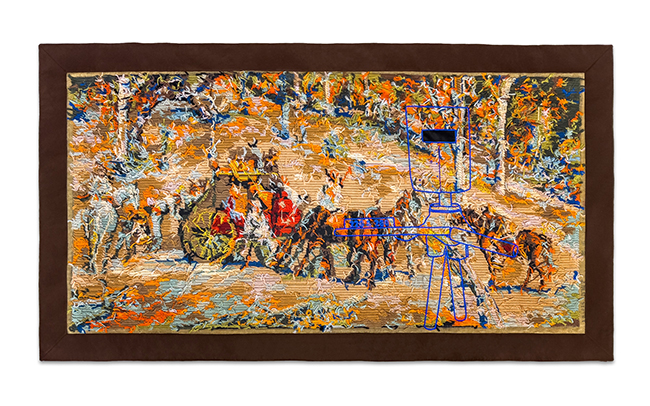
In Bolters (2026), this negotiation takes on a distinctly historical dimension. The work begins with a found tapestry printed on Twill Waratah textile, bordered with green felt and reworked through hand-stitched blended yarn. At first glance, the scene recalls a familiar narrative: bushrangers halting a stagecoach, an image deeply embedded in Australian visual history. The reference to Tom Roberts’ Bailed Up (1895) is present, but it is not treated as something fixed or authoritative. Instead, Di Mauro reopens it.
Inserted into this already loaded scene is a figure that shifts the reading entirely. Ned Kelly appears, but not as a painted or sculpted form. He is reimagined as a letterbox constructed from scrap metal, marked with the house numbers of two rural residences in the Northern Highlands of New South Wales. The gesture feels both accidental and precise. It draws from something encountered in everyday life, yet carries the weight of cultural memory.
This transformation alters the role of Kelly. No longer confined to the image of an outlaw captured in art history, he becomes part of a living environment. A letterbox is functional, ordinary, and often overlooked. By placing this form within the composition, Di Mauro collapses the distance between myth and the present. The figure of rebellion is no longer distant or symbolic alone. It exists within the rhythms of daily life, embedded in the landscape in unexpected ways.
The stitching itself reinforces this shift. It does not attempt to hide its presence. Instead, it moves across the surface in visible lines, asserting a second layer of authorship. The original tapestry remains, but it is no longer stable. It has been interrupted, questioned, and expanded. Through this process, Bolters becomes less about retelling a historical scene and more about examining how such scenes continue to circulate, adapt, and persist.
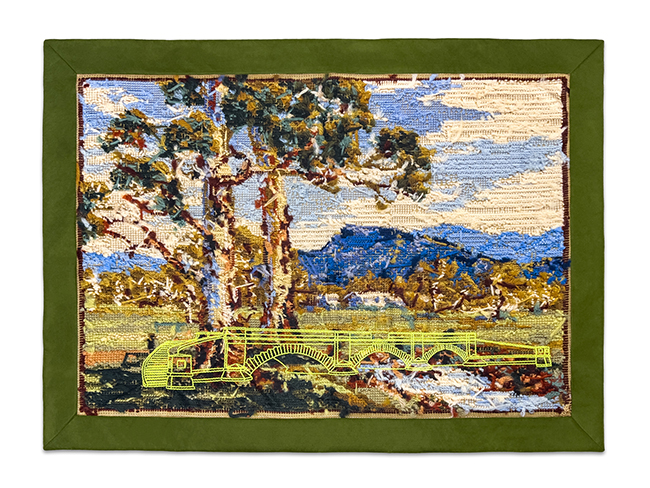
A similar approach unfolds in Abridged Landscape (2026), though the focus shifts from myth to omission. Here, Di Mauro works with the reverse of a traditional landscape tapestry, printing it onto fabric before adding hand-stitched imagery. This inversion is important. The back of a tapestry reveals its construction—the threads, the structure, the labor that is usually hidden from view. By foregrounding this side, he brings attention to what is typically concealed.
Across this surface, he introduces the form of the Ross Bridge in Tasmania. The bridge carries its own history, having been built through the labor of convicts. This context sits in contrast to the idealized landscape imagery often associated with such tapestries. Where the original image suggests harmony and calm, the stitched intervention introduces a more complex narrative.
The act of stitching functions here as a form of re-inscription. It does not overwrite the existing image, but it insists on another layer of meaning. The bridge emerges gradually, its lines constructed through thread rather than paint. This method slows the image down. It asks the viewer to consider not just what is shown, but how it has been made, and what has been left out.
Abridged Landscape exposes the gaps within picturesque representations of place. Landscapes that appear serene are often built upon histories that remain unspoken. By bringing the Ross Bridge into the composition, Di Mauro points to the systems of labor and punishment that underlie colonial settlement. The work does not dramatize this history. Instead, it allows it to surface quietly, through material and process.
Across both works, Di Mauro’s approach remains consistent. He does not create images from scratch. He begins with something that already exists—an image, a textile, a fragment of visual culture—and works into it. This method reflects his broader concerns with memory and identity. Just as his own experience is shaped by movement between places, his artworks exist between states. They are neither entirely original nor entirely inherited. They occupy a space in between.
What emerges is a practice that resists resolution. The surfaces remain active, layered, and open to interpretation. History is not presented as a fixed narrative, but as something that can be revisited and reshaped. Through stitching, layering, and recontextualizing, Di Mauro creates works that hold multiple timelines at once, where past and present remain in constant dialogue.
