

Jo Gabe approaches painting as a way of holding onto experience while allowing it to shift. Working across acrylic, oil, and pastel, their practice moves between observation and interpretation, where memory is never fixed and place is never entirely stable. Influences from artists such as Kandinsky can be felt in the looseness of form and the sensitivity to color, yet Gabe’s work remains grounded in personal reflection rather than abstraction alone. Landscapes, interiors, and figures are not treated as separate subjects but as extensions of lived moments.
Travel plays a steady role in shaping this direction. From the density of Sydney to the open stretches of Queensland, Gabe gathers impressions that later reappear in altered form. These are not direct translations of what was seen. Instead, they are filtered through feeling—reshaped, simplified, or distorted until they carry something more internal. The result is a body of work that reads less like documentation and more like a quiet reconstruction of experience, where narrative unfolds through atmosphere, gesture, and tone.
The Work
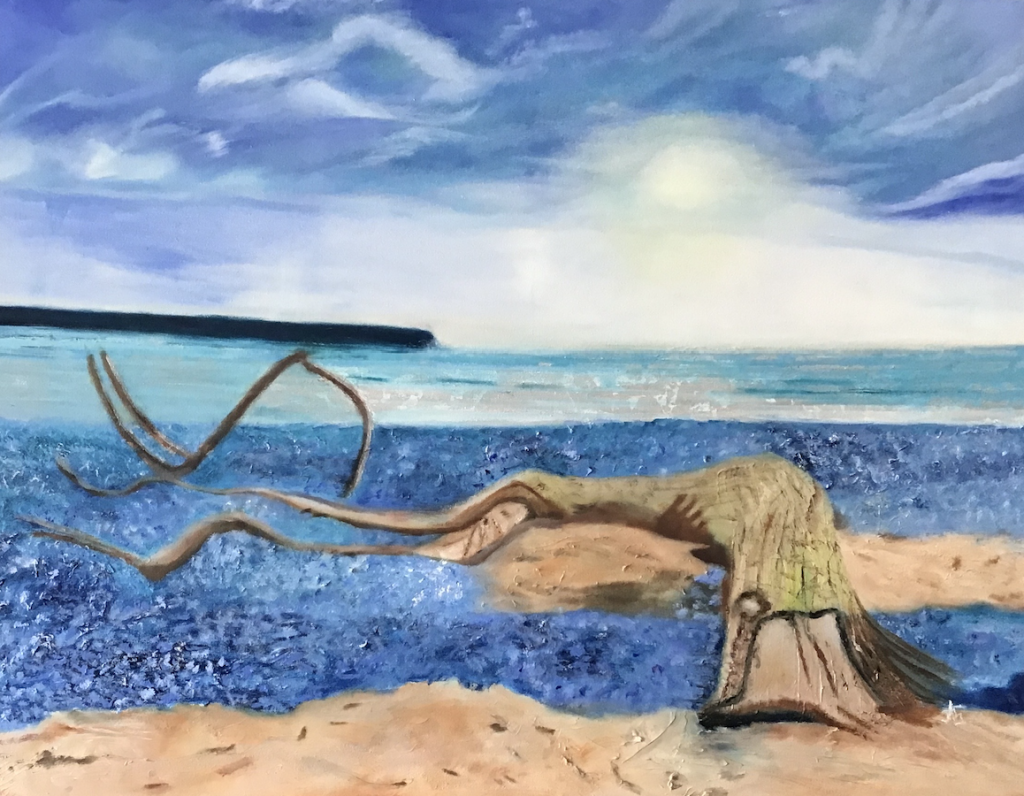
Jo Gabe’s paintings sit in a space where representation begins to loosen, allowing image and emotion to merge. Across the two works presented, Noosa North Shore and The Voyeur, this approach becomes clear. While one leans toward landscape and the other toward portraiture, both are guided by the same underlying impulse: to move beyond surface description and toward something more reflective and psychological.
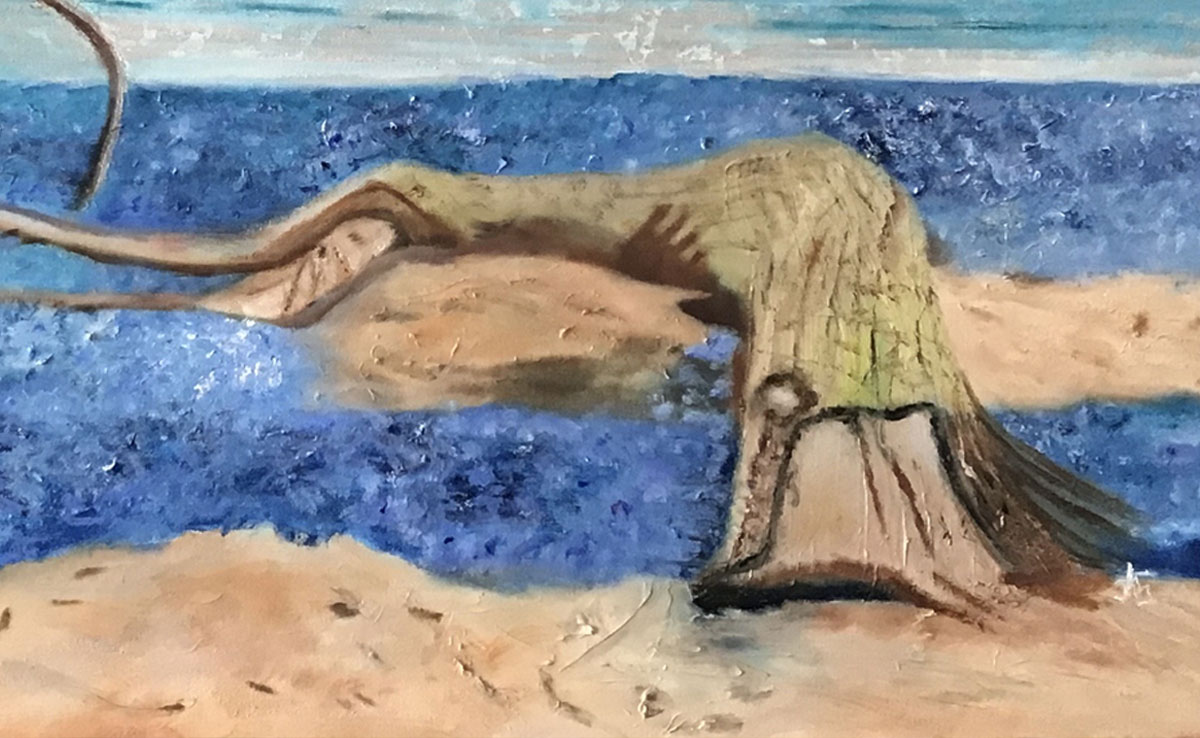
In Noosa North Shore, the coastline is recognizable at first glance, yet it quickly shifts into something less literal. The horizon line holds the composition together, but everything around it feels in motion. The water is built through layered blues, carrying a tactile presence that suggests both movement and weight. There is a physicality to the surface, as if the paint itself is echoing the rhythm of the tide.
The inclusion of silverleaf introduces a subtle disruption. Light does not behave in a predictable way across the canvas. Instead, it flickers and shifts depending on the viewer’s position, creating a surface that feels unstable. This instability mirrors the way memory operates. What begins as a clear image becomes altered over time, catching light in unexpected places.
At the center of the composition, a fallen tree stretches across the sand and into the water. Its form is elongated, almost unnatural, pulling the eye across the painting in a slow, deliberate movement. The tree reads as both an object within the landscape and something more symbolic. It suggests interruption, displacement, or the quiet aftermath of change. There is no human presence, yet the scene feels inhabited, as if something has just occurred or is about to.
The sky above remains soft and diffused, offering a contrast to the density of the foreground. Light breaks through in a way that feels distant rather than immediate. This distance creates a sense of pause within the painting, a moment where time seems to stretch rather than move forward.
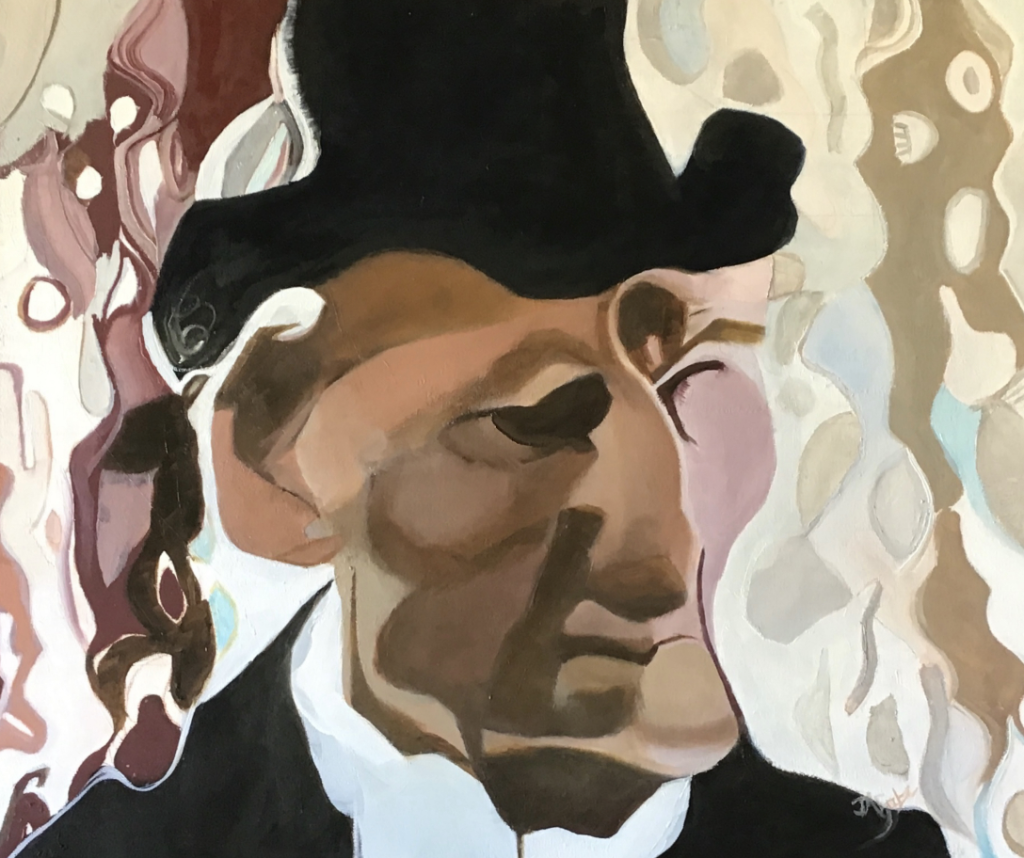
In The Voyeur, Gabe shifts from external space to internal observation. The figure is presented in profile, yet the face resists clarity. Features dissolve into one another through soft edges and tonal shifts, creating a sense of instability. The subject is not fully accessible. Instead, the viewer is placed in a position of looking without complete understanding.
The title suggests an act of watching, but the painting complicates that idea. It is unclear who is observing and who is being observed. The figure’s closed or partially obscured eye removes the possibility of direct connection, creating a barrier between subject and viewer. This distance introduces a quiet tension, one that runs through the entire composition.
Color plays a central role here. Flesh tones are layered with unexpected hues—muted pinks, browns, and cooler undertones—giving the face a shifting quality. The surrounding background is populated with abstract forms that feel loosely figurative, almost like echoes or fragments of other presences. These shapes do not settle into clear identities, reinforcing the sense that the image exists somewhere between perception and imagination.
The handling of paint remains controlled but not rigid. Edges blur, transitions soften, and forms seem to emerge and recede at the same time. This approach allows the painting to feel fluid, as if it is still in the process of becoming. Nothing is fully resolved, and that lack of resolution becomes part of its structure.
Across both works, Gabe resists the idea of a fixed image. Whether working with landscape or figure, the goal is not to define but to suggest. Forms are allowed to shift, light is allowed to behave unpredictably, and space is treated as something that can expand or compress depending on how it is remembered.
There is a quiet consistency in this method. The paintings do not demand attention through scale or intensity. Instead, they hold it through subtle shifts—through the way a surface catches light, through the way a form refuses to fully settle. What remains is a body of work that feels open, where meaning is not delivered directly but unfolds gradually through looking.
