

Cynthia Karalla is an American artist whose practice moves between activism, material experimentation, and a direct, unfiltered way of thinking through art. Her path began in architecture before shifting into photography, and later into fine art, where she developed a language that resists neat categorization. What carries through all of her work is a willingness to confront systems—political, social, and visual—and rework them into something tangible. Karalla approaches materials much like a darkroom process, transforming what is often overlooked or overwhelming into something visible and deliberate. Her work operates in this tension: between structure and disruption, between information and form. By converting dense, bureaucratic content into sculptural and photographic compositions, she reframes how viewers engage with both the material and its meaning, asking not just to look, but to reconsider what is already in front of them.
Karalla’s recent body of work draws directly from one of the most widely discussed political documents in recent American history: the Mueller Report. Thousands of pages, dense with legal language and institutional tone, are dismantled, repurposed, and reassembled into sculptural forms. Rather than presenting the report as text to be read, Karalla converts it into something to be seen, felt, and questioned. The act itself is deliberate—transforming a document that many found inaccessible into a visual experience that demands attention.
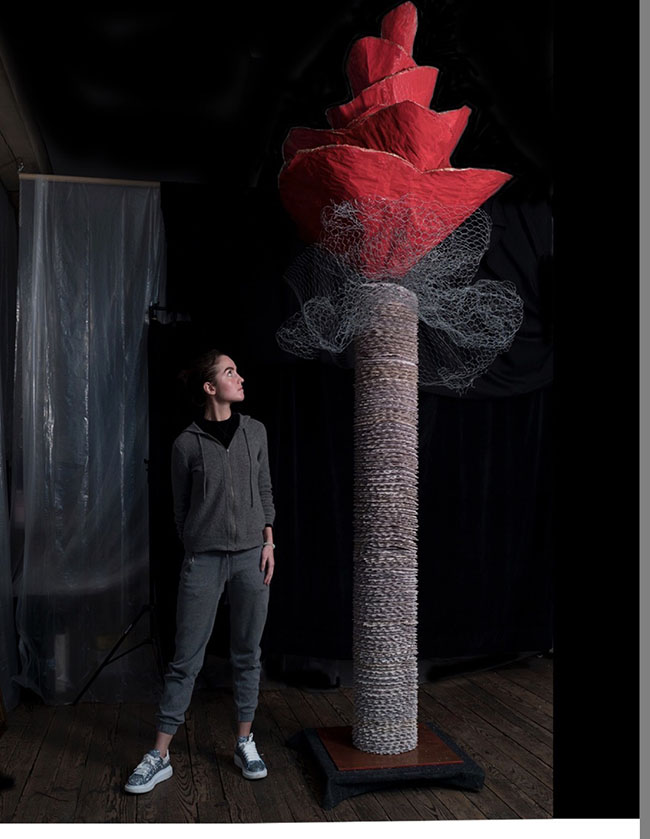
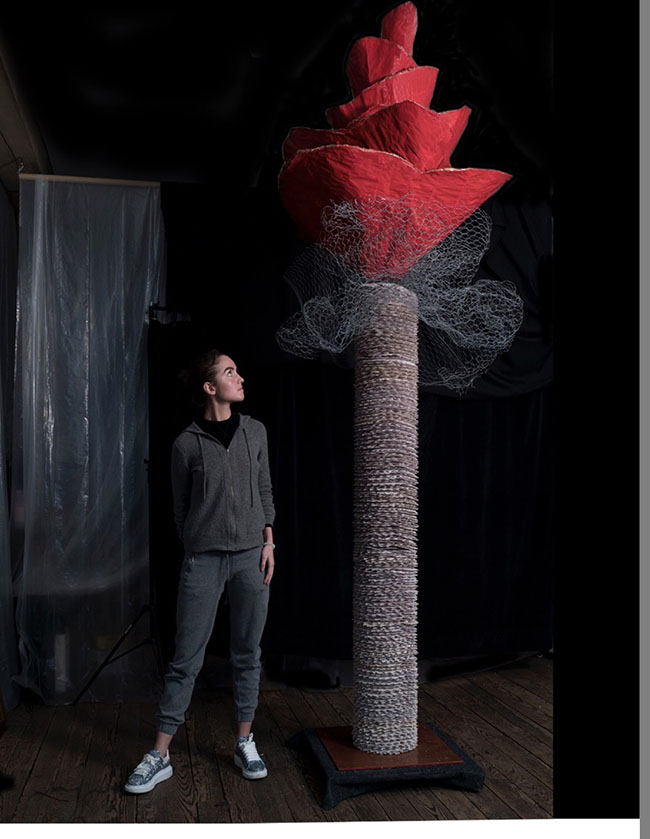
In works like The Gift, pages of the report are shaped into a large, unfolding red form reminiscent of a rose. The scale is important. It is not a small, delicate object but something that takes up space, almost overwhelming in its presence. The material, though fragile on its own, becomes structural through repetition and layering. The red coloration introduces another layer of interpretation. It references not only the visual language of the rose but also the emotional charge surrounding the political narratives embedded in the source material. The piece suggests both offering and burden—something presented, yet not easily accepted.
Karalla extends this approach further in The Pillar of Truth, where approximately 20,000 pages are used to construct a towering column. The verticality of the piece shifts the conversation. It becomes less about a single object and more about accumulation—of information, of narratives, of weight. The column stands as a physical manifestation of scale, echoing the overwhelming nature of the report itself. At the top, the rose form reappears, acting almost like a culmination point. The structure invites viewers to consider not just what is contained within the document, but how its sheer volume shapes understanding. It is less about reading every page and more about confronting the magnitude of what is presented.
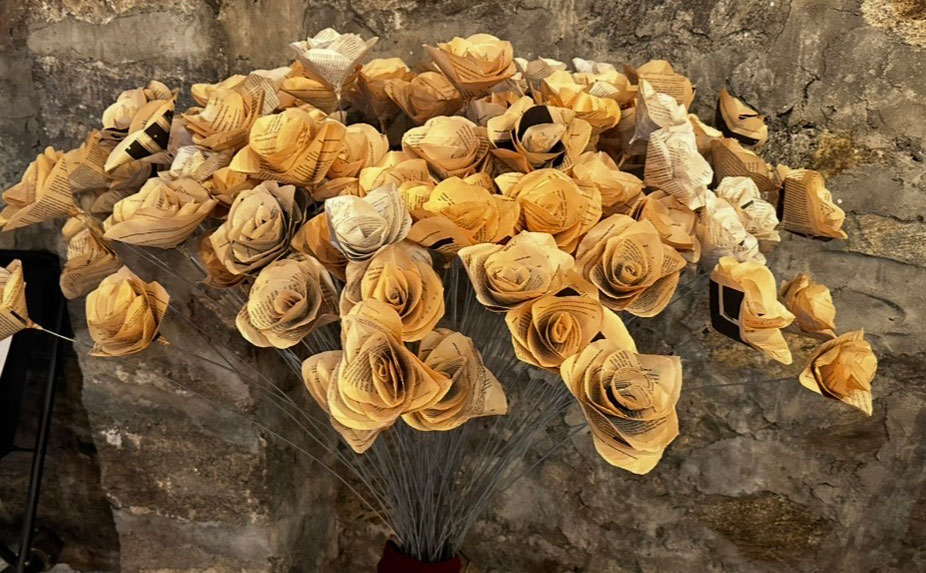
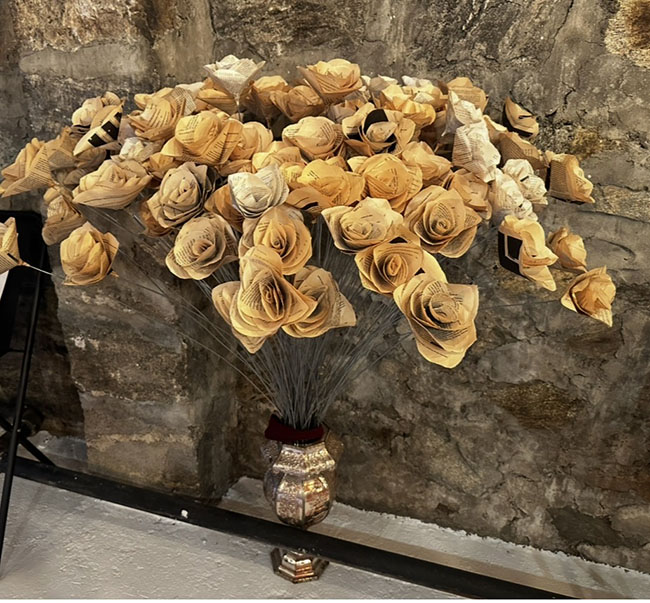
Across these works, Karalla introduces an ongoing motif: the rose. It appears repeatedly, sometimes bold and red, other times formed from uncolored pages, as seen in White Roses. Here, the absence of color shifts the tone. The roses are quieter, more restrained, but no less complex. Made entirely from printed pages, they retain fragments of text—partial words, lines, and typographic traces that remain visible on the surface. These fragments resist full legibility, creating a tension between what can be read and what is obscured. The viewer is left with pieces of language that hint at meaning without fully delivering it.
This interplay between visibility and obscurity is central to Karalla’s approach. By turning text into form, she disrupts its original function. The report, intended as a vehicle for information, becomes instead a material for interpretation. The viewer is not asked to decode every detail but to engage with the broader implications. The sculptures function as both objects and prompts—encouraging reflection on how information is presented, consumed, and often ignored.
Photography plays a key role in how these works are ultimately experienced. Karalla does not stop at constructing the objects; she carefully documents them, presenting them almost as products. This framing is intentional. By photographing the sculptures in controlled environments, she creates a sense of distance, allowing the work to circulate beyond its physical form. The images become part of the artwork, extending its reach and reinforcing its message. The polished presentation contrasts with the rawness of the source material, highlighting the transformation that has taken place.
The inclusion of unconventional materials, such as wire mesh in some compositions, adds another layer. These elements introduce a sense of containment or tension, as if the forms are both supported and restricted. It mirrors the larger themes at play—systems that hold information in place while also shaping how it is perceived. The balance between organic forms, like the rose, and industrial elements, like wire, reflects the intersection of human experience and institutional structures.
Karalla’s Read Roses of the Mueller Report series operates within a broader intention. It is not limited to the creation of objects but extends into a wider effort to encourage engagement with political realities. The works act as entry points, drawing viewers in through visual impact while pointing back to the source material. The message is direct: information matters, but so does the willingness to confront it.
What makes Karalla’s work effective is its ability to operate on multiple levels. It is visually compelling, materially inventive, and conceptually grounded. It does not rely on abstraction alone, nor does it present a singular narrative. Instead, it opens space for interpretation while maintaining a clear connection to its source. The sculptures are not answers; they are invitations—to look closer, to question, and to reconsider how meaning is constructed.
In transforming thousands of pages into objects that occupy physical and visual space, Karalla shifts the role of the viewer. The work asks for participation, not passivity. It suggests that understanding is not simply a matter of access, but of attention.
