

Pasquale J. Cuomo has devoted more than fifty years to photography, yet his work still carries the energy and curiosity of a young photographer learning how to see the world through a lens for the first time. What began as a teenage fascination with cameras gradually became a lifelong commitment to observation, precision, and visual storytelling. Cuomo first started photographing as a teenager and never stepped away from the medium. Through every major shift in photography—from film and darkroom printing to digital technology, smartphones, and artificial intelligence—he continued adapting while remaining focused on the essential act of looking carefully.
Rather than limiting himself to one field, Cuomo built a career that moved across many areas of professional photography. His experience includes weddings, fashion photography, commercial projects, architecture, legal documentation, and public relations assignments. By the 1980s, he had established a complete professional studio with his own lab and advanced equipment, allowing him to oversee every stage of the photographic process. Clients respected not only his technical reliability, but also his sharp attention to detail and ability to recognize moments others often missed. Cuomo approached his work quietly and thoughtfully, placing emphasis on the subject itself instead of drawing attention to the photographer behind the camera.
That philosophy still guides his photography today. While trends in image-making continue to change rapidly, Cuomo remains interested in the foundations of photography: composition, light, structure, timing, and atmosphere. In recent years, he has returned to shooting film, reconnecting with the slower and more intentional process that shaped his early years as a photographer. For Cuomo, photography has never been about chasing novelty. It is about patience, discipline, and maintaining a close awareness of the visual world.
Two photographs taken at the National Museum of the United States Air Force in Dayton, Ohio, reflect these interests clearly. Though centered on military aircraft, the images move beyond straightforward documentation. Cuomo uses the aircraft as visual structures, exploring geometry, proportion, texture, and contrast through careful framing and composition.
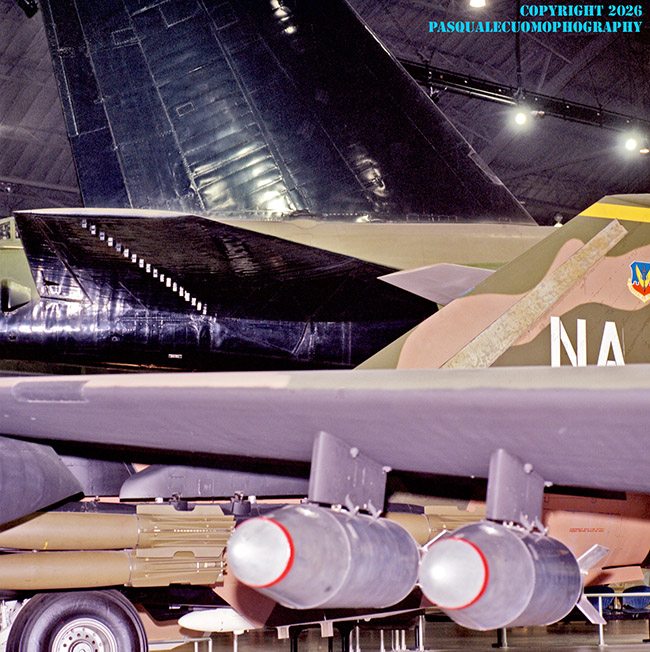
In the first photograph, the sharply angled surfaces of a stealth aircraft dominate the frame. Cuomo focuses on the overlapping forms of wings, missiles, and structural lines, compressing them into a tightly constructed composition filled with diagonal movement. Rather than presenting the aircraft as a complete object, he breaks it into fragments of shape and reflection, allowing the machine to become almost abstract. The glossy black surface catches surrounding light, producing subtle tonal variations that soften the otherwise rigid geometry of the aircraft.
The image reveals Cuomo’s understanding of visual balance. Despite the heavy dark forms occupying much of the composition, the photograph maintains a sense of rhythm and control. The repeated missile shapes in the foreground guide the viewer’s eye through the frame, while muted camouflage tones provide contrast against the deep black surfaces above. The museum environment remains present, though secondary, serving mainly to reinforce the scale and presence of the aircraft itself.
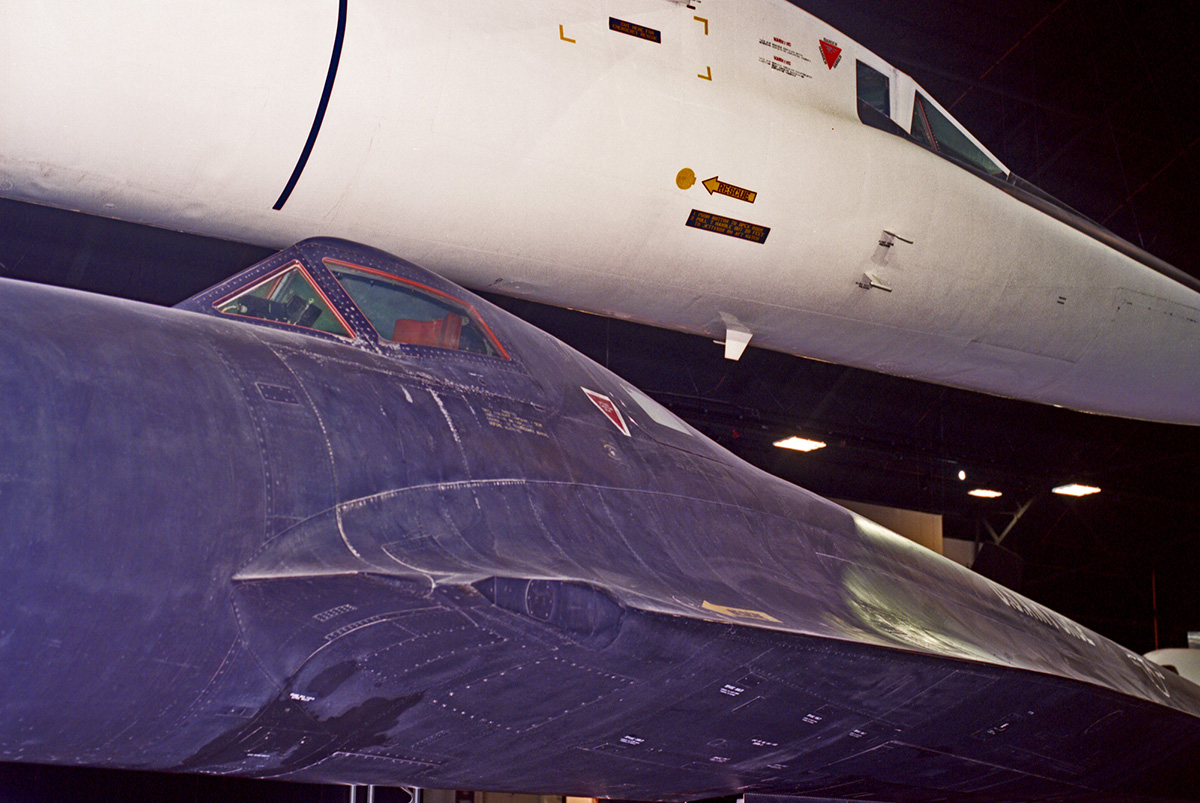
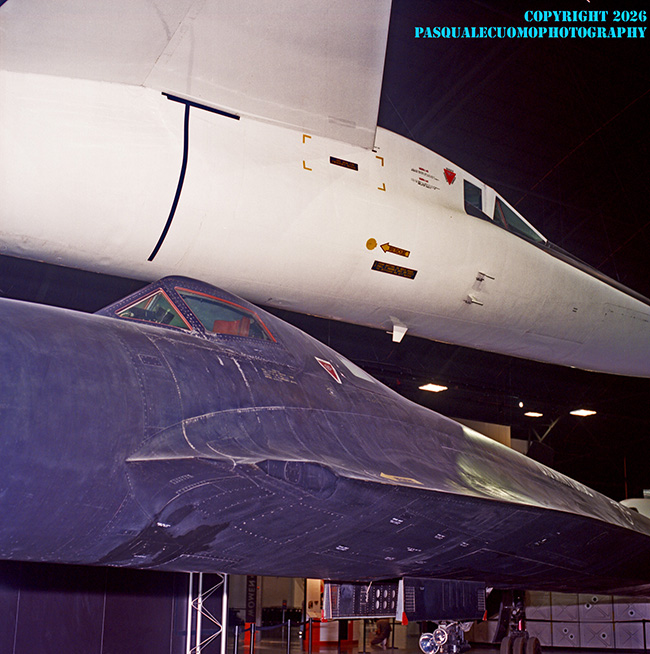
The second photograph shifts toward the sleek contours of two aircraft positioned together inside the museum space. Cuomo layers the forms so that the lighter aircraft above contrasts against the darker aircraft below, creating a visual exchange between lightness and density, shadow and reflection. The composition emphasizes aerodynamic curves and elongated lines, turning the aircraft into sculptural forms suspended within the frame.
Perspective plays a major role in the image’s impact. By photographing from a low angle and tightly controlling the framing, Cuomo gives the aircraft a monumental quality. The planes feel less like museum displays and more like studies in form and engineering. Small details—the cockpit windows, markings, and reflected light—become compositional elements rather than simple informational features.
Underlying both photographs is Cuomo’s admiration for aircraft design and engineering. Yet the images avoid spectacle or dramatic exaggeration. He does not rely on excessive manipulation or theatrical presentation. Instead, he trusts the design of the aircraft and the strength of the composition itself. The photographs become studies of structure, surface, and human ingenuity viewed through the steady eye of an experienced photographer.
These works also reveal Cuomo’s deep connection to film photography. The careful tonal range, measured exposure, and deliberate compositions suggest the mindset of a photographer accustomed to slowing down and constructing an image with intention before pressing the shutter. Even within the visually crowded setting of a museum, Cuomo isolates moments of order and clarity.
After decades spent photographing a wide range of subjects, Pasquale Cuomo continues to work with the same attentiveness that first drew him to photography as a teenager. His photographs at the National Museum of the United States Air Force demonstrate how technical subjects can become thoughtful visual compositions when approached with patience, experience, and careful observation. More than images of aircraft, these photographs are reflections on form, structure, and the enduring practice of truly seeing.
