

Adamo Macri moves through art without staying in one place for long. Born in Montreal in 1964, he developed his foundation at Dawson College, where he studied commercial art, graphic design, photography, art history, and fine arts. That range continues to shape how he works today. While often recognized for sculpture, his practice extends across photography, video, painting, and drawing, shifting between mediums depending on the demands of the idea. Rather than separating disciplines, Macri treats them as interchangeable tools, each capable of carrying the same underlying concerns. His work circles around identity, transformation, and the uneasy space between what is seen and what is felt. Faces, figures, and constructed personas appear repeatedly, not as fixed portraits, but as unstable forms—part human, part symbol—caught somewhere between reality and invention.
The Work
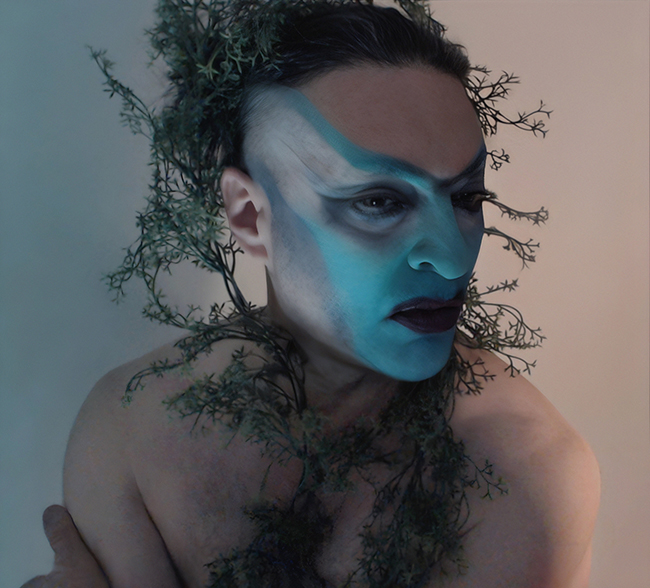
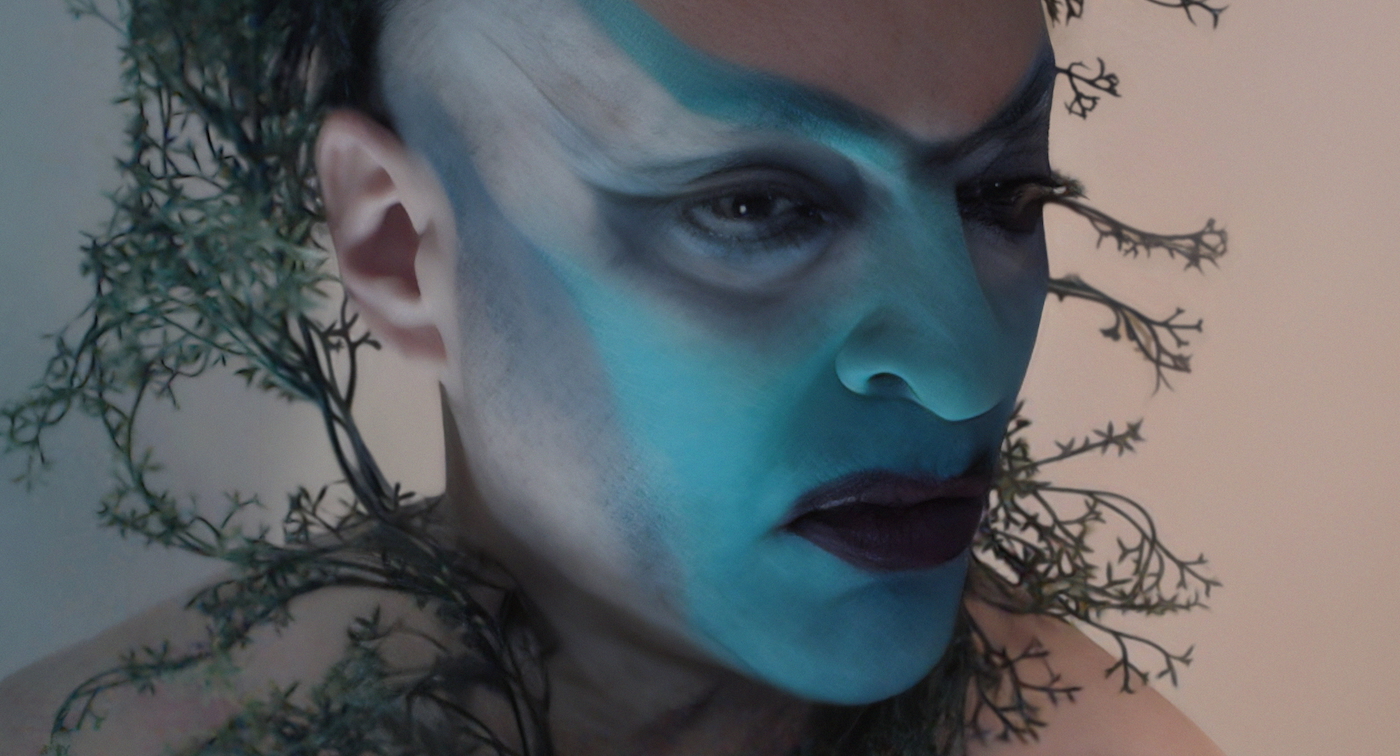
In Hinterland (2016), Macri reimagines the idea of landscape as something internal rather than geographical. The term “hinterland” traditionally refers to a remote area lying beyond a city or port, but here it becomes a psychological terrain. The face itself acts as this “land behind”—a space that exists beyond the visible, beyond what is socially presented. Instead of a portrait grounded in identity, the figure appears displaced, removed from any clear context, as if it exists outside the mapped structure of the self.
The image is saturated in aquamarine tones, giving it an underwater or dreamlike quality. The head emerges through dense, organic matter that reads ambiguously as foliage, sea growth, or tangled hair. This surrounding mass does not simply frame the figure; it merges with it, suggesting that the boundary between body and environment has dissolved. The figure feels unearthed rather than constructed, as if discovered in a place where categories no longer hold.
There is a quiet tension in the face. The lips are dark, still, and unreadable. The expression does not guide interpretation, leaving the viewer without a clear emotional entry point. Instead, the work operates through atmosphere. It resists explanation, pulling attention toward sensation rather than narrative clarity. The figure feels suspended—neither fully human nor entirely other—existing in a state of transition.
Macri has described the character as something both grounded and unfamiliar: possibly aquatic, possibly terrestrial, slightly tribal, and somewhat alien. This layering of references creates a figure that does not settle into one identity. It carries traces of multiple origins without belonging to any single one. The sense of displacement is central. The figure appears as if it has drifted away from a known place, no longer anchored to a stable environment.
There is also a strong maritime undertone. The head can be read as a figurehead detached from a ship, no longer attached to its original function. Removed from its context, it becomes something else entirely—a character rather than an ornament. This shift from object to presence is key to the work. What was once symbolic becomes active, as if it has stepped into its own narrative.
The influence of music plays a role here as well. Macri has pointed to David Bowie and the song Red Sails as an early inspiration. The idea of traveling toward an unknown, distant place—linguistically and culturally foreign—echoes in the image. The figure seems to inhabit that distance, positioned in a space where identity becomes difficult to define or articulate. It exists in a kind of visual translation, where meaning is present but not fully accessible.
Critically, Hinterland connects to a broader thread in Macri’s work, where identity is treated as fluid rather than fixed. Writer Kenneth Radu has linked this piece to Memento Mori (2014), suggesting that both works explore the tension between outward appearance and internal reality. In these works, the “surface” of the figure—whether through costume, environment, or texture—acts as a layer that both reveals and conceals.
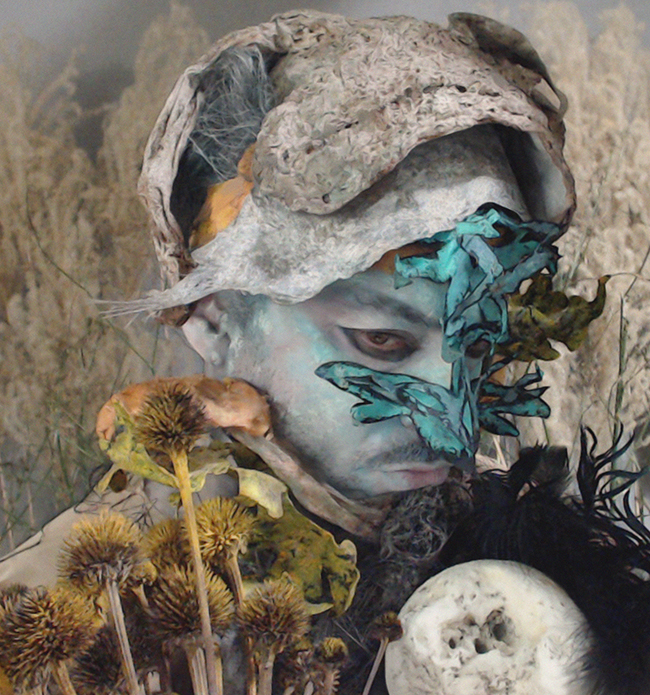
In Memento Mori, this idea shifts toward the awareness of mortality. While Hinterland opens into a space of transformation and possibility, Memento Mori turns inward, focusing on the inevitability of time and the fragility of existence. The title itself, traditionally meaning “remember that you will die,” places the work within a long historical lineage. Yet Macri does not approach it through traditional symbolism alone. Instead, he filters it through his ongoing interest in constructed identity.
The figure in Memento Mori can be understood not just as a reminder of death, but as a reflection on the roles we inhabit while alive. Just as in Hinterland, the surface becomes important. What appears outwardly—face, posture, expression—does not fully contain what lies beneath. There is always another layer, something hidden or shifting. Mortality, in this context, is not only physical but psychological. It suggests the constant ending and reshaping of identity over time.
Across both works, there is a consistent refusal to provide resolution. Macri does not present identity as something stable or fully knowable. Instead, he creates figures that exist in-between states—between human and nonhuman, between presence and absence, between recognition and uncertainty. These figures do not explain themselves. They remain open, allowing multiple readings to exist at once.
What emerges is a body of work that treats the figure not as a fixed subject, but as a site of ongoing change. Hinterland and Memento Mori do not function as isolated images. They form part of a larger inquiry into what it means to exist within layers—social, psychological, and symbolic. Macri’s work moves through these layers without settling, holding attention in that unstable space where identity is still forming, dissolving, and forming again.
