

Judit Nagy L. was born in Slovakia, a place shaped by deep cultural layers and a long visual tradition. From an early age, she approached the world with an instinctive sense of curiosity, seeing forms, colors, and textures as something to engage with rather than simply observe. Even in kindergarten, her surroundings became material for exploration, as if everything held the potential to be translated into an image. This early sensitivity guided her toward formal art education, first in a public art school and later through private studio training, where her visual language began to take shape.
Yet her path did not move in a straight line. Life shifted direction, leading her into civil engineering, where she completed a Master’s degree, and into building both a family and a business. These experiences added structure, discipline, and a different kind of problem-solving to her life. Still, something remained unresolved. The absence of art created a quiet but persistent tension. Over time, that absence became impossible to ignore, drawing her back toward creative work. When she returned, it was not as a continuation of where she had left off, but as a deeper, more grounded engagement with material, meaning, and process.
The Work
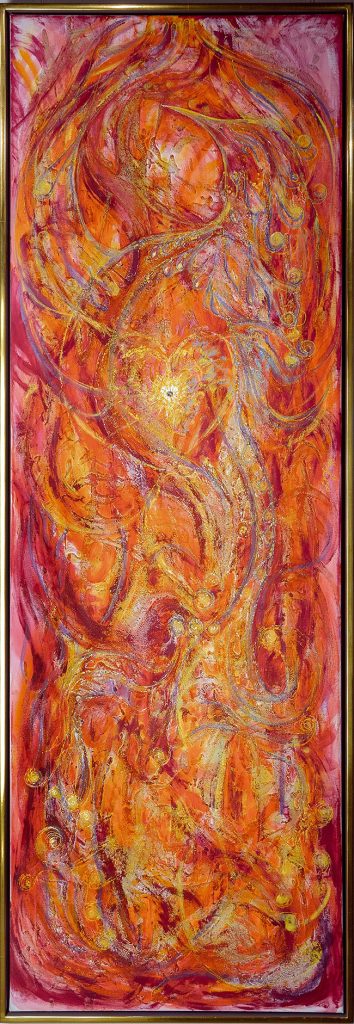
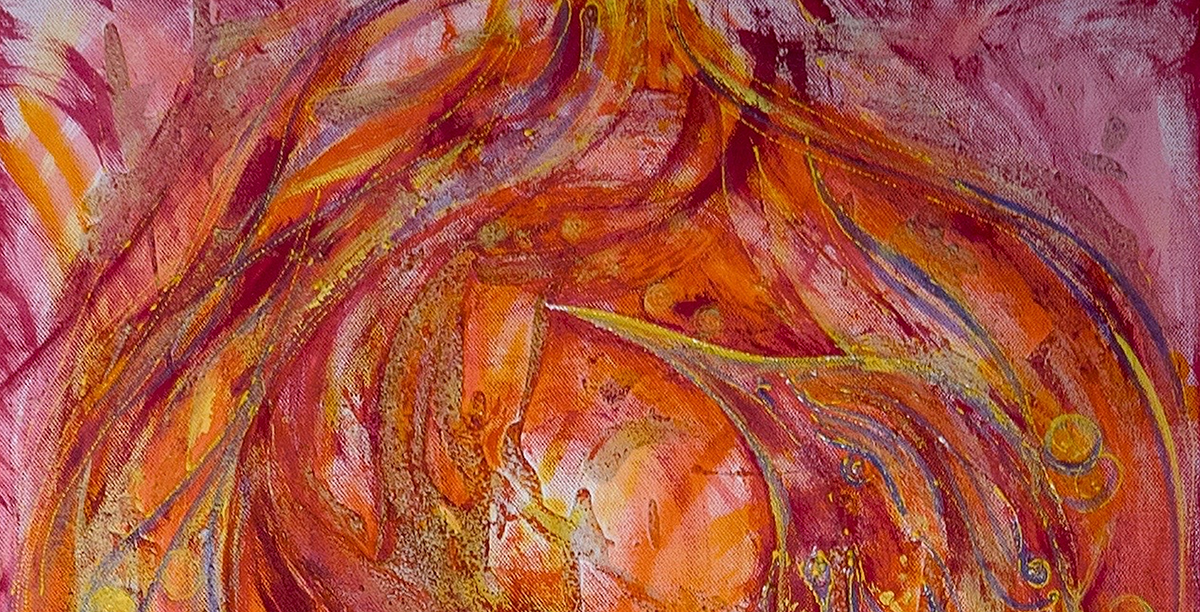
“Phoenix’s Dance” (2018), measuring 50 × 150 cm, reflects a key direction in Judit Nagy L.’s practice, where material experimentation and symbolic thinking intersect. The work is created using her self-developed WINEporTRAIT technique, part of the In Vino Veritas Art Method © (IVVArt Method ©), which incorporates real wine, soil, and additional organic elements. These materials are not simply aesthetic choices. They carry associations tied to time, transformation, and the physical world, allowing the painting to exist as both image and substance.
The composition unfolds vertically, immediately establishing a sense of upward movement. This elongated format shapes how the painting is experienced. Rather than spreading outward, the energy concentrates and rises, forming a column-like structure that directs the eye along its ascent. The surface is built through layered applications, where reds, burnt oranges, and gold tones shift in density and transparency. These colors do not sit flatly on the canvas. They move, overlap, and dissolve into one another, creating a sense of continuous motion.
At its core, the work draws on the archetype of the Phoenix, though it avoids any literal depiction. There is no defined figure, no wings or recognizable form. Instead, the idea of the Phoenix is translated into movement and light. The center of the composition holds a concentrated brightness, a kind of visual nucleus from which the surrounding forms expand. This central point does not remain fixed. It pulses outward through fine lines and textured marks that spread across the surface, suggesting both growth and release.
The use of wine as a medium introduces an additional layer of meaning. Wine is a material shaped by time, fermentation, and change. It carries a sense of transformation within its very structure, shifting from grape to liquid through a process that cannot be rushed. When used in the painting, it becomes more than pigment. It acts as a record of transformation, reinforcing the thematic focus of the work. Combined with soil and other elements, the surface holds a physical connection to natural cycles—decay, renewal, and regeneration.
Texture plays a central role in how the painting operates. The surface is not smooth or uniform. It contains variations that catch light differently, creating moments of reflection and absorption. These shifts in texture mirror the conceptual framework of the work. Just as the Phoenix moves through destruction and rebirth, the painting itself moves between density and openness, opacity and translucency. The viewer is not given a fixed point of interpretation. Instead, the work unfolds gradually, depending on how it is approached and experienced.
“Phoenix’s Dance” also reflects a broader interest in forces that are not immediately visible. Rather than focusing on external representation, Judit Nagy L. directs attention inward, toward processes that shape experience beneath the surface. The painting can be understood as a field rather than an image—something that holds energy, movement, and transformation without resolving into a single, stable form.
This direction in her work marks a period where spiritual and symbolic references become more pronounced. The Phoenix, as an enduring symbol across cultures, carries associations of renewal, resilience, and cyclical existence. By removing its literal form, she allows these ideas to remain open, accessible through sensation rather than narrative. The viewer is invited to engage with the painting not as a depiction, but as an experience that mirrors these cycles.
There is also a sense of balance between control and unpredictability in her process. The materials she uses—wine, soil, layered textures—do not behave in entirely predictable ways. They react, shift, and settle over time. This introduces an element of chance into the work, where the final image emerges through both intention and material response. That tension becomes part of the meaning, reflecting the broader idea that transformation is never fully controlled.
In “Phoenix’s Dance,” destruction and renewal are not treated as opposites. They exist as part of the same movement, continuously feeding into one another. The painting does not resolve this cycle or offer closure. Instead, it holds it in motion, allowing the viewer to encounter a moment within an ongoing process. Through its material choices, vertical structure, and layered surface, the work becomes a space where change is not only represented but embedded into the fabric of the image itself.
