

Maridee Hays is a California-based artist whose creative practice blends a wide range of influences, including literature, dance, psychology, Eastern philosophy, journaling, and studio experimentation. Rather than separating these disciplines, Hays allows them to merge naturally into a visual language shaped by intuition, reflection, and personal exploration. Her work moves beyond traditional boundaries, combining painting, mixed media, and sculptural elements in ways that feel both thoughtful and emotionally direct. Guided by an interest in spirituality and human perception, Hays approaches art as an ongoing process of discovery rather than a search for definitive conclusions. Her artworks often explore transformation, awareness, memory, and the unseen emotional layers that shape human experience. Over the years, her practice has become increasingly textured and multidimensional, with materials and symbolism working together to bridge inner thought and external form. Her recent rusted metal kimono pieces continue this exploration, bringing together weathered surfaces, vibrant color, and symbolic structure in artworks that balance delicacy with endurance.
In her two latest rusted metal kimono works, Maridee Hays reimagines the traditional garment as a space for reflection, memory, and spiritual resonance. These pieces move far beyond representations of clothing. Instead, the kimono becomes an abstract human presence — a silent form carrying traces of emotion, ritual, transformation, and lived experience. Through layers of rusted metal, expressive paint, embedded objects, and glowing color, Hays creates works that exist somewhere between painting, sculpture, and installation.
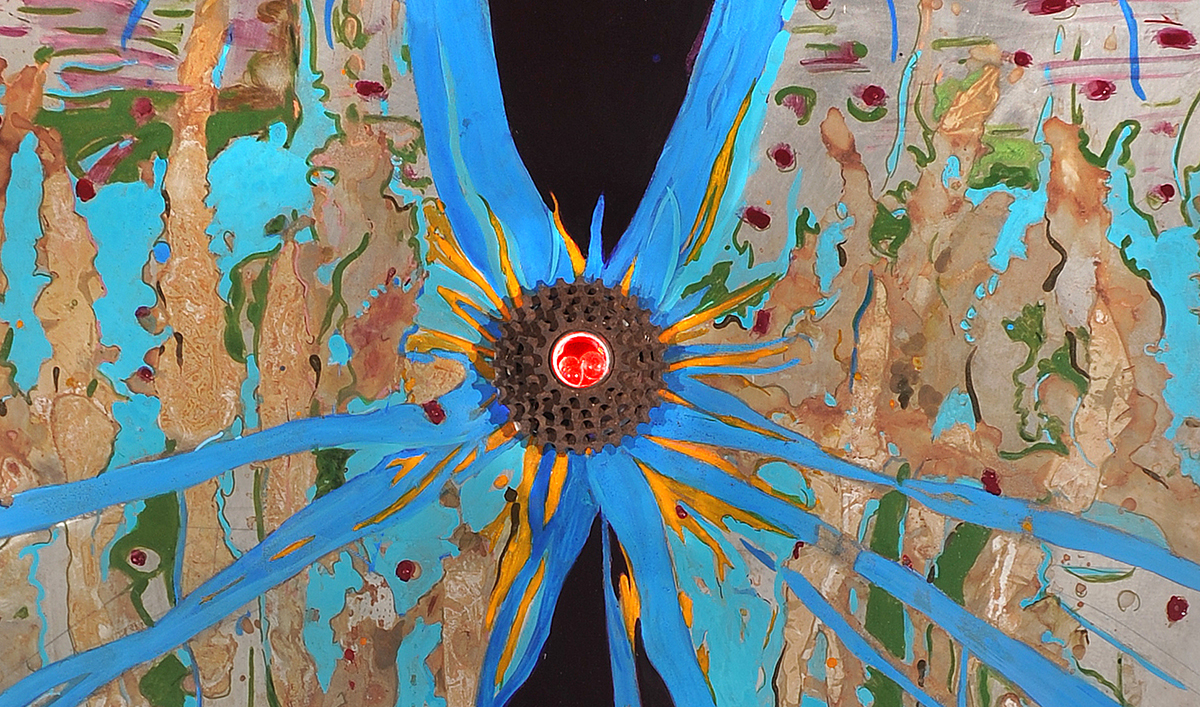
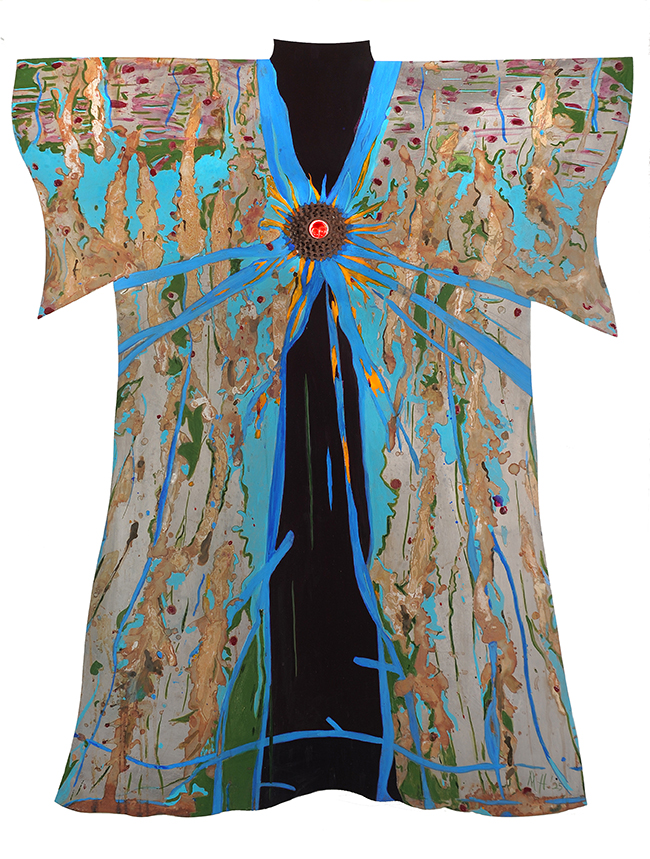
The first kimono artwork is structured around a bold central division of deep black and radiant blue that cuts vertically through the piece. The composition feels charged with motion, as though energy is emerging outward from the center of the garment. Positioned near the chest is a circular form that radiates like a symbolic sun or spiritual core. Blue linear marks stretch across the surface like currents, pathways, or streams of thought. Surrounding these vivid sections are heavily weathered rust textures that introduce a raw, earthly quality to the work.
A dialogue between deterioration and renewal runs throughout the piece. Rust suggests time, erosion, exposure, and survival, while the luminous blues introduce a sense of awakening and vitality. Hays does not attempt to conceal the corrosion of the metal; instead, she embraces it as an essential part of the artwork’s meaning. The rusted surface becomes evidence of change and endurance. The kimono itself seems almost inhabited, carrying the impression of experiences absorbed over time while continuing to radiate energy and presence.
The kimono form also carries symbolic weight within the work. Historically tied to ceremony, identity, and cultural continuity, the garment here becomes less functional and more spiritual in nature. Without a physical figure inside it, the shape evokes presence through absence. It functions almost like a vessel for memory, consciousness, or emotional traces. Hays uses the kimono not simply as a cultural reference, but as a universal structure capable of holding human experience and reflection.
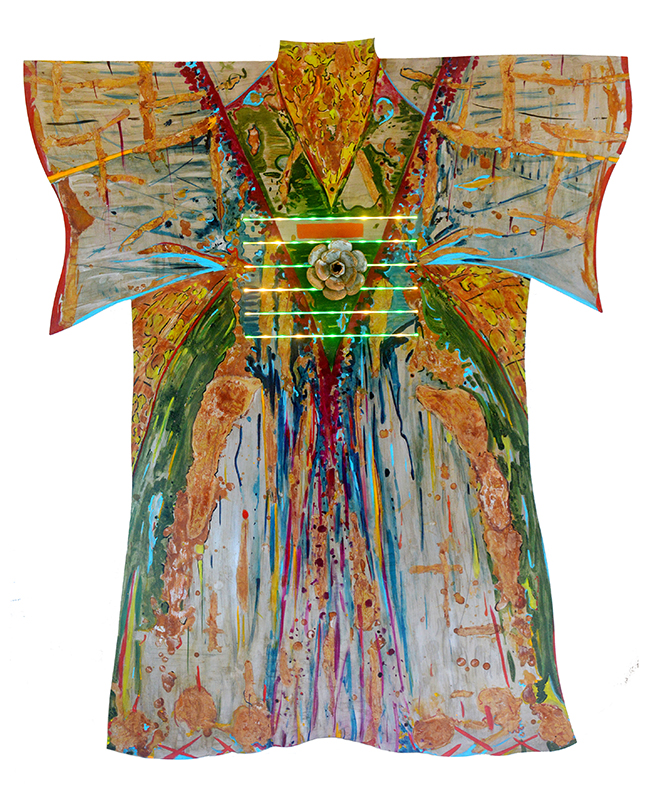
The second kimono piece approaches this idea through a brighter and more celebratory visual atmosphere. Rich golds, reds, greens, and blues flow across the surface in layered drips and gestural marks. At the center is a sculptural floral element framed by illuminated horizontal lines that appear to pulse across the garment. The addition of programmed LED lighting transforms the work into a more immersive visual experience, where light becomes part of the material language rather than merely a source of illumination.
The glowing lines introduce movement and rhythm to the composition. As light interacts with the rusted metal and painted surface, the artwork shifts depending on the surrounding space and the viewer’s position. The piece feels active and responsive rather than fixed or static. Through this combination of sculpture, paint, and light, Hays expands the boundaries of painting into something more atmospheric and experiential.
Despite the layered materials and technical complexity, both kimono works retain an organic and intuitive quality. Dripping paint recalls rainfall, roots, rivers, or emotional release. The surfaces feel spontaneous and open rather than rigidly controlled. Hays preserves the gestures and imperfections created during the process, allowing the works to maintain a sense of immediacy and honesty.
These rusted metal kimono pieces also continue Hays’ long-standing interest in consciousness and perception. Rather than presenting direct narratives, the works invite quiet contemplation. Viewers are encouraged to spend time with the textures, colors, forms, and symbols as meanings slowly unfold. The garments become meditative structures where emotional, spiritual, and psychological associations emerge gradually.
Through these recent works, Maridee Hays continues to investigate art as a living and transformative process. By combining rusted metal, paint, sculptural forms, and light within the symbolic shape of the kimono, she creates artworks that feel timeless yet contemporary. The pieces carry echoes of ritual, healing, endurance, and transformation while remaining deeply personal in their visual language. Hays demonstrates how even worn and weathered materials can hold beauty, memory, and illumination.
